



IoT Services
Turning Connected Assets Into Business Intelligence
A connected device is only the starting point; real value comes when machines, equipment, vehicles, and environments generate actionable data that flows securely into enterprise systems for real-time decisions. Our IoT services unify device intelligence, connectivity, edge computing, cloud, analytics, and enterprise systems into a scalable ecosystem. For businesses exploring IoT solutions in the USA, this enables predictive maintenance, asset tracking, remote monitoring, and energy optimization. Matrix Bricks Corporation combines IoT strategy, cloud, data, cybersecurity, and integration to deliver secure, enterprise-ready connections between physical and digital systems.
- 15+ years across technology, digital transformation, cloud, data, and connected systems.
- 19+ industries with experience spanning diverse operational and technology environments.
- Clutch-recognized Digital Partner delivering enterprise-focused technology solutions.
Device Telemetry to Business Intelligence: Get Free IoT Roadmap
Tell us about your assets, monitoring needs, or operational pain points. Get clear guidance on IoT strategy, development, and secure implementation.
Why You Need IoT Beyond Basic Connectivity
IoT delivers real business value only when connected data drives decisions, automation, and operational intelligence. Simply linking devices is not enough, organizations need systems that transform raw telemetry into measurable outcomes, efficiency gains, and proactive control across operations.
Your Assets Are Generating Data. Is Anyone Acting on It?
Sensors continuously capture critical operational data such as temperature, vibration, location, and usage patterns. Without structured IoT data management, this information often remains underutilized instead of driving maintenance, efficiency, or business decisions.
Unexpected Downtime Is More Expensive Than Prevention
Equipment failure impacts production, delivery timelines, workforce productivity, and customer commitments. With Industrial IoT and predictive analytics, businesses can detect early warning signs and address issues before they escalate into costly downtime.
Connected Devices Expand Security Risks
Every connected sensor, gateway, and application increases the potential attack surface. Strong IoT security, covering device identity, encryption, firmware updates, and access control, is essential to protect systems throughout the device lifecycle.
Without Strategy, IoT Becomes Costly and Fragmented
IoT investments can quickly expand across devices, platforms, and infrastructure. A clear IoT strategy ensures alignment with business goals, defines architecture, controls costs, and establishes measurable outcomes before scaling deployments.
IoT Capabilities for Connected, Intelligent Operations
A connected ecosystem involves far more than deploying sensors. Devices need to communicate reliably, data needs somewhere intelligent to go, and the resulting information has to reach the people and systems responsible for acting on it. Our IoT services span strategy, architecture, development, connectivity, cloud, and intelligence to help organizations build connected environments that can support real operational demands.
IoT Consulting
A useful IoT program starts with the business problem. IoT consulting services help identify high-value opportunities, assess technology readiness, and shape an architecture around the way assets, people, and processes actually operate.
- IoT Strategy
Prioritize use cases across connected products, industrial operations, fleet management, smart facilities, energy, and remote monitoring based on business value and technical feasibility. - IoT Readiness Assessment
Evaluate existing infrastructure, devices, networks, data flows, security controls, and operational processes before committing to a connected technology roadmap. - IoT Architecture Consulting
Define the relationship between devices, gateways, edge systems, cloud platforms, applications, and data services to create a coherent IoT architecture. - IoT Roadmap Development
Translate strategic priorities into phased implementation plans covering pilots, device deployment, integrations, security, analytics, and future expansion.
IoT Development
Connected products and operational environments require software that can communicate with devices reliably and process information as conditions change. Our IoT development services cover the applications, device interfaces, APIs, and control layers that turn connected infrastructure into usable business technology.
- IoT Application Development
Build web and mobile applications for asset monitoring, remote operations, equipment visibility, alerts, and connected product experiences. - Device Integration
Connect sensors, controllers, gateways, and embedded systems through protocols such as MQTT, HTTP, CoAP, and OPC UA where appropriate. - IoT API Development
Create secure APIs that allow IoT platforms and device data to interact with enterprise applications, analytics systems, and third-party services. - Edge Application Development
Run selected workloads closer to connected assets for situations where latency, bandwidth, availability, or local decision-making matters.
IoT Connectivity Solutions
Connectivity determines whether an IoT deployment can function reliably beyond a controlled pilot. The right approach depends on location, range, power requirements, device density, bandwidth, and the sensitivity of the data being transmitted.
- Device Connectivity
Design connectivity models using Wi-Fi, cellular networks, Bluetooth, LPWAN, Ethernet, and other technologies according to the operating environment. - Gateway Management
Use edge gateways to aggregate device data, translate protocols, apply local processing, and maintain communication between physical assets and cloud platforms. - Device Provisioning
Establish processes for secure onboarding, authentication, configuration, credential management, and lifecycle administration across connected devices. - Connectivity Monitoring
Track network availability, signal quality, device status, communication failures, and other indicators that can affect connected operations.
IoT Cloud
The cloud provides the central intelligence layer for many modern IoT environments. Our IoT cloud solutions bring together device management, telemetry ingestion, storage, analytics, application services, and enterprise connectivity.
- Cloud-Based IoT Platform
Create centralized environments for registering devices, collecting telemetry, managing configurations, applying rules, and coordinating distributed deployments. - IoT Data Ingestion
Handle high-volume device streams through event processing, message brokers, APIs, and scalable cloud infrastructure. - Edge-to-Cloud Integration
Combine local processing with centralized cloud capabilities so latency-sensitive workloads can stay near the device while broader analytics and management remain centralized. - IoT Platform Integration
Connect cloud-based IoT environments with enterprise applications, dashboards, data platforms, and operational systems.
IoT Data & Analytics
Raw telemetry becomes valuable when it reveals something the business could not see before. IoT data platforms bring structure to device information, while analytics turns that information into operational intelligence.
- IoT Data Management
Organize, process, store, and govern telemetry from connected assets using appropriate data pipelines, time-series databases, data lakes, and cloud data platforms. - Real-Time IoT Analytics
Analyze incoming data streams to identify changes in equipment behavior, environmental conditions, asset movement, energy usage, or operational performance. - Predictive Maintenance
Use historical and live sensor data with machine learning models to identify patterns associated with equipment degradation and potential failures. - Operational Intelligence
Turn connected-device information into dashboards, alerts, forecasts, and decision-support tools that give operations teams a clearer view of what is happening in the physical environment.
IoT Security & Management
Thousands of connected devices create a distributed technology environment that needs consistent oversight. Security and lifecycle management cover everything from device identity to firmware updates, network controls, data protection, and eventual decommissioning.
- IoT Security Architecture
Protect devices, gateways, networks, APIs, cloud environments, and data flows through layered security controls and zero-trust principles. - Device Identity & Access
Establish trusted device identities, authentication mechanisms, certificates, and role-based access controls across the connected environment. - Firmware & Lifecycle Management
Manage updates, configuration changes, vulnerability remediation, device health, and retirement throughout the IoT device lifecycle. - Compliance & Governance
Build controls around data privacy, access, auditability, encryption, and security governance while aligning applicable environments with industry-specific requirements.
Have an IoT Idea? Let’s Make It Work for Your Business.
Share your IoT requirements to explore tailored solutions for device connectivity, system integration, and operational efficiency that align with your business goals.
Awards & Recognition


Case Studies
Matrix Bricks has helped businesses navigate complex digital change, modernise capabilities, and turn transformation initiatives into measurable business outcomes. Backed by 15+ years of industry experience, our approach combines digital strategy, emerging technologies, customer experience, process optimisation and AI-driven transformation to help organisations build more agile, connected and future-ready businesses. Explore our case studies to see how this expertise translates into real-world transformation outcomes.

Reduction in Screening Time
Candidate Ranking & Shortlistingc
“Introduced an AI-driven recruitment engine that analyses resumes beyond keyword matches, ranks candidates by contextual role fit, and supports recruiters with instant summaries and intelligent queries for quicker, more consistent shortlisting.”

Operations
Resumes Processed in One Batch
Employee & Workforce Management
“Created a unified HRM ecosystem bringing employee records, attendance, leave, recruitment, self-service, and workforce analytics into one platform, with an AI engine capable of evaluating large volumes of resumes using semantic role-fit analysis.”

Institutions
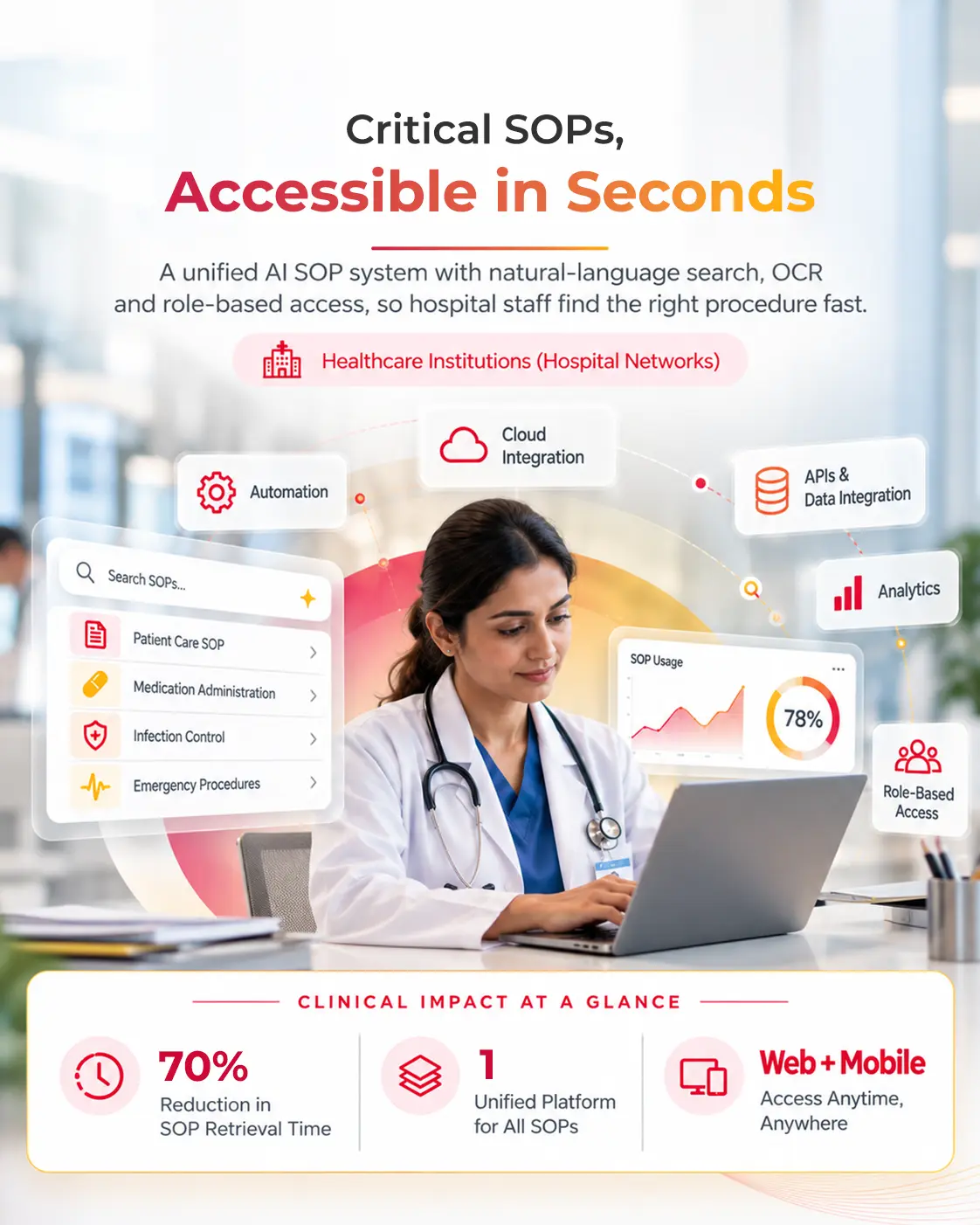
Faster SOP Retrieval
Access to Critical Procedures
“Converted scattered hospital SOPs across PDFs, scans, folders, and SharePoint into an intelligent knowledge system, allowing medical teams to search procedures in natural language while maintaining version control and role-based access.”
Client Testimonials
Our Connected Operations Framework
IoT projects often fail long before the first device is deployed. The problem usually starts with unclear use cases, fragmented architecture, poor connectivity assumptions, or an inability to operate thousands of devices consistently. Our approach works backward from the operational decision the IoT system needs to improve, then builds the technology around it.
Start With the Decision
Instead of beginning with a device catalog, identify the operational question that needs a better answer. Is the objective to predict equipment failure, understand asset movement, reduce energy consumption, improve production visibility, or respond to field conditions faster?
Map the Physical Environment
Machines, sensors, gateways, connectivity, protocols, locations, environmental conditions, and existing control systems are mapped before the architecture is finalized. This reveals constraints that a purely software-led IoT plan can easily miss.
Design the Data Journey
Telemetry needs a defined route from device to decision. The architecture establishes where data is captured, processed, filtered, stored, analyzed, and exposed to users, balancing edge computing with cloud processing based on latency, bandwidth, and workload requirements.
Secure the Connected Surface
Security is addressed across the entire IoT lifecycle, from device identity and secure provisioning to encryption, network segmentation, firmware updates, API protection, and decommissioning. Depending on the environment, controls can be aligned with, ISO 27001, SOC 2, HIPAA, PCI DSS, and applicable industry requirements.
Pilot the Operating Model
A focused deployment provides a controlled environment for validating connectivity, device behavior, data quality, system performance, security controls, and user workflows. The objective is to prove the operational model before expanding the footprint.
Scale What Works
Once the architecture and use case have demonstrated value, deployment can expand across locations, devices, and business functions. Device lifecycle management, observability, cloud economics, predictive analytics, and ongoing security become part of the operating model rather than afterthoughts.
Design a Secure, Scalable Edge-to-Cloud IoT Architecture, Free
Turn your connected technology goals into a clear direction. Discuss your requirements with our team and explore IoT solutions aligned with your business operations.
Why Enterprises Choose Matrix Bricks for IoT
IoT Designed Around the Operation
From Device Data to Business Action
Security Across the Device Lifecycle
15+ Years of Technology Expertise
Why Do 3600+ Clients Trust Us?
We bring 15+ years of expertise in IoT services, development, device connectivity, and enterprise IoT solutions to help businesses build smarter, connected, and more efficient operations.
“My experience has been so great. We have seen such an increase in our overall numbers coming from Internet searches and people who have cited internet search as their reason. Bringing you guys on has made it just so simple and so easy, and I’ve learned so much. The month reports are really great and make it very simple for me to understand, and we’re really happy with the outcomes.”

Heather Baird
Department Director, Brighton Recovery Center“We are very much happy with the website design services offered by Matrix Bricks and they are also fully dedicated to satisfying our needs. Alongside, we also appreciate their creative approach towards designing a powerful website.”

Sangeeta Jain
Director, All India Association of Industries“Matrix Bricks has a very creative and skillful team who constantly thrives towards the complete satisfaction of the customer with functional and innovative skills. The web development services provided from their end is of exceptional quality.
I wish them all the best in their future endeavors.”

Neetu S Srivastava
Group Product Manager - Majesta, Glenmark Pharmaceuticals Limited“I would like to thank Mr. Mehul for creating a wonderful website. I have been appreciated by lots of acquaintances both personal and professional for the website. It has come out exactly the way or rather I would say even better than what I envisaged. His team is very patient and understanding, always ready to support you in best possible ways. Another very good point about Mr. Mehul’s approach is that he always tries to figure out the best ways to match customer’s budget and still give a quality solution. I look forward to a long-term relation with Matrix Bricks.”

Shrey Kejriwal
“We at P3 Sports, have been with Matrix Bricks for a short time but our experience has been very pleasant & fulfilling. The staff is super-efficient & amazing. You name it they do it. We have only warm words & appreciation for them. We would like to give special mention to Urvi, who worked with us on our project. Nothing is impossible for her. Super service with sweet smile. Rafique who liaised for us proved sp invaluable for his hard work in giving our project the discipline of time. Thank you all at Matrix Bricks… Keep it up & see u at the top.”

Sushmita & Moonmoon Partners
Frequently Asked Questions
What are IoT services?
What is the difference between data engineering and DataOps?
IoT costs vary considerably because a sensor deployment across one facility is very different from a multi-site industrial ecosystem. Matrix Bricks Corporation typically assesses:
- Number and type of connected devices
- Connectivity, edge, cloud, and data infrastructure
- Software development, security, integration, and ongoing management
A pilot can provide a practical way to validate the technology and business case before committing to a larger deployment.
What are the most common IoT use cases for businesses?
The right use case depends on the industry and the assets being connected. Common applications include:
- Predictive maintenance and equipment monitoring
- Fleet, logistics, and asset tracking
- Energy management and smart facility operations
Matrix Bricks evaluates IoT opportunities according to operational impact, data availability, deployment complexity, and potential return rather than simply connecting devices because the technology is available.
What is the difference between IoT and Industrial IoT?
How does an IoT platform work?
An IoT platform acts as the technology layer between connected devices and business applications. It can handle device registration, authentication, telemetry ingestion, processing, rules, alerts, data storage, analytics, and application integration.
A typical architecture includes:
- Sensors and connected devices
- Gateways, networks, and edge computing
- Cloud services, IoT data platforms, analytics, and enterprise applications
Matrix Bricks develops IoT solutions around the specific device ecosystem, connectivity model, data requirements, and business workflows involved.
Why is edge computing important for IoT?
Can IoT data integrate with existing ERP and CRM systems?
How secure are IoT devices?
IoT security depends on the complete connected environment rather than the device alone. Matrix Bricks considers:
- Device identity, authentication, and secure provisioning
- Encryption, network segmentation, and access management
- Firmware updates, vulnerability management, monitoring, and secure decommissioning
Security controls can also be mapped to applicable frameworks such as NIST, ISO 27001, SOC 2, HIPAA, and industry-specific requirements.
How long does it take to implement an IoT solution?
What should I look for when choosing an IoT services company in the USA?
What makes Matrix Bricks different from other IoT companies in the USA?
IoT projects often involve several technology layers at once: devices, networks, edge computing, cloud infrastructure, data platforms, applications, and security. Matrix Bricks brings expertise across these connected layers, allowing organizations to approach IoT services in the USA through one integrated technology partner.
The focus remains on:
- Connecting IoT investments to a defined operational use case
- Building secure and scalable device-to-cloud architectures
- Turning telemetry into analytics, automation, and business intelligence
This approach helps organizations move from a collection of connected devices toward an IoT ecosystem that can support sustained operational value.