





 India
India  UK
UK  UAE
UAE 
Farms in India are becoming smarter than ever before, not through the sheer power of the massive tractors or towering harvesters, but through the quiet intelligence of tiny sensors and interconnected IoT solutions for agriculture. These small but mighty devices are now embedded in the soil, monitoring the moisture levels, tracking nutrients, and even sensing plant health. They are suspended in the air, measuring humidity, temperature, and changes in the weather. They are connected underground, above ground, and even remotely via cloud platforms, all working in sync to make sure every drop of water is used wisely, every gram of fertilizer is delivered precisely where it is needed.
This digital transformation of Indian agriculture isn’t just a technological upgrade — it’s a necessity. With over 1.4 billion mouths to feed, efficiency is no longer optional. The margin for error is razor-thin. Whether it’s optimising irrigation to combat water scarcity, predicting pest attacks before they spread, or boosting crop yield in unpredictable climates, IoT farming solutions are becoming the backbone of a resilient agricultural ecosystem. The farms may look traditional from the outside, but beneath the surface, a silent revolution is underway — one that’s data-driven, sensor-led, and digitally powered.
Transformation of Industries
Over the past decade, various industries, including manufacturing, logistics, and healthcare, have undergone significant transformations as a result of the adoption of digital technologies. Factories have become smarter; supply chains are more transparent; quality control is more data-driven. As these transformations took hold elsewhere, agriculture — traditionally viewed as low-tech — began to catch up. The convergence of low‑cost sensors, mobile internet, cloud computing, and data analytics opened a new chapter: the smart agriculture system using IoT.
Transformation of Agriculture
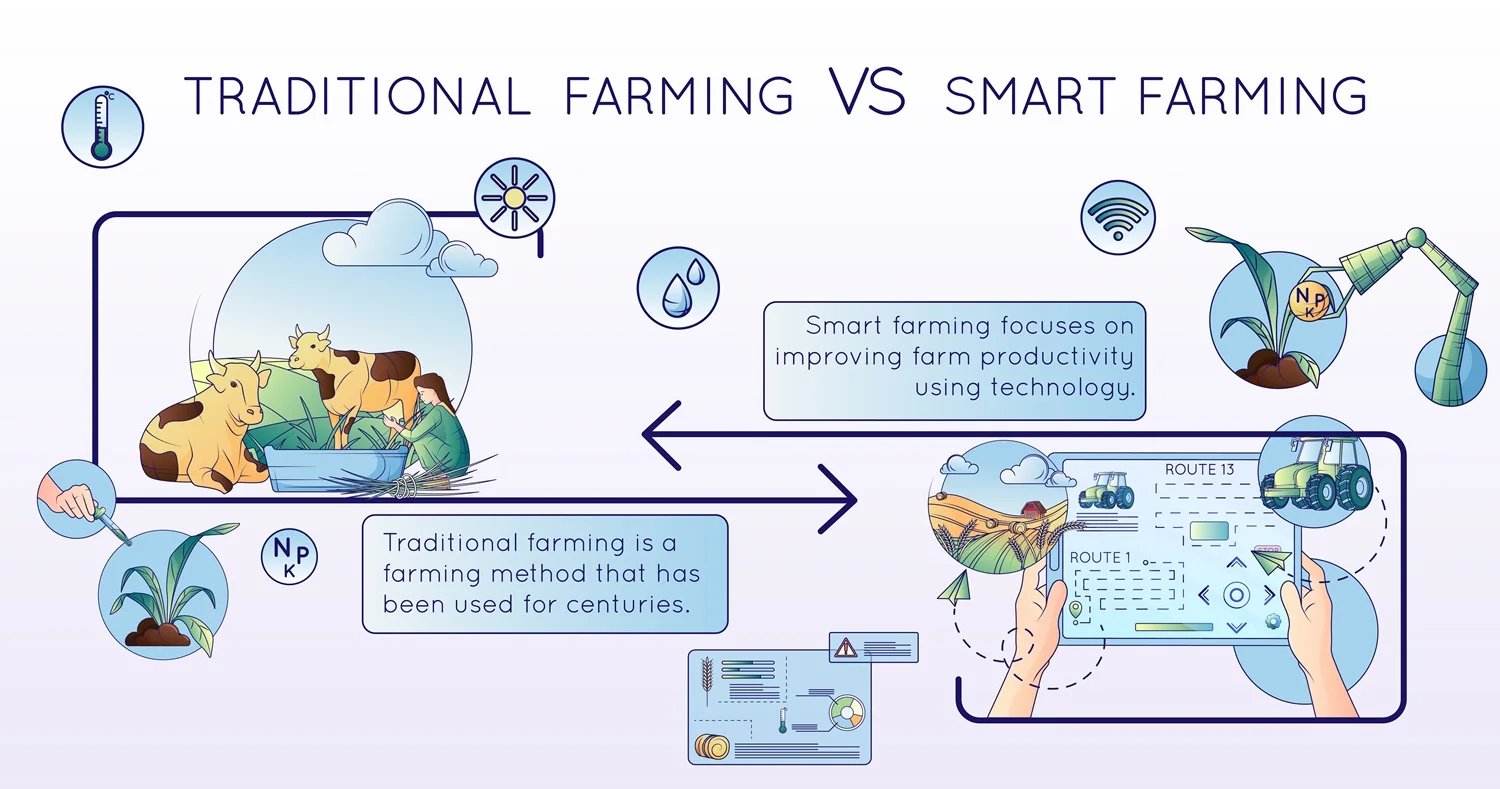
Agriculture in India is going through a silent revolution. Smallholder farmers, large farms, and agro-enterprises are adopting tools that were once considered science fiction just a few years ago: soil moisture sensors, weather stations, automated drip irrigation systems, drones for crop health monitoring, wearable sensors for animals, remote monitoring, and AI-based disease detection. The aim is to increase yield, reduce waste, conserve water and energy, improve inputs, and overall make farming more sustainable and profitable.
What is IIoT?
IIoT stands for Industrial Internet of Things. It is a subset of IoT (Internet of Things), focused on industrial‑scale systems. In agriculture, IIoT involves connecting devices and sensors (moisture sensors, temperature, humidity, pH, etc.), machines (irrigation pumps, tractors, drones), and environmental monitoring systems via networks; collecting large amounts of data; processing or sending that data to cloud platforms; using analytics or dashboards; enabling automation, predictive maintenance, and optimisation. It’s IoT applied in a systematic, scalable, and often mission‑critical way.
Benefits of IoT or IIoT in Agriculture
Here are some of the key benefits when farms use IoT / IIoT tools solutions for agriculture:
- Precision Farming & Resource Efficiency
By using sensors, farmland can be monitored in fine detail, including soil moisture, nutrient levels, and microclimates. This allows precise irrigation, fertiliser or pesticide application only where needed. Water and chemicals are saved. Yield often goes up. - Cost Reduction & Operational Automation
Automation (e.g., pumps, drip systems, greenhouse control) and remote monitoring reduce labour costs, minimise waste, and prevent manual errors. Maintenance can be predictive, avoiding breakdowns. - Higher Productivity & Yield Improvements
Because inputs are better timed and matched to plant growth, disease or pest issues are detected earlier, and crop losses are reduced. Multiple studies show yield increases of 15‑30% in contexts with smart sensors and precision farming. - Water Conservation and Environmental Benefits
Intelligent irrigation systems, soil moisture sensors, and other technologies reduce water use by significant percentages. Helps sustainability and climate resilience. - Traceability, Quality, and Market Value
Using IoT devices and data analytics, farms can prove the conditions in which crops were grown, harvested, and stored — this builds trust and enables premium pricing in markets that demand quality and safety. Also helps in satisfying regulatory or certification demands. - Risk Management & Decision Support
Weather forecasting, pest or disease alerts, and predictive models (e.g., for drought risk and pest infestations) help farmers make informed, timely decisions. Reduces risk of crop failure.
Why It Matters in Agriculture (Especially in India)
India has some challenges and opportunities:
- Huge population and food demand: feeding 1.4 billion people requires maximising productivity on existing farmlands.
- A large number of small landholdings: many farmers have small plots and limited capital, so any technology must be both affordable and scalable.
- Variable climate, frequent droughts, erratic rainfall, soil degradation: innovative systems help adapt to these risks.
- Water scarcity: efficient irrigation is not optional.
- Government goals include sustainability, self-sufficiency, reducing waste, and minimising environmental impact.
Thus, IoT/IIoT in agriculture is not just “nice to have” — it matters for food security, for economic welfare, for environmental health.
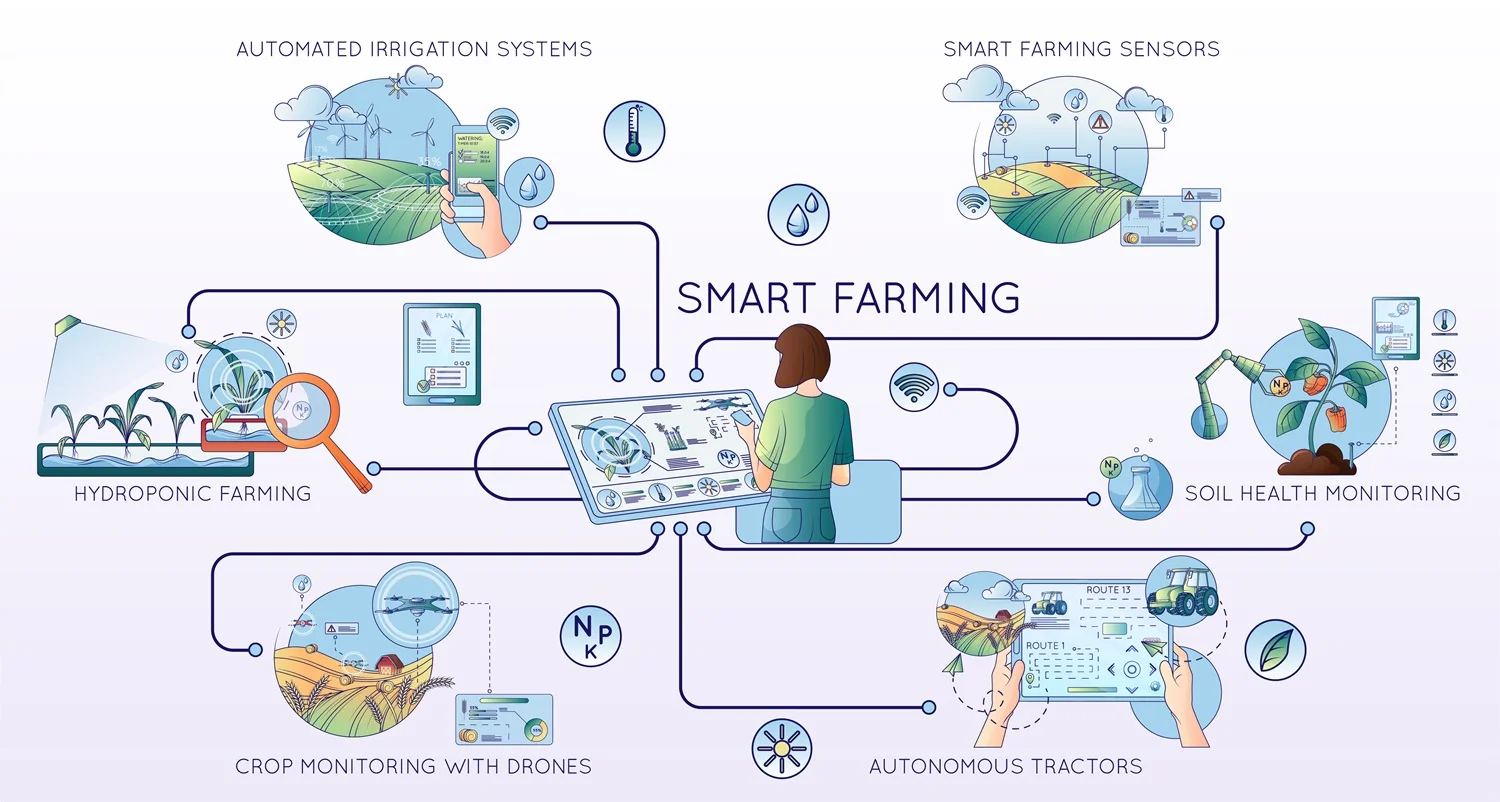
How India is Using IoT in Agriculture: Devices and Solutions in Action
| Solution / Device | What it does | On‑ground Benefit / Example |
| Soil moisture sensors + automated drip irrigation | Measures soil moisture; triggers irrigation automatically or gives alerts to the farmer | In Maharashtra, sugarcane growers are using such systems to reduce water use by ~30% while increasing yields. |
| Smart greenhouses with climate‑control sensors (temperature, humidity, light) | Keeps environmental parameters optimal for plants; reduces pests, improves crop uniformity | Greenhouse growers utilise automated fans, shading, and misting to enhance quality and minimise pesticide requirements. |
| Drones + remote imaging + spectral sensors | Monitor crop health, spot disease, and spray precisely | For example, drone-sprayed pesticides in Punjab reduce chemical usage and labour. |
| Livestock wearable sensors/health monitoring | Track animal movement, health, temperature, and feeding behaviour | Smart collars monitor key metrics, enabling early disease detection and improved milk yields, resulting in reduced loss. |
| Mobile apps + dashboards + cloud analytics | Aggregating data from fields and sensors, offering recommendations, and real‑time alerts | Farmers can track multiple fields, get suggestions for fertiliser, and detect nutrient deficiency via apps. |
These solutions often combine multiple technologies, including sensors, connectivity (such as wireless, LPWAN, or rural broadband), cloud platforms, dashboards, AI, or analytics. Some devices are low‑cost and solar-powered, enabling remote/rural deployment.
Consider this scenario:
Ramesh is a farmer in Karnataka who cultivates tomatoes. He installs soil moisture sensors in his field. These sensors send data via a low‑power wireless network to a cloud platform. Ramesh has an app on his phone (in his local language). Every morning, the app tells him: “Soil moisture is low in zones A and C; scheduling drip irrigation for 10 minutes in those zones.” It also warns: “Forecast: heavy rain in next 3 hours — you may want to delay fertiliser spraying.”
One week, the app’s analytics show signs of early blight in tomatoes (via images taken by a drone + processed in the cloud). The app sends him suggestions: use organic fungicide spray in affected patches, isolate those beds, and monitor for moisture. Instead of losing 25‑30% of the crop, Ramesh controls the disease early, preserving yield, saving cost. He shares data from his farm via the app to a marketplace/aggregator, which helps him get a better price because of the traceability record.
This kind of solution combines device integration (sensors, connectivity), cloud‑platform services, application development, data analytics & dashboards, remote monitoring and alerting.
Indian Startup and Government Support
- Startups in AgriTech are rising fast, building apps, cloud platforms, dashboards, and complete IoT systems. They provide device integration, data analytics, advisory and marketplace linkages. These companies often deliver sensor hardware, connectivity, cloud services, analytics dashboards and mobile apps.
- Government initiatives are also stepping in:
- Digital Agriculture Missions/Policies that promote unified farmer data platforms, open data, and standards.
- Subsidies or schemes for smart sensors and innovative irrigation systems.
- Support for rural connectivity (internet, LPWAN) to enable remote areas to utilise IoT.
- Research bodies (ICAR, state agricultural universities) pilot projects (smart greenhouses, drone use, disease detection), which help scale.
- Partnerships between government, research institutes, and the private sector are crucial to validate, scale, and adapt solutions for local conditions (soil types, climate, languages, literacy, price points).
IoT Beyond Agriculture
While agriculture is one of the biggest users of IoT in rural India, there are broader uses:
- In supply chain and cold chain, IoT sensors ensure produce stays fresh and track temperature & humidity from farm to market.
- In environmental monitoring, sensors track air quality, soil health, and groundwater levels, aiding in sustainability and informed policy decisions.
- In smart villages / rural services: monitoring water supply, energy usage, solar farms, and weather stations.
- Maintenance of farm machinery and irrigation systems: Utilising IIoT to predict failures and schedule maintenance.
- Post‑harvest processing, storage & packing: optimising energy, controlling environment, monitoring quality.
Why This Matters for 1.4 Billion
Because scale magnifies everything, even small inefficiencies multiplied across millions of farms become huge losses. Suppose IoT helps reduce water waste, cuts down on fertiliser misuse, controls disease early, and improves y. In that case, the difference is measurably significant for food security, farmers’ income, environmental health, and building resilient agriculture against climate change.
Additionally, these tools help reduce inequalities: small farmers can access knowledge via apps and sensors, so not only do big farms benefit. With cloud services, dashboards, and remote monitoring, the gap in information access is significantly reduced. IoT farming solutions help bridge the gap between large and smallholders by providing equal access to the latest technologies, enabling everyone to benefit from smarter, more efficient farming practices.
Challenges & Considerations
For completeness, there are hurdles:
- Connectivity issues in remote/rural areas. Without reliable internet or power, IoT devices can’t function well.
- Cost and affordability: sensors, devices, maintenance, apps — initial setup can be expensive for smallholders.
- Data literacy and trust: farmers must understand and trust the data and recommendations.
- Scalability & maintenance: devices exposed to harsh weather; needs durable hardware and regular servicing.
- Standards, interoperability, and security: Many devices from different manufacturers require standards so that systems can integrate; data protection/privacy are also important.
- Sustainability: devices need to be energy efficient; service models need to ensure long‑term support, not one‑off.
The Road Ahead for IoT in Agriculture
The future of IoT in agriculture holds immense promise, with new technologies continuously emerging. The integration of AI, machine learning, and blockchain with IoT will help further optimise agricultural practices, from planting to harvesting to marketing. As these innovations spread across India’s farming community, we’ll see more smallholder farmers adopting IoT farming solutions, which will significantly improve food security and environmental sustainability.
In addition, with more robust networks (satellite, LPWAN, 5G) on the horizon, even remote areas will benefit from connectivity. Low-cost, durable IoT devices will make it possible for farmers in India’s most rural regions to access the benefits of smart agriculture systems using IoT.
Conclusion
India’s agricultural landscape is undergoing a dramatic transformation thanks to IoT in agriculture. From smallholder farms to large agro-enterprises, IoT farming solutions are enhancing productivity, improving sustainability, and reducing environmental impacts. The future of farming is smart, data-driven, and digital — all thanks to the quiet revolution of IoT.
Frequently Asked Questions
1.What is the difference between IoT and IIoT?
IoT refers broadly to any “Internet of Things”‑connected device, sensor, or system. IIoT focuses on industrial or large‑scale applications — with stricter reliability, scalability, automation, safety, and integration needs. Agriculture, when scaled and tied to production, can be an IIoT use case.
2. What kinds of sensors are commonly used in agriculture IoT?
Standard sensors include: soil moisture sensors, pH sensors, temperature & humidity sensors, light sensors, nutrient sensors, weather stations, pest/disease detection (via imaging), animal wearables (for health/location).
3. How do farmers with little tech exposure benefit from IoT?
Through simple interfaces (mobile apps in local languages), dashboards with alerts, extension services or AgriTech agents assisting with installation and upkeep. Also, via programs where the hardware is subsidised, or services are offered as “IoT as a service”, so farmers pay modest recurring fees instead of significant upfront costs.
4. Is IoT expensive for small farmers?
Initial costs can be higher, but many solutions are being designed to be cost‑effective. The payback from increased yield, reduced water & inputs, and better market prices often offsets costs. Also, subsidies and government/NGO programs help reduce upfront costs.
5. What about data privacy and security?
IoT devices collect lots of data. Data must be stored securely (often in cloud platforms), so that devices are secured from tampering, and that access is controlled correctly. Also, farmers should understand who owns data and how it is used. Companies offering these services must follow best practices.