






 India
India  UK
UK  UAE
UAE 
Ranking used to be the main event. Now, your content may influence a search journey without becoming the first link someone clicks.
A potential customer can ask ChatGPT a question, compare options through Gemini, scan a Google AI-generated response and then ask several follow-ups before visiting a website. Perplexity and Microsoft Copilot add another layer by combining answers with source discovery.
This shift puts a different kind of pressure on content. Being relevant is not enough. Your expertise needs to be understandable, attributable and supported by evidence.
That is the real purpose of E-E-A-T for AI search. It gives publishers a useful framework for turning authority from something they claim into something readers and search systems can actually examine.
E-E-A-T has moved beyond the author bio
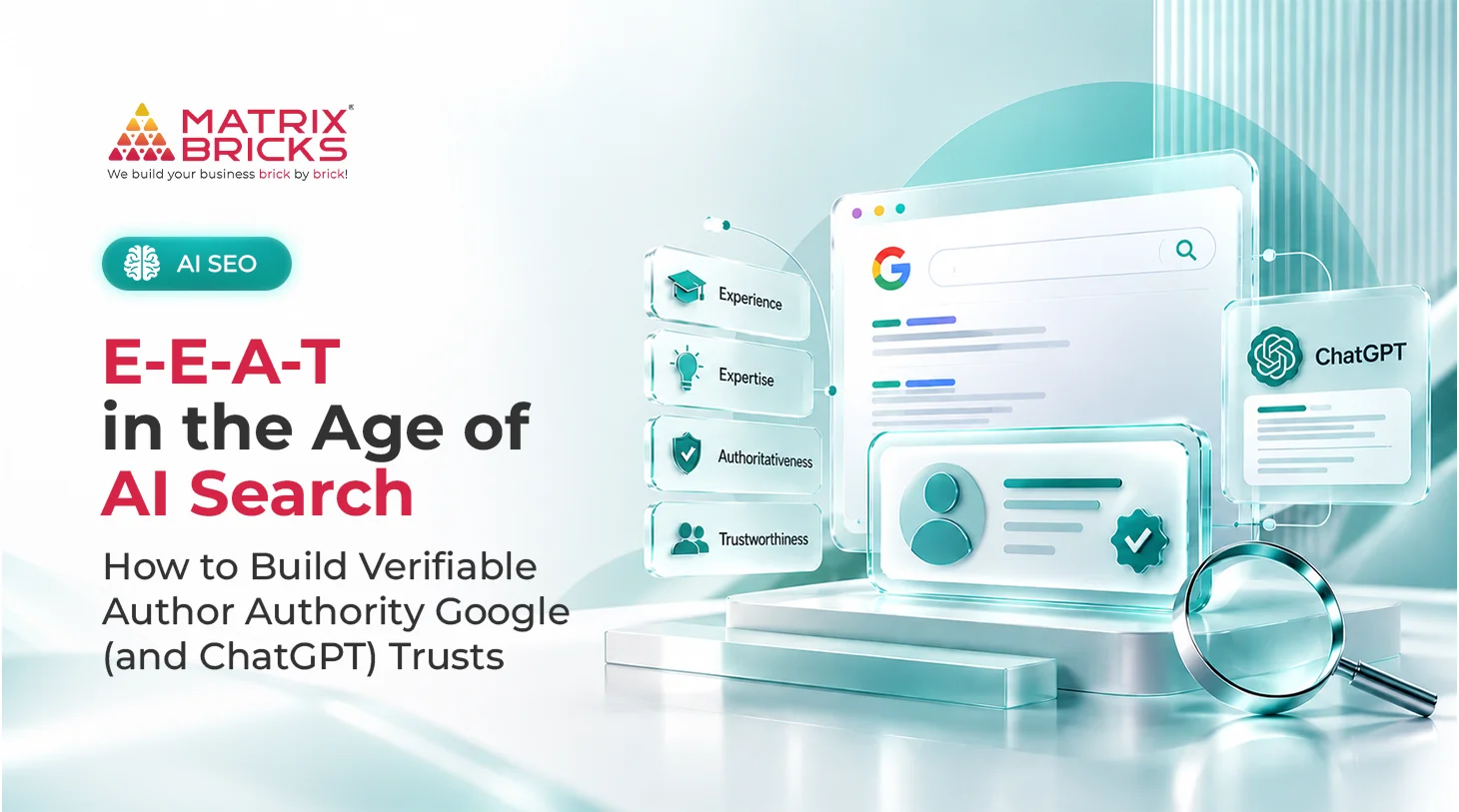
E-E-A-T refers to Experience, Expertise, Authoritativeness and Trustworthiness. Google uses these ideas in its quality guidance to help describe characteristics of reliable, people-first content. E-E-A-T should not be confused with one standalone Google ranking factor.
For publishers, the useful question is not whether a page has “enough E-E-A-T”. It is whether the page provides convincing reasons to believe its information.
| Element | What it should reveal | Evidence worth showing |
|---|---|---|
| Experience | Direct familiarity with the subject | Tests, projects, observations, first-hand examples |
| Expertise | Genuine subject knowledge | Technical explanations, qualifications, specialist insight |
| Authoritativeness | Recognition beyond your own claims | Relevant citations, mentions, publications, industry contributions |
| Trustworthiness | Reasons the information can be relied upon | Sources, methodology, author details, dates, corrections |
This distinction becomes particularly useful when thinking about E-E-A-T and AI search.
Anyone can write “our experts have extensive experience”. Far fewer websites can show who those experts are, what they have worked on, where their information came from and how their conclusions were reached.
Authority becomes stronger when the evidence survives scrutiny.
Author authority SEO now needs an evidence trail
Author authority SEO is about connecting a real person with demonstrable expertise in the topics they publish about.
Consider two hypothetical SEO articles.
The first is credited to “Marketing Team”. There is no author page, no reviewer, no explanation of experience and few external references.
The second identifies the author, links to a substantive biography, shows their specialist area, includes observations from actual projects and references primary documentation when making factual claims.
Both pages may contain accurate information. The second, however, gives a reader considerably more context for judging why its information deserves attention.
A strong author footprint can include:
- A dedicated author page with relevant experience
- Consistent professional information across credible profiles
- Articles concentrated around genuine areas of expertise
- Original research, experiments or practical observations
- Industry contributions and reputable third-party mentions
- Clear editorial or expert review where appropriate
Think of this as building an authority graph around the author.
The person, organisation, subject expertise, published work and external recognition should connect logically. That is far more meaningful than attaching an impressive job title to every article.
Get Your Free Consultation!
Connect with our team to improve visibility, unlock growth opportunities, and build strategies tailored to your business goals.
How do you actually build author authority?
Start with proof before promotion.
An author page should explain what somebody knows and why they know it. If they have spent years managing paid search campaigns, say what kinds of campaigns. If they specialise in technical SEO, connect them with relevant analysis and content.
Then strengthen those connections across the site.
A practical sequence is:
- Define expertise clearly. Avoid giving every author an unrealistically broad list of specialisms.
- Build topic depth. Publish connected content around areas the author genuinely understands.
- Add first-hand insight. Include observations from projects, testing or research where appropriate.
- Reference strong evidence. Use original documents and primary sources whenever they are available.
- Connect related work. Link author profiles, articles, case studies and relevant research logically.
- Use expert review. For technical or sensitive subjects, identify qualified reviewers where necessary.
- Maintain the evidence. Update biographies, sources and articles when circumstances change.
A simple test helps here: search the author’s name independently.
Does the wider footprint support what the website says about them?
If not, adding more adjectives to the biography will not solve the underlying problem.
How does ChatGPT decide which sources are worth using?
There is no publicly available universal “ChatGPT authority score” that publishers can optimise towards.
When web search is involved, ChatGPT can retrieve current information and show citations or source links. The practical implication for publishers is that content needs to be both discoverable and useful once retrieved.
This is where AI search optimisation starts to look different from old-fashioned keyword optimisation.
Imagine an AI system reaches your article while answering:
“How can I demonstrate E-E-A-T on a financial services website?”
If the page spends 400 words introducing digital marketing before answering the question, the useful information is buried.
A stronger passage might immediately explain that financial content should clearly identify the author and reviewer, demonstrate relevant expertise, reference authoritative financial or regulatory sources and show when the information was last reviewed.
That paragraph works independently.
This is increasingly important because AI answers are assembled around questions, subtopics and follow-up intent rather than simply matching one keyword to one webpage.
Google trust signals are really about reducing uncertainty
The phrase Google trust signals can make trust sound like a collection of SEO switches waiting to be turned on.
It is more useful to think about uncertainty.
When someone reaches your article, how many questions remain unanswered?
Who wrote this?
Where did this number come from?
When was this information checked?
Is this first-hand experience or a summary of somebody else’s work?
Who reviewed the technical advice?
Strong content removes those uncertainties.
That may involve:
- Named authors and reviewers
- Publication and revision dates
- Primary-source references
- Transparent research methodology
- Relevant case evidence
- Clear distinctions between fact and opinion
- Corrections when information changes
This also makes content easier for humans to evaluate. That matters because AI search optimisation should improve the information itself, not merely its machine readability.
Write in answer units, not keyword blocks
One of the most practical changes for GEO is to stop treating every section as a place to insert keywords.
Treat it as an answer.
A useful pattern is:
Question → direct response → context → evidence → example
Suppose the heading asks:
What is author authority SEO?
A strong opening would be:
Author authority SEO is the practice of making a content creator’s relevant expertise, experience and professional credibility easy to identify and independently verify.
The next paragraphs can expand on how that works.
This creates what we call an answer unit: a passage with enough context to remain meaningful even when retrieved separately from the rest of the article.
That matters across ChatGPT, Gemini, Perplexity, Copilot and Google’s AI-driven search experiences because users increasingly move from broad questions to highly specific follow-ups.
AI visual search adds another layer of E-E-A-T
AI visual search means credibility is not restricted to prose.
Original diagrams, screenshots, charts, photographs and demonstrations can provide evidence that plain text cannot.
Imagine a technical SEO article discussing JavaScript rendering.
A generic laptop stock image proves nothing.
An annotated screenshot showing the actual rendering issue, followed by an explanation of how it was diagnosed, contributes genuine information.
The same principle applies across industries.
A manufacturer can show a production process. A design agency can show annotated project decisions. A researcher can visualise original findings. An ecommerce business can provide accurate product imagery from multiple useful perspectives.
For visual content, context matters too. Use meaningful filenames, captions, surrounding explanations and descriptive alt text where appropriate.
The question should always be: Does this visual contribute evidence or understanding?
If not, it is decoration rather than authority.
The emerging GEO opportunity: become easy to verify
The next phase of E-E-A-T for AI search is likely to reward something content marketers have sometimes neglected: verifiability.
Do not just say you have experience. Show the work.
Do not simply publish a statistic. Trace it to its source.
Do not describe something as research if it is really commentary.
Do not hide authors behind a company name when individual expertise matters.
And do not create ten near-identical articles because ten keywords look commercially attractive.
Build a recognisable body of expertise instead.
Before publishing, check seven things:
- Author: Is the creator clearly identifiable?
- Expertise: Is their relevance to this topic evident?
- Experience: Is there first-hand knowledge where it adds value?
- Evidence: Can important factual claims be checked?
- Originality: Does the page contribute something beyond existing summaries?
- Freshness: Are time-sensitive statements current?
- Extractability: Can important passages make sense independently?
That combination is much closer to what good GEO should achieve.
Authority is becoming something you prove
AI search has not made expertise less important. It has made weak claims of expertise easier to expose.
As search moves deeper into conversational answers, citations and multi-source discovery, organisations need content that can withstand a simple question: Why should anyone rely on this source?
With 15+ years of digital marketing experience, Matrix Bricks brings established search expertise into the GEO era, combining SEO knowledge with evolving AI search optimisation strategies focused on visibility, authority and evidence-led content. The objective is not simply to publish more, but to create information that deserves to be discovered, understood and referenced.
That is ultimately where E-E-A-T for AI search is heading. Authority will not come from saying the right things about yourself. It will come from leaving enough credible evidence for readers, search engines and generative platforms to reach that conclusion themselves.
Frequently Asked Questions
ChatGPT does not publish a universal trust score for websites. When search is used, it can retrieve current web information and provide sources alongside its response. Publishers should therefore concentrate on creating accurate, clearly structured and verifiable information rather than trying to optimise for an imagined ChatGPT authority metric.
- Make the author authority SEO footprint easy to verify.
- Support important statements with credible primary sources.
- Keep factual and time-sensitive information current.
Author authority SEO is built by connecting an identifiable author with consistent evidence of genuine expertise. A detailed biography helps, but stronger authority comes from specialist content, first-hand insight, original work, relevant professional experience and independent recognition.
- Develop content around genuine subject expertise.
- Connect authors with relevant research, case studies and professional profiles.
- Earn credible mentions rather than manufacturing authority signals.
E-E-A-T stands for Experience, Expertise, Authoritativeness and Trustworthiness. It provides a useful framework for understanding whether content demonstrates the qualities associated with credible, helpful information. For E-E-A-T and AI search, these qualities also make the source and its evidence easier to evaluate.
- Experience shows first-hand involvement.
- Expertise demonstrates meaningful subject knowledge.
- Trustworthiness helps users verify the information presented.
AI search can retrieve web information and use sources to ground generated responses, but this should not be confused with perfect fact-checking. Content owners can improve credibility by making claims traceable, identifying authors and reviewers, maintaining accurate information and clearly distinguishing evidence from interpretation.
- Cite reliable sources close to important claims.
- Explain methodologies behind original findings.
- Review and update information when the underlying facts change.
Using AI during content production does not automatically remove credibility. The real problem arises when AI is used to publish generic, inaccurate or unverified information at scale. Human expertise, editorial judgement, original insight and rigorous fact-checking remain valuable regardless of which tools support the writing process.
- Verify AI-generated factual claims before publishing.
- Add experience and insights that generic generation cannot provide.
- Maintain clear responsibility for authorship and editorial quality.