






 India
India  UK
UK  UAE
UAE 
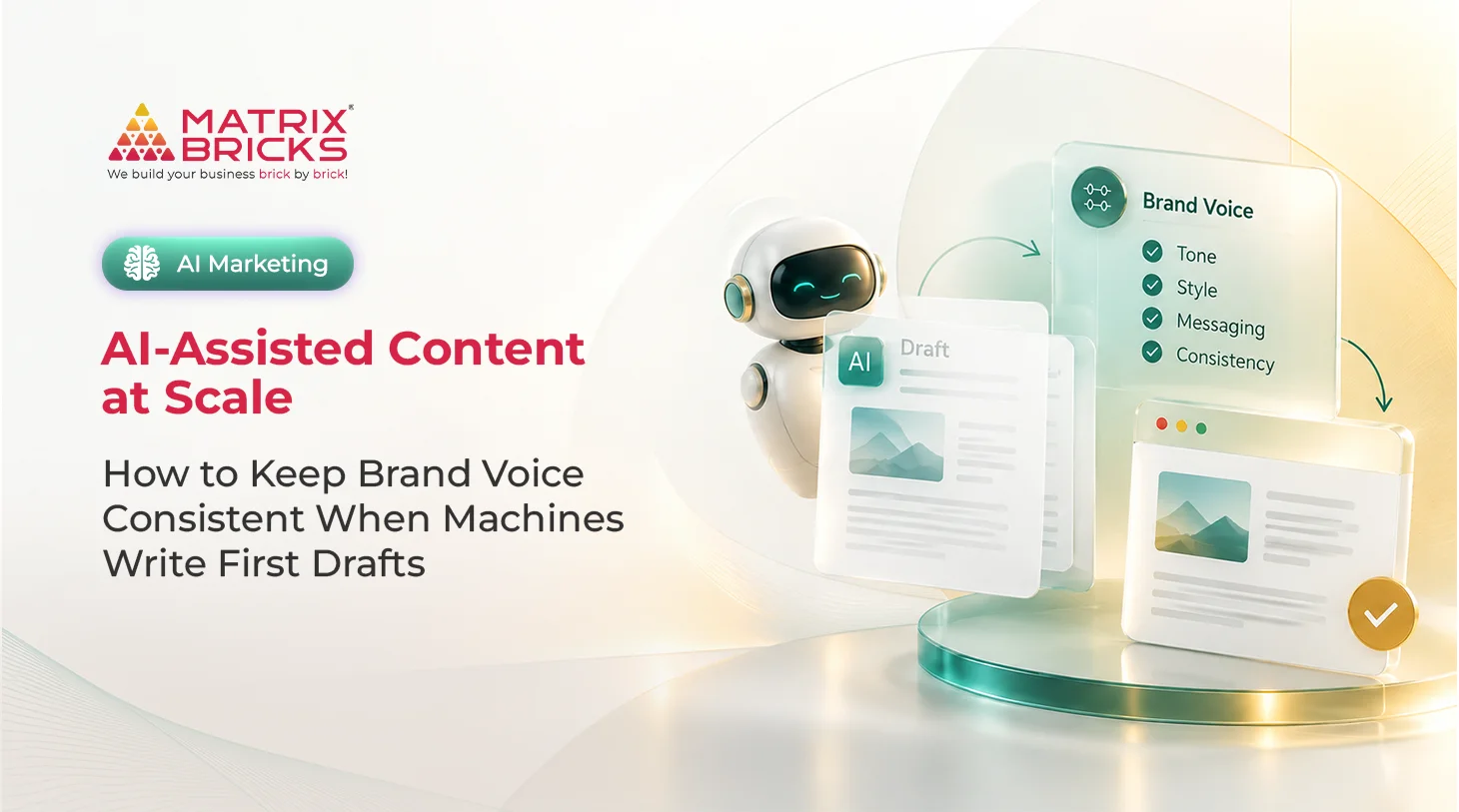
Your content team has a problem. The business wants more blogs, social posts, landing pages and email campaigns, but there is only so much time in a working day. So, you turn to AI Content Writing. The first drafts arrive faster, research becomes easier and content teams can produce far more than before.
Then another problem appears. The content starts sounding the same.
The words may be grammatically correct, but the personality is missing. One blog sounds formal, another sounds overly casual, and a third could have been written by almost any company in the industry. This is where Brand Voice Consistency becomes critical.
A smarter approach is not to stop using AI. It is to give AI the right boundaries.
- Use AI for speed: Let machines handle research, outlines, first drafts and variations.
- Keep humans in control: People should shape opinions, stories, judgement and final messaging.
- Build clear rules: Give AI practical brand voice guidelines for AI, rather than simply asking it to “sound like our brand”.
For Indian businesses competing across crowded digital markets, this balance can make content production faster without making the brand forgettable.
AI Should Write First, Not Have the Final Say
The biggest mistake businesses make with AI content is treating the first draft as the finished article. AI is useful at producing a starting point, but a starting point still needs direction.
Think about a marketing team producing 20 product pages for an Indian SaaS company. An AI tool can create the initial copy quickly. It can structure features, explain benefits and suggest calls to action. However, it does not automatically understand why customers trust that particular company, what its sales team hears every week or which phrases its leadership would never use.
Those details come from people.
A strong AI content strategy therefore gives machines a defined role within the workflow rather than allowing them to control the entire process.
| Content stage | AI’s role | Human’s role |
|---|---|---|
| Research | Find themes and questions | Check relevance and accuracy |
| First draft | Build initial copy | Add expertise and perspective |
| Brand review | Apply defined style rules | Protect personality and positioning |
| Fact checking | Flag possible claims | Verify facts and sources |
| Final editing | Suggest improvements | Approve the finished message |
This division is particularly useful when businesses move from occasional AI use to AI content at scale.
Get Your Free Consultation!
Connect with our team to improve visibility, unlock growth opportunities, and build strategies tailored to your business goals.
What Actually Makes a Brand Voice?
Brand voice is more than choosing whether your writing is “professional” or “friendly”. Those descriptions are too broad to guide either a writer or an AI system.
A useful voice has recognisable characteristics. For example, a fintech brand might be clear, confident and practical. A luxury property developer may use a more polished and aspirational tone. A technology company selling cybersecurity services might sound knowledgeable without becoming overly technical.
Consider how brands such as Apple, Nike and Zomato communicate. Their industries are very different, but their messaging tends to have a recognisable personality. That consistency helps people identify the brand even before seeing its logo.
Your voice should define things such as:
- Vocabulary: Which words does the brand regularly use, and which should it avoid?
- Sentence style: Does the brand favour short, direct sentences or more descriptive writing?
- Personality: Is it authoritative, conversational, bold, reassuring or understated?
- Point of view: Does it challenge conventional thinking or focus on practical guidance?
- Boundaries: Which claims, jokes, expressions and industry clichés are off limits?
This becomes the foundation for effective AI content generation for brands.
Turn Brand Guidelines Into AI-Ready Instructions
A traditional brand book may contain colours, logos and visual rules but provide little practical help for content creation. AI needs something more specific.
Instead of writing, “Keep our tone professional and approachable”, give the system usable instructions. Explain what professional means for your business. Show examples of sentences that work and sentences that do not.
For instance:
Instead of: “We deliver innovative solutions that transform businesses.”
Try: “We help growing businesses overcome technology challenges, enabling their teams to work more efficiently and make confident, informed decisions.”
The second example tells the reader something useful. It also gives AI a clearer pattern to follow.
Your brand voice guidelines for AI should ideally include examples of approved language, common customer questions, preferred terminology, banned phrases, formatting preferences and several examples of existing high-quality content.
Build a Human Review Layer
AI can generate hundreds of pieces of content. That does not mean hundreds should be published without review.
Human editing is where generic writing becomes brand-specific communication. Editors can add an opinion, replace vague claims with evidence, bring in customer language and remove phrases that sound unnatural.
A practical review process can include three checks:
- Voice check: Does this sound like something the brand would genuinely say?
- Value check: Does it teach, clarify or solve something for the reader?
- Trust check: Are claims accurate, supported and presented responsibly?
This is especially important in sectors such as healthcare, finance, real estate and technology, where an incorrect or exaggerated statement can damage credibility.
Create a Content System, Not Just Better Prompts
A good prompt helps but prompts alone will not create consistency across a large content operation.
Businesses need a repeatable system. Start by creating a central voice document that writers, editors and AI tools can all work from. Then establish a content workflow where every draft passes through the same essential checks.
For example, an Indian B2B company expanding from Mumbai to Bengaluru, Delhi and international markets may have several teams producing content simultaneously. Without a shared system, each team can interpret the brand differently.
A central content system can include:
- Master voice guide: The single source of truth for tone, vocabulary and style.
- Approved examples: Strong blogs, landing pages, emails and social posts that demonstrate the voice.
- AI prompts: Reusable instructions for different content formats.
- Editorial checklist: A simple review process before publication.
- Performance feedback: Content data used to understand what audiences respond to.
This makes AI-assisted content more scalable without allowing volume to dilute identity.
Measure Consistency Alongside Content Volume
Businesses often measure AI success by how much content they produce. That is only half the picture.
If a team goes from producing ten articles a month to fifty, but readers find the content repetitive and engagement falls, the process has not really improved.
Track quality alongside quantity.
Useful indicators include:
- Content engagement and average time spent on key pages
- Conversion rates from content-led journeys
- Editorial revision rates
- Search visibility for strategic topics
- Feedback from sales and customer-facing teams
- Brand consistency across different channels
The goal is not to produce the maximum number of words. It is to produce more useful content without losing what makes the business recognisable.
The Future Belongs to Brands That Combine Speed With Judgement
AI will continue changing how marketing teams work. For many Indian businesses, especially those managing multiple products, markets and digital channels, the ability to produce content efficiently will become increasingly important.
But efficiency alone will not create a strong brand.
The businesses that benefit most will use AI to remove repetitive work while keeping human judgement at the centre of communication. Machines can help produce the draft. People must decide whether the draft deserves to represent the brand.
That distinction matters because customers do not build relationships with a content generator. They build relationships with brands that sound clear, credible and human.
The Next Step Is Better, Not Just Faster, Content
AI can give your marketing team more capacity, but capacity without control can quickly create a sea of interchangeable content. The businesses that win will be the ones that build systems where AI handles speed and humans protect meaning, personality and trust.
If your content operation is growing and you want to scale production without sacrificing Brand Voice Consistency, now is the time to build the right framework. Matrix Bricks can help you develop a practical AI-led content approach that keeps your brand distinctive, consistent and ready to scale. Start refining your content system now, before volume becomes harder to manage.
Frequently Asked Questions
A defined content framework can keep AI-assisted writing aligned across blogs, social media and web pages. The key is to provide specific examples rather than vague instructions.
- Create clear rules around tone, vocabulary and sentence structure.
- Review AI drafts against approved examples before publishing.
Yes. AI can support content production for Indian businesses across sectors, provided the output is reviewed for accuracy, cultural context and audience relevance.
- AI-generated content for Indian businesses should reflect local customer behaviour and market expectations.
- Regional references and industry-specific terminology should be checked by people who understand the audience.
AI responds better when it receives clear examples and structured instructions. A collection of strong existing content can help establish patterns for future drafts.
- Build an AI writing style guide containing examples of preferred and avoided language.
- Give the system context about the audience, product and purpose of each piece.
AI can reduce repetitive writing work, but it does not remove the need for editorial judgement, original thinking and subject expertise.
- Human-AI content collaboration allows writers to spend more time on strategy, storytelling and refinement.
- Human review is particularly important for expert-led, regulated or reputation-sensitive content.
The answer is to standardise the process rather than simply increasing AI output. Every piece should move through research, drafting, editing and quality checks.
- A structured content scaling strategy helps teams increase production without creating inconsistent messaging.
- Performance data can identify which formats and topics deserve greater investment.
AI can reduce repetitive writing work, but it does not remove the need for editorial judgement, original thinking and subject expertise.
- Human-AI content collaboration allows writers to spend more time on strategy, storytelling and refinement.
- Human review is particularly important for expert-led, regulated or reputation-sensitive content.
Read the content aloud and ask a simple question: would a real person from the company actually say this? If the answer is uncertain, the draft needs another editorial pass.
- Use humanised AI content as a starting point, then add genuine experience, customer language and specific examples.
- Remove repetitive phrasing, unnecessary jargon and generic claims that could belong to any competitor.