

 India
India  UK
UK  UAE-English
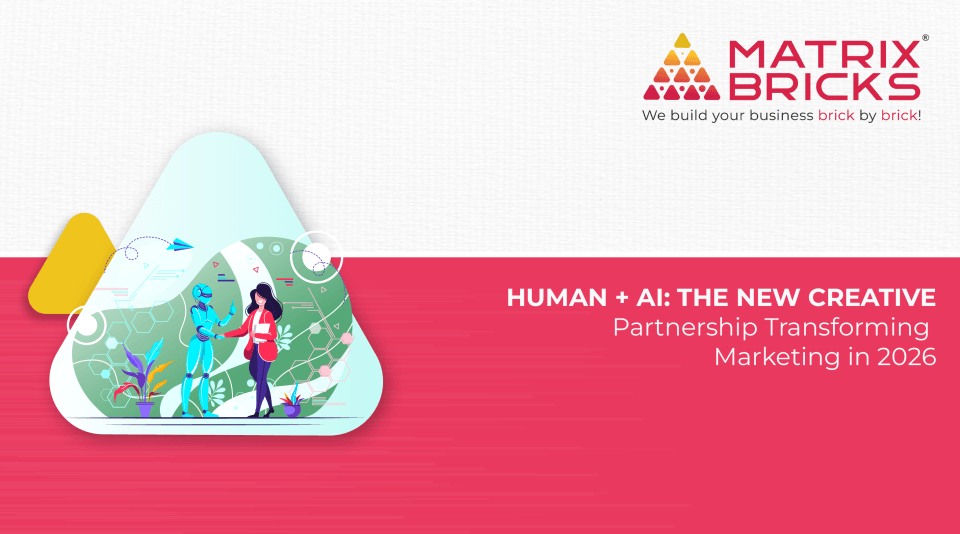
The marketing world has entered an era of intervention, a phase where creativity is neither fully human nor fully machine-driven, but a fusion of both. As we move deeper into 2026, the conversation is no longer about whether AI will disrupt marketing, but how humans and AI can innovate together to shape a more intuitive, personalised, and emotionally-led digital landscape.
The rising importance of AI in creative marketing is not as a replacement, but as an intelligent partner. Similarly, human-AI collaboration, AI-powered content creation, and a hybrid marketing workflow are becoming essential building blocks for brands looking to stay relevant. The future of creative automation is not about pushing humans aside; it is about unlocking a new dimension of creativity that neither humans nor AI could reach on their own.
And sitting at the centre of this evolution are partners like Matrix Bricks, helping brands navigate this powerful convergence of machine intelligence and human storytelling. They bring a future-ready approach that takes the precision of AI and the emotional insight of human creators, transforming campaigns from ordinary assets into meaningful, impactful experiences.
We are witnessing a fundamental shift: 2026 is the year of Human + AI co-creation.
From Automation to Collaboration: The Next Step in AI Evolution
A few short years ago, AI in creative marketing was synonymous with automation, tools designed to streamline repetitive tasks, speed up execution, or generate simple templates. While useful, these tools were largely functional rather than inspirational. They solved problems but did not push creative boundaries.
But 2026 looks nothing like the early days of automation.
AI has evolved from being a backstage assistant to a frontline creative partner. It doesn’t just carry out tasks; it contributes, interprets, and collaborates in ways that feel increasingly conversational and strategic.
The transition from automation to collaboration has unfolded in three major waves:
Wave 1: AI as a Task Automator
This was the era where AI wrote captions, resized images, or scheduled social media posts. It was efficient, but not transformative.
- AI was mostly used for predictable, repetitive tasks that required speed rather than creative depth.
- Marketing teams saw AI as a productivity booster but rarely as a source of creative inspiration.
Wave 2: AI as Personalised Engine
As AI grew smarter, brands used it to personalise experiences based on user behaviour.
- Email subject lines changed dynamically.
- Ad recommendations are tailored to browsing patterns.
- Chatbots offered semi-human conversations.
While more advanced, AI still played a supporting role. Humans created the strategy; AI scaled it.
Wave 3: AI as a Creative Collaborator (2026 and beyond)
Today, we are here. The era of human-AI collaboration is in full swing.
- AI can generate campaign concepts based on cultural analysis and audience sentiment.
- It can evaluate visual trends and predict which creative direction will resonate.
- It can brainstorm with teams, offering dozens of variations and creative insights in seconds.
This shift has allowed marketers to move from “What can AI automate?” to “What can AI help us imagine?”
Why collaboration now matters more than automation
- Markets are more saturated than ever, demanding standout storytelling.
- Personalisation needs have skyrocketed, making AI indispensable.
- Creative cycles have shortened dramatically, requiring faster ideation.
- Consumers expect authenticity, which only humans can deliver.
- AI gives teams superpowers, but human creators still define the soul of a brand.
This is the evolutionary space where Matrix Bricks thrives, guiding organisations not just to adopt AI, but to work with it, integrate it into their teams, and innovate collaboratively.
Why Human Creativity Still Drives Brand Emotion
Emotion has always been the heartbeat of marketing, and 2026 is no different. In fact, in a world increasingly filled with AI-generated content, real human emotion stands out even more. People connect with stories, experiences, failures, successes, and vulnerabilities, not algorithms.
AI can mimic emotion, but cannot feel it. It can recognise patterns, but it cannot live them. It can generate variables, but it cannot understand the experiences behind them.
Where humans remain irreplaceable:
1. Cultural Context and Nuance
Humans understand society through lived experience—interactions, upbringing, culture, humour, fears, and trends.
- AI can analyse cultural data, but cannot interpret cultural tension the way a person can.
- It may not always understand sarcasm, irony, or double meanings within specific communities.
- Humans recognise unspoken rules, emotional triggers, and sensitivities.
An advertisement can be technically perfect, but if it lacks cultural nuance, it fails instantly.
2. Emotional Storytelling
Stories rooted in truth resonate deeply. Stories driven by algorithms can feel hollow.
- Humans craft narratives based on memory, imagination, empathy, and vulnerability.
- Emotional arcs, character journeys, conflict, tension, and resolution require lived experience.
- AI can provide structure, but humans provide purpose.
3. Authentic Brand Voice
Brands are more than visuals; they are personalities. And personalities cannot be automated.
- Human creators understand tone, humour, warmth, and conversational style.
- They maintain consistency even when the brand evolves.
AI helps scale voice, but humans define it.
4. Ethical and Moral Judgement
Marketing often sits at the intersection of influence and responsibility.
- Humans understand when something “feels wrong,” insensitive, or inappropriate—even if the data supports it.
- Ethical boundaries require human judgment rooted in social awareness.
Why this matters more in 2026 than ever before
Consumers today recognise AI-generated content almost instantly. They crave originality, sincerity, and emotional depth, qualities that only humans can deliver. This makes human creativity no less valuable, but more essential.
This is where Matrix Bricks excels, ensuring brands never lose their emotional authenticity while using AI in creative marketing to scale possibilities.
How AI Enhances Ideation, Content, and Campaign Design
While humans lead with emotion and originality, AI brings speed, scale, structure, and data intelligence. Together, they form a creative powerhouse that neither can achieve alone.
Let’s break down how AI elevates each stage of the creative process:
1. Ideation and Concept Development
This is where many creative teams struggle: blank page syndrome, limited perspectives, or repetitive thinking. But AI transforms the ideation phase entirely.
AI now contributes by:
- Analysing industry trends, cultural shifts, and audience behaviour to present idea directions.
- Suggesting campaign angles based on consumer sentiment.
- Reviewing data from high-performing content to predict what creative elements will work.
How it benefits teams
- Teams no longer start from zero; they start from insights.
- Creative blocks become less common because AI can generate dozens of variations instantly.
- New creative territories emerge, ones humans may not have considered.
AI helps humans imagine more, not less.
2. AI-Powered Content Creation
AI-powered content creation is one of the biggest growth areas in marketing. But contrary to misconceptions, AI does not replace writers or designers.
Instead, it accelerates their capabilities.
What AI creates:
- First drafts of scripts, blogs, social posts, and newsletters.
- Variations of visuals, layouts, and ad formats.
- Editable templates for campaigns across multiple platforms.
Why this matters
- Creators spend less time on formatting and more time refining emotional impact.
- Teams get multiple creative directions quickly, saving weeks of back-and-forth.
- Large campaigns become easier to scale locally and globally.
Yet the final voice, emotion, and authenticity always come from humans, ensuring every asset reflects the brand’s heart.
3. Campaign Design and Execution
AI supports campaign execution by:
- Predicting which colours, wording, or visuals will resonate best with each segment.
- Testing variations of ad creatives in real time.
- Optimising ads based on behavioural patterns.
AI turns creative strategy into performance-driven execution
- Every creative decision is backed by data.
- Teams make fewer subjective choices and more informed ones.
- Campaigns adjust dynamically, improving ROI.
This synergy is the backbone of the hybrid marketing workflow, one that Matrix Bricks helps brands implement seamlessly to maximise both creativity and efficiency.
Building a Human-AI Workflow for Your Marketing Team
To fully benefit from AI in creative marketing, companies need more than technology; they need structure. A carefully designed hybrid marketing workflow ensures both humans and AI contribute where they perform best.
Here is how brands can build a system that merges emotion with intelligence:
1. Assign AI to Repetitive and Analytical Tasks
Let AI handle:
- Data analysis
- Performance predictions
- Market research
- Draft creation
- Creative variations
- Personalisation at scale
This frees humans for tasks that require emotional judgment, strategic thinking, or creative storytelling.
2. Build Human-Led Creative Checkpoints
Even the most advanced models require human oversight.
- Humans review tone, ethics, cultural appropriateness, and emotional resonance.
- Creative leads refine voice, narrative structure, and conceptual clarity.
Without checkpoints, AI outputs can become generic or misaligned.
3. Train Teams to Collaborate, Not Compete
Brands must create a culture where AI is seen as a partner, not a threat.
- Encourage experimentation with AI tools.
- Reward hybrid ideas created through human + AI synergy.
- Build cross-functional teams where technologists and creatives collaborate.
The companies succeeding in 2026 are those that embrace AI as a colleague—not an adversary.
4. Partner With Future-Ready Agencies
Implementing a human-AI system requires guidance, experience, and technical expertise. This is where Matrix Bricks becomes essential.
They specialise in:
- Integrating advanced AI tools into marketing workflows
- Training teams in human-AI collaboration
- Building emotional, data-driven campaigns
- Ensuring brands maintain authenticity while scaling content
Their approach delivers campaigns that are emotionally resonant and performance-driven, something only possible through a balanced mix of human insight and AI intelligence.
Human Strengths vs AI Strengths in 2026
| Area | Human Strengths | AI Strengths |
| Creativity & Emotion | Deep storytelling, cultural understanding, and emotional instinct | Pattern recognition, creative variations, and idea expansion |
| Strategy | Long-term vision, brand identity, cultural sense-making | Predictive modelling, data insights, real-time optimisation |
| Content Creation | Authenticity, original voice, experiential narratives | Rapid draft generation, personalisation, cost-efficient scaling |
| Workflow Efficiency | Quality control, final decisions, and ethical judgment | Automation, speed, performance-based adjustments |
Frequently Asked Questions
1. What is human-AI collaboration in marketing?
Human-AI collaboration refers to the partnership between human creativity and artificial intelligence to produce more effective, scalable, and emotionally engaging marketing campaigns. Instead of replacing creative teams, AI acts as a catalyst, offering insights, suggestions, predictions, and variations that humans refine.
Put simply:
- AI accelerates and enhances
- Humans create and humanise
Together, they form a creative powerhouse.
2. How does AI in creative marketing help improve results?
AI improves results by offering deeper insights into consumer behaviour, identifying patterns, and predicting what content will perform best. It moves marketing from guesswork to evidence-based decision-making.
AI helps teams:
- Optimise messaging with precision
- Personalise campaigns for each audience segment
- Produce more variations in less time
This leads to stronger engagement and higher overall ROI.
3. What is AI-powered content creation?
AI-powered content creation refers to using AI tools to generate or assist with copywriting, design, video editing, idea generation, social posts, and more. These tools help kickstart creativity while saving time.
AI supports creators by:
- Drafting initial versions of content
- Offering variations in tone, structure, and style
- Converting ideas into campaign-ready formats
Humans then refine the emotional and strategic elements.
4. Why is a hybrid marketing workflow important in 2026?
A hybrid marketing workflow is essential because brands must produce more content at faster speeds while maintaining authenticity. By dividing tasks between humans and AI, teams operate more efficiently without losing emotional resonance.
In 2026, hybrid systems will help teams:
- Balance speed with creativity
- Maintain brand identity while scaling campaigns
- Reduce creative burnout and bottlenecks
It’s the new standard for modern marketing.
5. What is the future of creative automation?
The future of creative automation goes far beyond simple efficiencies. AI will become even more intuitive, emotionally aware, and embedded into the creative process.
Emerging trends include:
- Emotionally intelligent AI capable of sentiment-driven ideation
- Real-time campaign personalisation across all digital touchpoints
- AI-driven creative studios inside brands
- Deeper integration between AI tools and human creators
But human imagination will always remain the core driver.