


 India
India  UK
UK  UAE-English
Why Slow Websites Quietly Drain Revenue and Trust
Every second matters online. Literally. Studies consistently show that even a single second of delay can reduce conversion rates by nearly 7 percent. Across industries, that delay quietly translates into billions of dollars in lost revenue each year. But the real damage caused by poor website speed goes deeper than numbers on a dashboard.It shows up as frustration when a page refuses to load. It shows up as doubt when a checkout page freezes. It shows up as lost confidence when a site crashes during peak traffic.Many businesses feel this pain but struggle to identify the root cause. In 2026, a large percentage of companies are still operating on a traditional CMS that was never built for mobile-first users, high traffic volumes, or rapid updates. These systems slow down website performance, weaken trust, and quietly limit growth.User behavior is unforgiving. Over 53 percent of visitors abandon websites that take longer than three seconds to load. Nearly 79 percent of dissatisfied users say they are unlikely to return. On mobile devices, which now account for more than 70 percent of traffic, conversion rates drop by up to 20 percent for every additional second of delay.Cloud adoption data reinforces the urgency. About 68 percent of businesses in the USA already operate on cloud infrastructure, compared to 47 percent in the UAE and 41 percent in India. The gap is widening because faster companies are compounding their advantage.At some point, the question is no longer “Why is our site slow?” It becomes “How much is this slowness costing us every month?”For many growing businesses, the answer leads directly to a cloud content management system.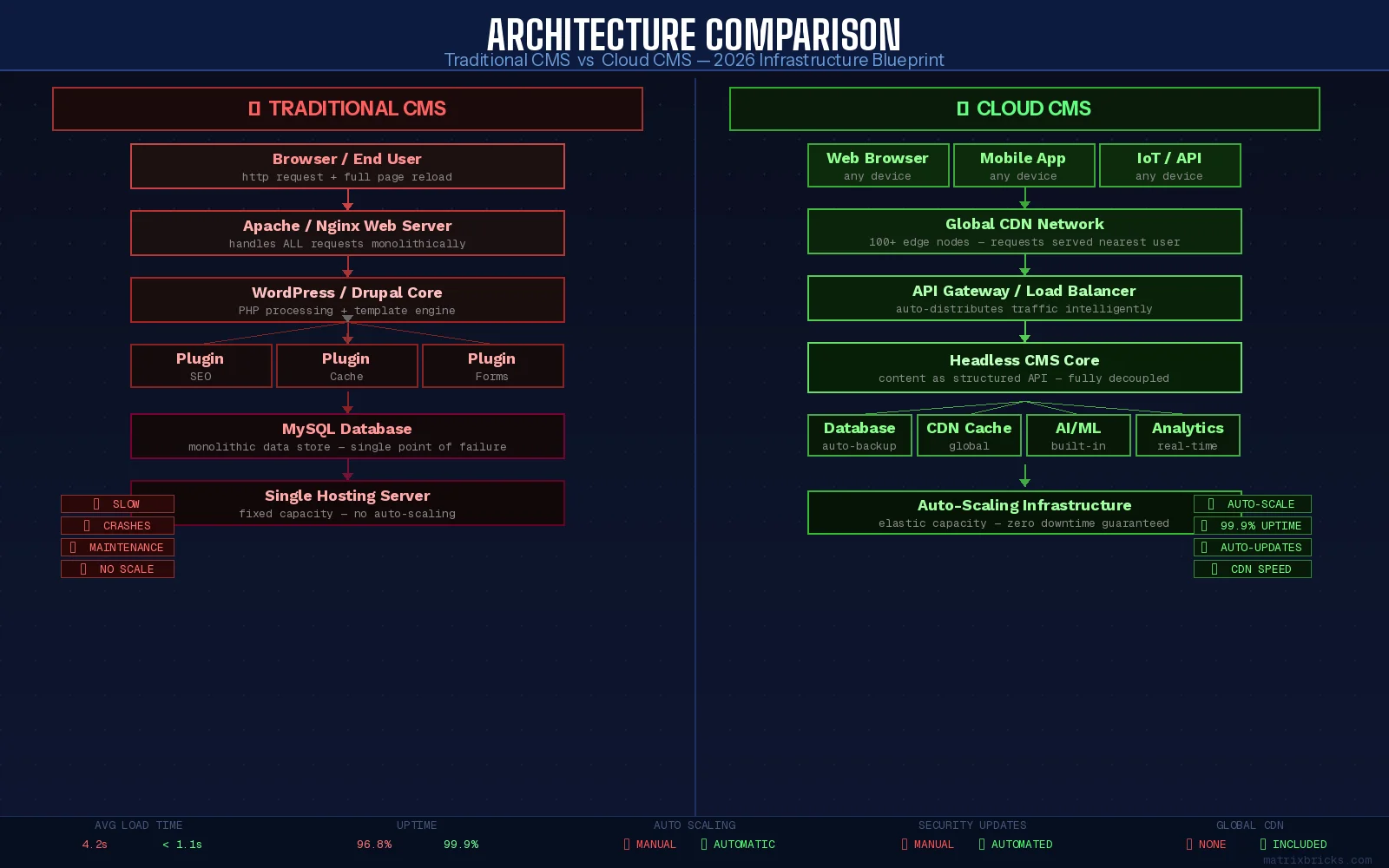
The Hidden Costs of a Traditional CMS in 2026
Performance Issues That Directly Affect Revenue
A traditional CMS struggles to keep up with modern expectations. Page load times stretch beyond three seconds; bounce rates climb sharply, and search visibility declines as Core Web Vitals fall below recommended benchmarks.Common performance challenges include:- Pages that load slowly due to bloated themes and excessive plugins, which increase server requests and slow down rendering.
- Websites that crash or become unresponsive during marketing campaigns, seasonal sales, or sudden traffic spikes.
- Backend systems that cannot efficiently cache or distribute content across global locations, leading to inconsistent user experiences.
Business Impact You Can Measure
The financial impact of slow sites is not abstract. It is measurable and persistent.- A one-second delay can reduce conversion rates by up to 7 percent, directly affecting revenue.
- Search engines deprioritize slow websites, reducing organic visibility and increasing dependency on paid traffic.
- As load times increase from one second to ten seconds, bounce rates can increase by more than 120 percent.
Hidden Operational Costs That Add Up
Beyond customer-facing issues, outdated systems quietly drain internal resources.- Developers spend significant time managing updates, resolving conflicts, and fixing broken plugins.
- Security vulnerabilities increase as patches are delayed or overlooked.
- Scaling the website often requires expensive migrations, downtime, and rework.
- Integrations with modern tools such as CRMs, analytics platforms, or AI systems become complex and fragile.
What a Cloud Content Management System Really Is and Why It Matters
A cloud content management system is designed for flexibility, speed, and scale. Instead of tightly coupling content, presentation, and infrastructure, it delivers content through cloud-hosted services that can be consumed anywhere.Key characteristics include:- An API first architecture that allows content to be delivered across websites, mobile apps, and digital platforms.
- A decoupled model where the user-facing interface operates independently from the system that manages and delivers content.
- Cloud-native infrastructure that supports global delivery through CDNs.
A Real-World Example: How Speed Translates Into Revenue
Walmart offers one of the most cited and relatable examples of performance-driven growth. After optimizing its website infrastructure and improving website speed, Walmart discovered that:- Every one-second improvement in page load time resulted in a measurable increase in conversion rates.
- Faster experiences led to higher engagement, longer sessions, and improved customer trust.
- Performance improvements directly translated into higher revenue during peak shopping periods.
Seven Game-Changing Benefits of Cloud-Based CMS
1. Lightning-Fast Website Performance
A cloud-based CMS dramatically improves loading speed by leveraging global CDNs and intelligent caching.- Pages load faster across regions, even during high traffic.
- Optimized delivery improves user experience and retention.
- Businesses often see 60 to 70 percent improvements in load times, which directly boosts conversion rates.
2. Automatic Scalability
Cloud platforms scale automatically without manual configuration.- Traffic spikes during campaigns or launches are handled smoothly.
- No downtime or server crashes during peak demand.
- Resources expand and contract based on real usage, not estimates.
3. Enhanced Security and Reliability
Security is built into the platform rather than bolted on.- Automatic updates reduce vulnerability exposure.
- Built-in DDoS protection safeguards availability.
- Compliance frameworks support regulated industries.
4. Stronger SEO Performance
Search engines reward fast, stable websites.- Improved Core Web Vitals enhance rankings.
- Mobile-first delivery supports modern search behavior.
- Structured data integration improves visibility.
5. Seamless Integrations Across Tools
An API first architecture enables clean integrations.- CRMs, analytics, marketing platforms, and AI tools connect easily.
- Content flows consistently across channels.
- Businesses avoid plugin conflicts and maintenance headaches.
6. Cost Efficiency Over Time
Cloud platforms reduce long-term expenses.- No infrastructure maintenance or hardware costs.
- Developer effort drops by 30 to 40 percent.
- Pay-as-you-grow pricing aligns costs with actual usage.
7. Future-Ready Architecture
A cloud content management system supports continuous evolution.- AI-driven personalization and automation.
- Omnichannel delivery across web, mobile, and emerging platforms.
- Continuous updates without disruptive upgrades.
Cloud CMS vs Traditional CMS: A Practical Comparison
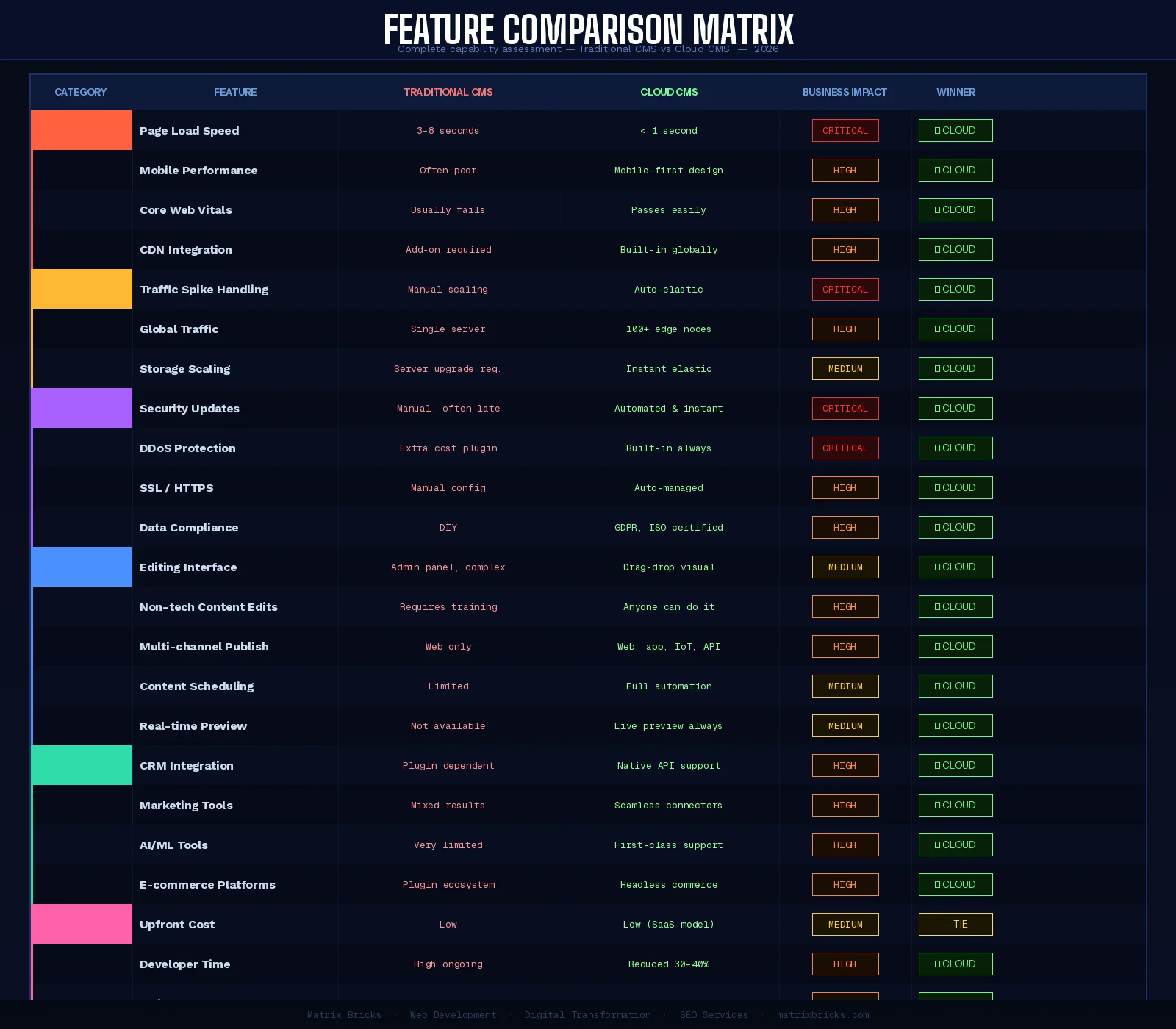
| Factor | Traditional CMS | Cloud-Based CMS |
| Performance | Limited by server capacity | CDN-optimized for global speed |
| Scalability | Manual upgrades required | Automatic elastic scaling |
| Security | Manual patching | Automatic security updates |
| Updates | Risk of downtime | Zero-downtime releases |
| Mobile Experience | Often inconsistent | Mobile-first by design |
| Integrations | Plugin-heavy | API first architecture |
| Cost Model | Fixed plus maintenance | Pay-as-you-grow |
Is a Cloud CMS Right for Your Business?
You likely need a cloud content management system if your website has started to feel more like a bottleneck than a growth engine. Many businesses don’t realize they have outgrown their existing setup until performance issues begin affecting customers, teams, and revenue.You should seriously consider moving to a cloud-based CMS if:- Your website speed consistently exceeds three seconds, causing visitors to abandon pages before they even engage with your content or offerings.
- Traffic spikes from campaigns, product launches, or seasonal demand lead to crashes, errors, or noticeable slowdowns that hurt credibility.
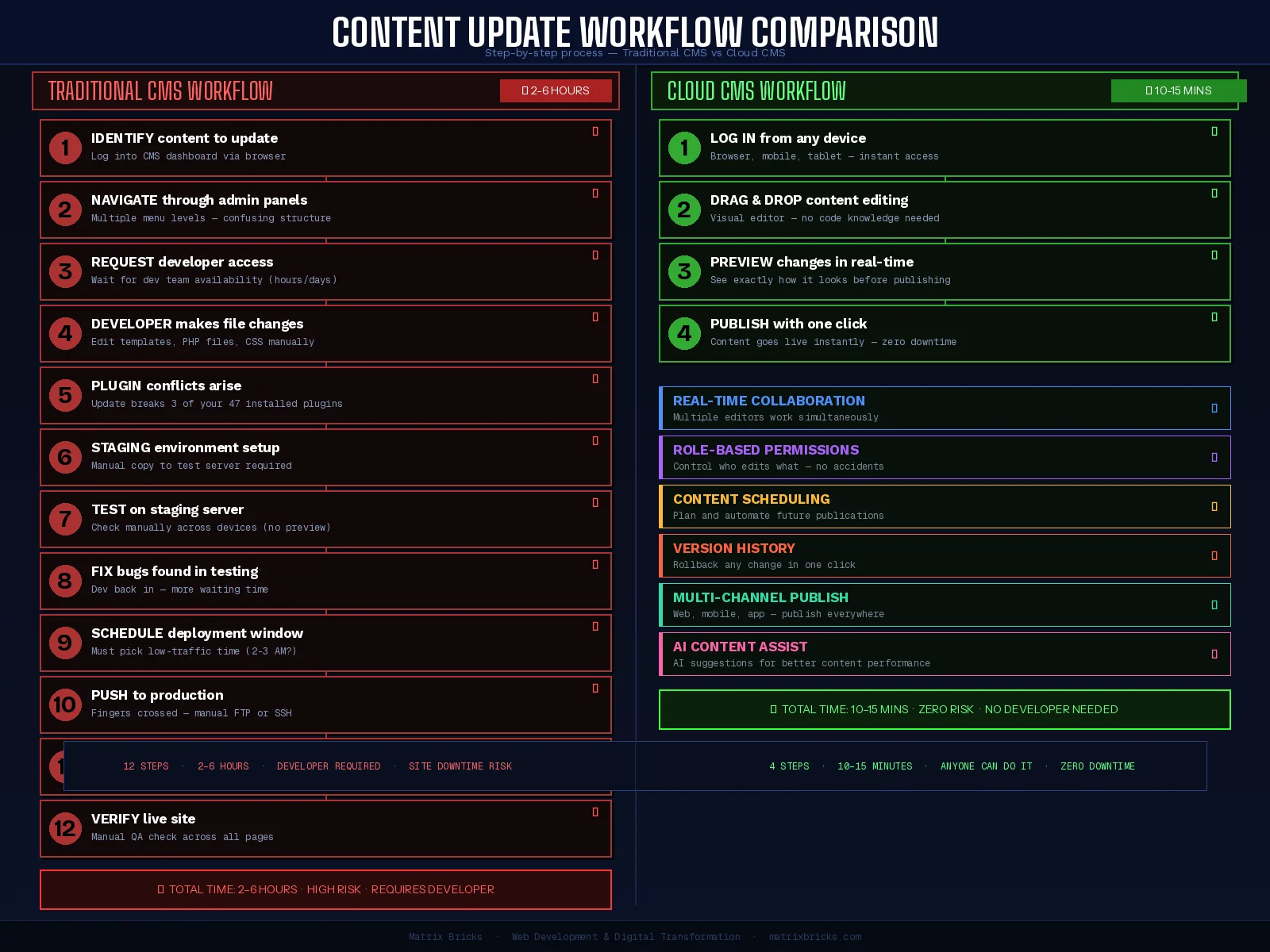
- Even simple content updates require developer involvement, slowing down marketing teams and delaying go-to-market timelines.
- Mobile performance lags behind expectations, creating friction for users who now make up the majority of website traffic.
- Bounce rates exceed 50 percent, signaling poor user experience and reduced engagement.
- SEO rankings are declining despite ongoing content efforts, often due to weak website performance and Core Web Vitals issues.
- Security concerns continue to surface, increasing risk and forcing reactive fixes instead of proactive growth.
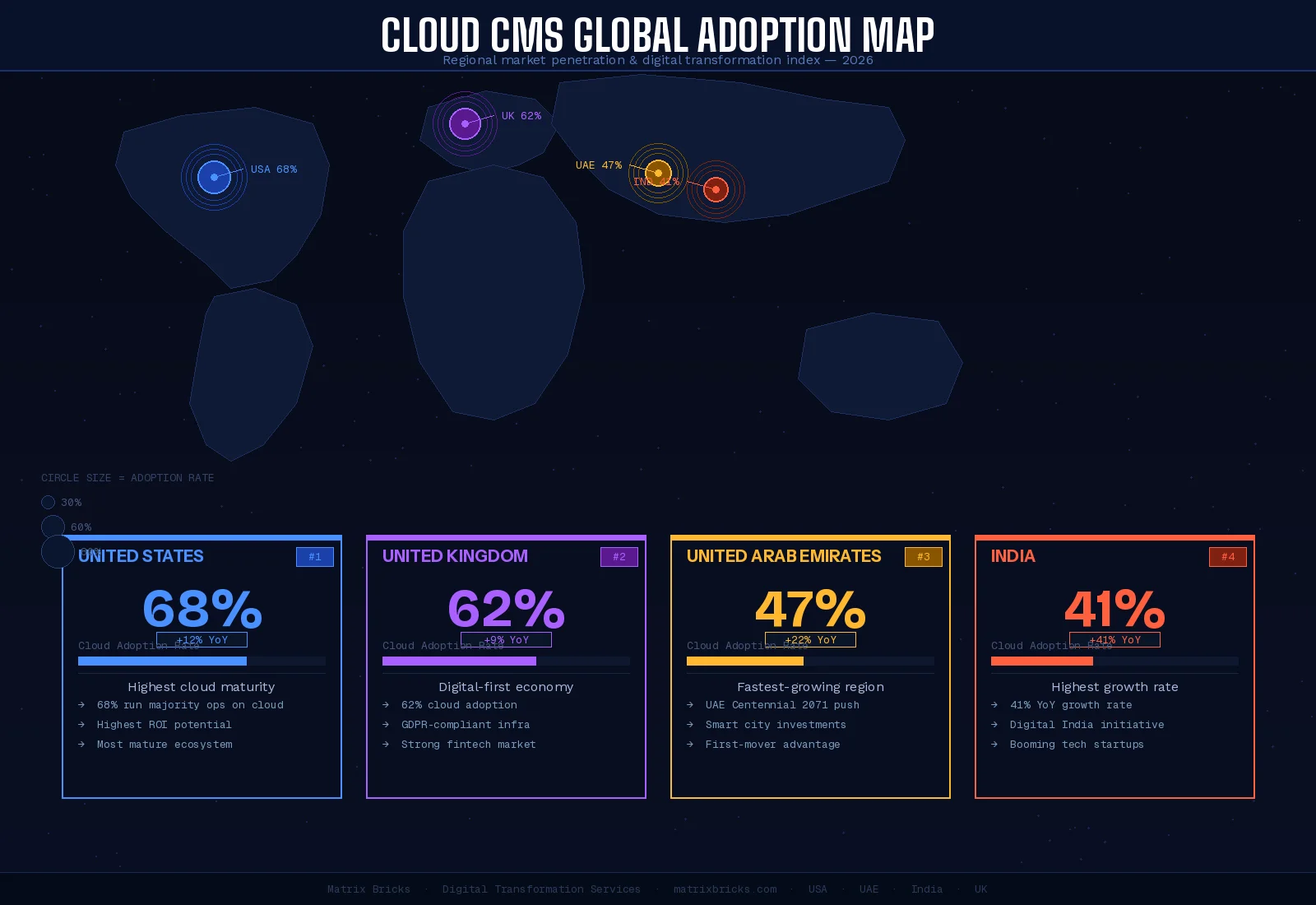
Regional Insights and Growth Opportunities
In the USA, cloud adoption stands at nearly 68 percent, making performance a key differentiator. Even a 100-millisecond delay can reduce sales by one percent.In the UAE, rapid digital transformation and smart city initiatives create strong incentives for cloud-native platforms.India’s fast-growing startup ecosystem relies on scalability and cost efficiency, making cloud-based CMS adoption a strategic advantage.The UK market prioritizes website optimization and conversion performance in mature digital environments.How to Transition Without Risk
A successful migration follows a structured approach:- Assessment Evaluate website performance, Core Web Vitals, and integration needs.
- Platform Selection Choose solutions aligned with business goals and scalability.
- Migration Planning Map content, preserve SEO, and define APIs.
- Implementation Migrate in phases, test performance, and validate security.
- Optimization and Launch Fine-tune delivery, train teams, and gradually shift traffic.
Future-Proof Your Website Starting Now
Slow websites rarely fail overnight. They fail quietly through lost trust, missed conversions, frustrated teams, and stalled growth. As competitors modernize, standing still becomes increasingly expensive.A cloud content management system aligns website speed, scalability, security, and ROI into one growth-focused foundation. For businesses exploring advanced content management system solutions, performance-driven website development in USA, and long-term digital resilience, the shift is clear.This is where Matrix Bricks helps businesses move forward with confidence. With over 15 years of experience in digital transformation, web development, and SEO, Matrix Bricks supports organizations across the USA, India, UAE, and the UK in building faster, more resilient digital platforms.If your website is holding your business back, now is the time to optimize, modernize, and grow with purpose.Frequently Asked Questions
1. What is the biggest benefit of switching to a cloud CMS?
A cloud content management system delivers measurable performance improvements.- Faster website performance improves trust and engagement.
- Better scalability supports business growth.
- Teams publish and iterate faster without technical friction.
2. Does a cloud-based CMS help improve SEO rankings?
Yes, because website optimization improves across multiple factors.- Faster load times enhance Core Web Vitals.
- Mobile-first delivery matches search behavior.
- Cleaner integrations using API first architecture reduce errors.
3. Is a cloud CMS expensive for small businesses?
A cloud-based CMS is often more cost-effective long-term.- Lower maintenance and infrastructure costs.
- Reduced developer dependency.
- Pricing scales with usage rather than fixed limits.
4. Can cloud CMS support enterprise needs?
Modern content management system solutions are built for scale.- High availability and security.
- Global content delivery.
- Seamless integration with enterprise systems.