





 India
India  UK
UK  UAE
UAE 
What Your Business Can Learn From the World’s Largest Food Company
Here’s a question worth sitting with:
If one of the largest companies in the world operating across 190 countries, managing more than 2,000 brands, and generating nearly $91 billion in annual revenue felt the urgent need to completely rebuild its data foundation… what does that say about businesses still relying on disconnected spreadsheets and gut instinct?
That company is Nestlé. And what it has done over the past few years is nothing short of a masterclass in digital transformation and enterprise digital transformation at scale.
Whether you’re running an FMCG brand in the US, scaling a consumer goods company in the UAE, managing retail operations in India, or competing in the UK market the lessons from Nestlé’s data-driven decision making approach are not just relevant. They are increasingly essential.
The Problem With Operating at Massive Scale (And Why It’s Not Just a Big Company Problem)
Nestlé’s global footprint is enormous over 300 factories, operations in nearly every country, and a workforce of around 280,000 employees.
But with that scale comes a fundamental challenge: complexity.
Imagine trying to make a high-stakes decision like launching a new product in Southeast Asia when:
- Your supply chain data is stored in one system
- Financial data lives in another
- Demand forecasts are already outdated
This creates a fragmented view of reality and limits effective business intelligence and data analytics.
And while Nestlé operates at a massive scale, the underlying issue is universal.
Without a unified data foundation:
- Teams operate in silos
- Decision-making slows down
- Visibility disappears
- Opportunities are missed
In fast-moving markets, lack of real-time data and data integration creates a serious competitive disadvantage.
The Digital Core Upgrade: What Nestlé Actually Did
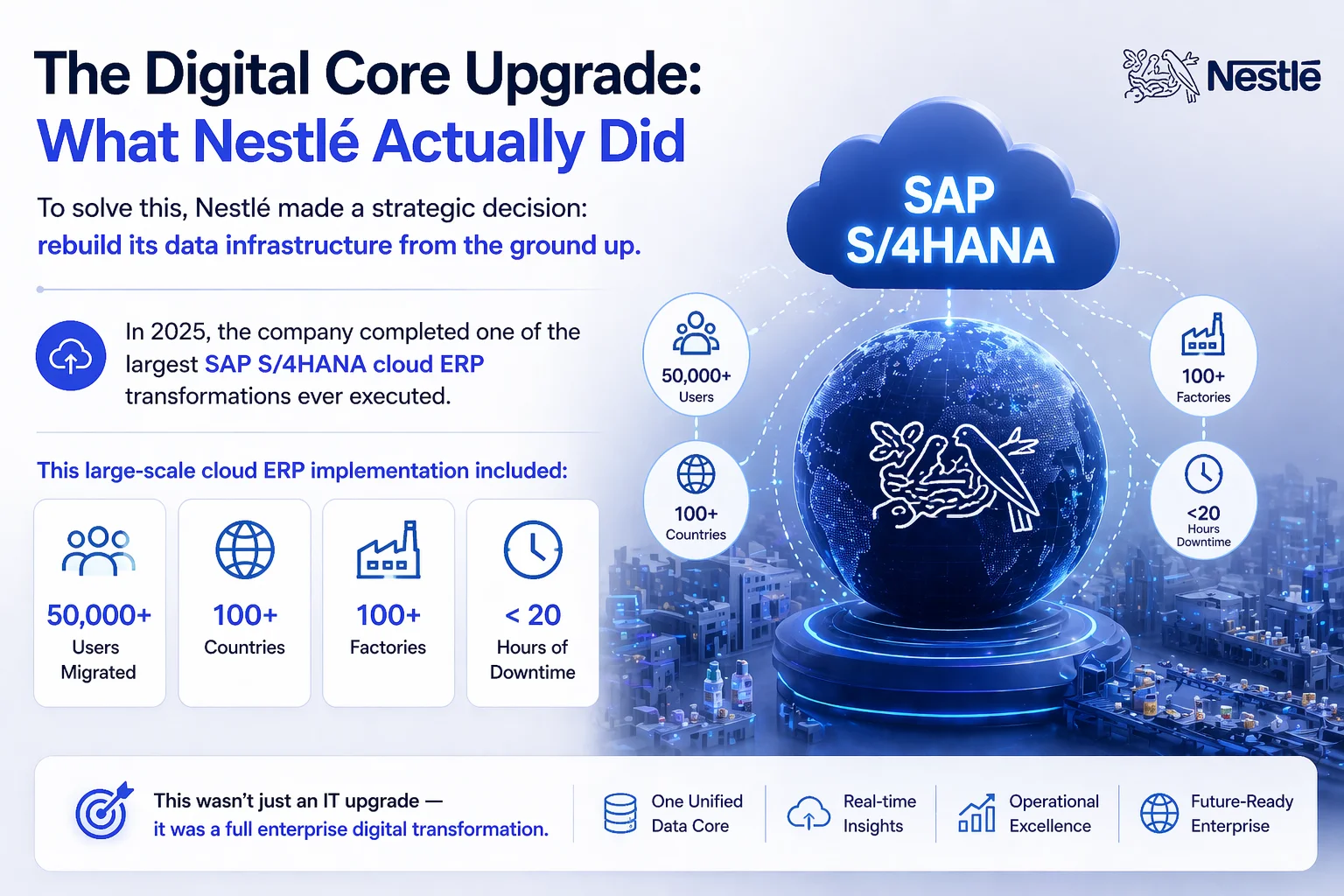
To solve this, Nestlé made a strategic decision: rebuild its data infrastructure from the ground up.
In 2025, the company completed one of the largest SAP S/4HANA cloud ERP transformations ever executed.
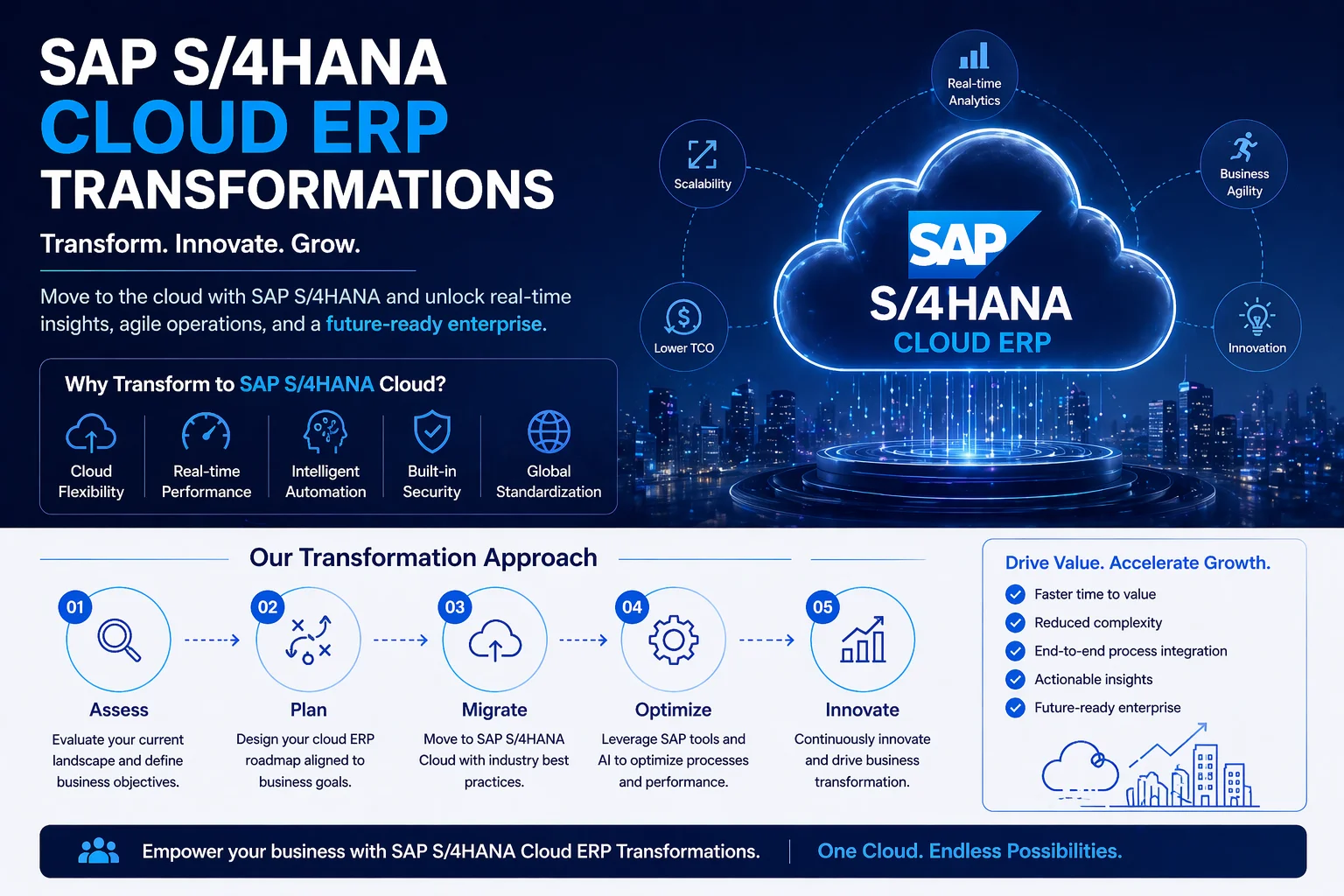
This large-scale cloud ERP implementation included:
- 50,000 users migrated
- 100+ countries
- 100+ factories
- Less than 20 hours of downtime
This wasn’t just an IT upgrade it was a full enterprise digital transformation.
Here’s a clear look at what the upgrade actually delivers:
| Capability | What It Means in Practice |
| Unified Digital Core | All data — finance, supply chain, manufacturing, HR — in one system |
| Real-Time Decision Making | Insights available instantly, not days later |
| AI Integration (Joule Copilot) | Employees get automated task support and instant answers |
| Demand Forecasting | Predict what consumers want before it becomes a trend |
| Smart Order Fulfillment | Match supply to demand in real time across 185 countries |
| Standardized Procurement | Global spend visibility and cost savings |
Turning Data Into Decisions: The Real Competitive Advantage
Many organizations invest heavily in data platforms, dashboards, and analytics tools yet continue to make decisions based on instinct or outdated reports.
Nestlé took a different approach.
It redefined the role of data from passive reporting to active decision-making.
With its digital core in place, Nestlé can now:
- Access real-time insights across the value chain
- Align supply with demand dynamically
- Execute faster across markets
A powerful example is its Available-to-Promise (ATP) system.
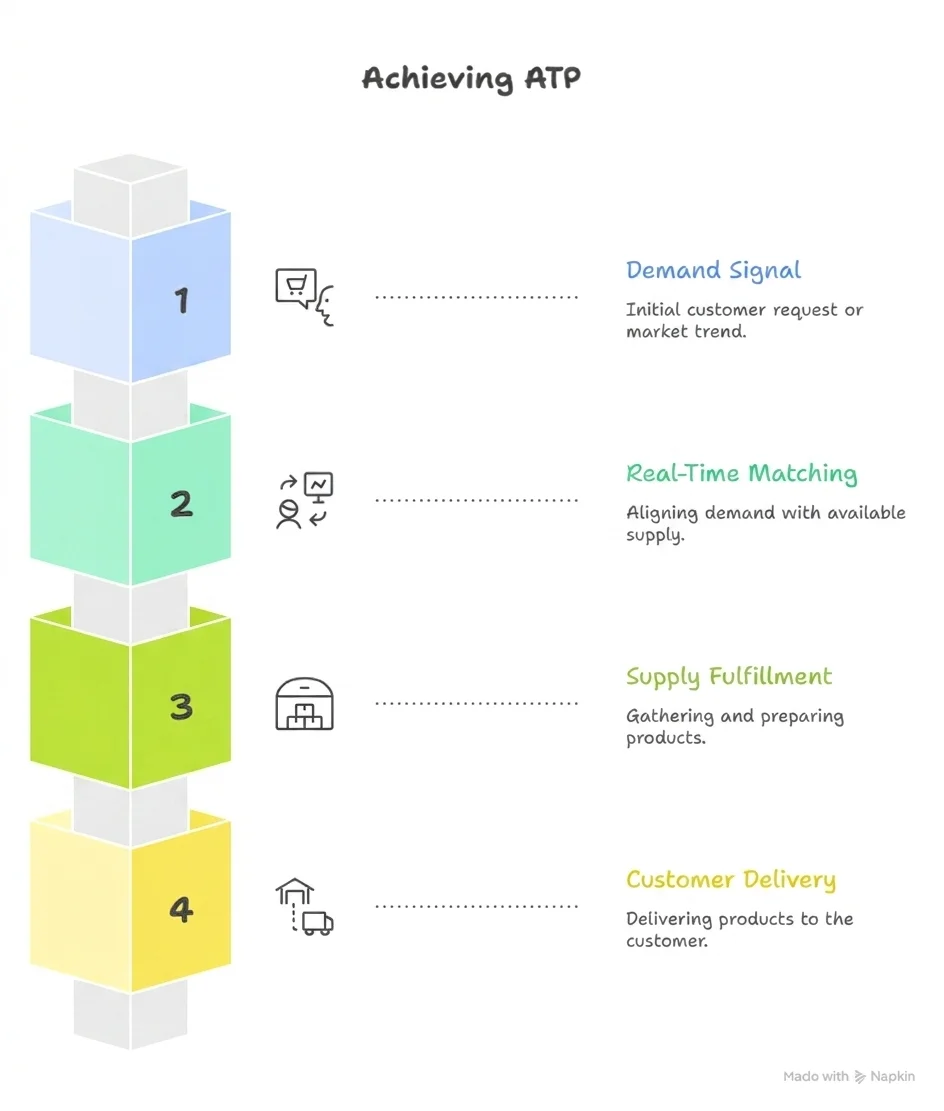
This next-generation capability allows Nestlé to match supply with demand in real time ensuring that products are available exactly when and where customers need them.
For a company selling products like coffee, confectionery, and packaged foods across diverse markets, this capability is transformative.
It means:
- Fewer stockouts
- Less overproduction
- Faster response to demand shifts
- Better customer satisfaction
In today’s environment, this is a practical application of AI in supply chain and predictive analytics in business.
AI and Automation: From Buzzwords to Business Value
Artificial intelligence is one of the most talked-about topics in business today.
But there’s a gap between talking about AI and actually using it effectively.
Nestlé sits firmly in the second category.
Nestlé has embedded AI in business processes using SAP’s Joule copilot.
This enables:
- Automation of routine tasks like journal entries and service requests
- Real-time insights delivered directly to employees
- Reduced manual workload across functions
Importantly, this approach doesn’t replace human expertise — it enhances it.
Employees spend less time on repetitive work and more time on:
- Strategic decision-making
- Supplier relationships
- Innovation and growth initiatives
That’s where real business value is created.
The business lessons here are clear:
| Business Function | Traditional Approach | Data + AI Approach |
| Inventory Management | React to stockouts after they happen | Predict and prevent them |
| Product Development | Long R&D cycles based on surveys | Real-time consumer trend data |
| Marketing | Broad campaigns for mass audiences | Personalized, behavior-driven outreach |
| Supply Chain | Static planning cycles | Dynamic, demand-responsive operations |
| Finance | Periodic reporting | Continuous, real-time visibility |
A Global Shift: Why This Matters Across Markets
Nestlé’s business transformation is not happening in isolation. It reflects a broader global shift toward data-driven business models.
Across key markets:
United States
FMCG companies are investing heavily in AI-driven supply chains, predictive analytics, and personalized customer experiences. The competitive bar is rising rapidly.
United Arab Emirates
With initiatives like Vision 2031, the UAE is accelerating its transition toward a knowledge-based economy. Digital transformation is becoming a strategic priority across industries.
India
As one of the fastest-growing FMCG markets in the world, India is seeing a surge in demand for data-driven operations. From legacy brands to D2C startups, companies are under pressure to modernize quickly.
United Kingdom
Post-Brexit supply chain complexity and the rise of direct-to-consumer models have made real-time data visibility a boardroom-level concern.
Across all these regions, one trend is clear:
Data is no longer a support function. It is the foundation of competitive advantage.
The Culture Shift Nobody Talks About. But Everyone Needs
Here’s the part that rarely gets enough attention:
Technology wasn’t the hardest part of Nestlé’s transformation.
Culture was.
Implementing new systems is a technical challenge.
Changing how people think and make decisions is a human one.
Nestlé didn’t just deploy new tools it built a data-driven culture:
- Data became accessible across all levels of the organization
- Decision-making shifted from intuition to insight
- Employees were empowered to act on real-time information
This cultural shift ensured that the technology investment actually delivered value.
Because even the most advanced systems are useless if people don’t use them.
For any business looking to follow Nestlé’s lead, the framework looks like this:
| Pillar | What It Requires |
| People | Training teams to interpret and act on data |
| Process | Redesigning workflows around insight-first decisions |
| Technology | A unified platform that makes data accessible, not siloed |
| Culture | Leadership that models data-driven behavior |
Real-World Case Studies: It’s Not Just Nestlé
Nestlé gets the headlines, but the playbook is being used across industries.
Unilever implemented a similar unified data platform and reduced product time-to-market by streamlining demand signals from over 190 markets. Their AI models now predict which products will succeed in which geographies before a single unit is manufactured.
HUL (Hindustan Unilever Limited) in India has built one of the most sophisticated real-time analytics infrastructures in the Indian FMCG space tracking sales data from millions of small kirana stores to make inventory and promotion decisions at near-instant speed.
P&G uses what they call a “Digital Cockpit” a unified dashboard that gives senior leaders real-time visibility into every market, every product line, and every supply chain constraint. It’s the same principle Nestlé is executing: one source of truth, accessible to everyone who needs it.
The common thread? All three started with a commitment to building a unified digital core before it became urgent.
What Businesses of Every Size Can Take From This
You don’t need 280,000 employees or a $44 billion cloud ERP market budget to apply these principles. The underlying strategy scales whether you’re a $10M brand or a $10B enterprise.
Here’s your action framework:
1. Audit your data silos first. Before you invest in any new tool, map out where your data lives today. Finance in QuickBooks, supply chain in Excel, CRM in one platform, marketing analytics in another? That’s your bottleneck and it’s costing you more than you realize.
2. Invest in a unified data foundation before it becomes urgent. Nestlé started this journey in 2022 and is still rolling it out today. The companies that wait for a crisis to force the issue always pay more in time, money, and lost market share.
3. Make AI practical, not theoretical. Start with automating the most repetitive, time-consuming processes in your business. Reporting, inventory alerts, demand forecasting, customer segmentation. Build confidence in AI tools before you tackle transformation.
4. Pair technology with training. Every technology rollout that fails does so for the same reason: the tools were deployed but the people weren’t brought along. Build change management into every implementation from day one.
5. Measure what matters. Define your KPIs before you start. Faster product launches? Reduced waste? Improved forecast accuracy? Your data strategy needs a business outcome tied to it or it stays a cost center instead of becoming a competitive weapon.
The Bottom Line: Data Is No Longer Optional
Nestlé’s story isn’t just about ERP systems or technology upgrades. It’s not even about SAP or cloud transformation in isolation.
It’s about something far more fundamental:
A global enterprise choosing to put data at the center of every decision and executing that vision with discipline.
What makes this transformation remarkable isn’t the tools it’s the intent and consistency behind them. Turning data into a strategic asset requires more than implementation. It demands:
- Organizational alignment
- Process standardization
- Long-term commitment to digital maturity
And that’s exactly what sets this benchmark apart.
The ripple effects of this shift will extend far beyond one company. Across the FMCG landscape, every competitor, supplier, and growing brand will feel the pressure to evolve.
Because in the next decade, growth won’t be driven by scale alone—it will be driven by how intelligently businesses use their data.
The Real Question for Your Business
The question is no longer whether to become data-driven.
It’s much simpler and more urgent:
Will you lead the transformation, or be forced into it later?
Across markets like the US, UAE, India, and the UK, the fastest-growing companies already share a common mindset:
They don’t treat data as a byproduct of operations.
They treat it as the engine that powers growth, innovation, and decision-making.
Where Matrix Bricks Comes In
At Matrix Bricks, we understand that digital transformation is not just about adopting new tools it’s about redefining how your business operates, competes, and grows.
Our approach goes beyond implementation:
- We help businesses build data-driven decision making
- Align technology with business intelligence tools
- Enable smarter, faster, and more scalable decision-making
Whether it’s modernizing your digital infrastructure, optimizing customer journeys, or integrating intelligent systems, we ensure your transformation is:
- Strategic
- Scalable
- Future-ready
Final Thought
The companies that will dominate the next decade aren’t just the ones with the best products they’re the ones with the best AI in business processes.
The shift has already begun.
The leaders are already moving.
The only question left is: Will you lead with data-driven innovation — or struggle to catch up later?
Frequently Asked Questions
1. What is a unified digital core and why does it matter for FMCG businesses?
A unified digital core is a single, integrated platform that connects all the business data finance, supply chain, manufacturing, and HR into a real-time system. For FMCG businesses, it eliminates data silos and accelerates decision-making and enables AI-driven capabilities like demand forecasting and smart order fulfillment. Nestlé’s SAP S/4HANA implementation across 100+ countries is a prime example of how this approach creates measurable competitive advantage.
2. How is AI being used in FMCG supply chain management today?
Leading FMCG companies like Nestlé, Unilever, and P&G are using AI to predict demand shifts, prevent stockouts, automate procurement, and match supply to consumer demand in real time. Tools like SAP’s Joule AI copilot can automate routine tasks like journal entries and service requests, freeing teams to focus on strategic growth.
3. What is data-driven decision-making and how can businesses implement it?
Data-driven decision making means replacing all the outdated reports with real-time, unified business intelligence. Implementation starts with auditing existing data silos, investing in a centralized data platform, training employees to act on insights, and tying every data initiative to a measurable business outcome like forecast accuracy or reduced waste.
4. What are the biggest challenges of enterprise digital transformation at scale?
Beyond technology, the biggest challenge is cultural change, to get employees at every level to shift from intuition-based to insight-based decisions. Nestlé’s transformation succeeded because it paired its SAP cloud ERP rollout with organization-wide training, process redesign, and leadership that actively modeled data-driven behavior.
5. Can small and mid-sized businesses apply the same data strategy as Nestlé?
Absolutely. The core principles unifying data sources, automating repetitive processes, and building a culture of insight scale to businesses of any size. A brand can start by consolidating its CRM, finance, and inventory data into one platform, automating reporting, and defining clear KPIs before expanding into predictive analytics or AI-powered tools.