





 India
India  UK
UK  UAE
UAE 
Artificial Intelligence is evolving faster than ever. Over the past few years, businesses have started using AI for content creation, automation, and decision-making. As this technology matures, new terms like Generative AI, AI Agents, and Agentic AI are becoming common in conversations around digital transformation.
However, many people still use these terms interchangeably, even though they represent different levels of intelligence and automation. Understanding the difference between them is important for businesses, marketers, developers, and decision-makers who want to leverage AI effectively.
This article explains what Generative AI, AI Agents, and Agentic AI are, how they differ, how they work together, and why they matter for the future of business and marketing.
The Evolution of AI: From Assistance to Autonomy
To understand these three concepts, it helps to look at how AI has evolved. Initially, AI tools were designed to assist humans by analyzing data and generating outputs. Over time, these tools became capable of performing tasks automatically. Now, AI is moving toward systems that can plan, decide, and execute actions with minimal human involvement.
This evolution can be viewed in three stages:
- Generative AI – Creates content based on prompts
- AI Agents – Performs tasks using instructions and tools
- Agentic AI – Acts autonomously to achieve defined goals
Each stage builds upon the previous one, making AI more powerful and more independent.
What is Generative AI?
Generative AI refers to artificial intelligence systems that can create new content such as text, images, audio, video, or code. These models are trained on large datasets and learn patterns that allow them to generate outputs similar to human-created content.
Generative AI works when a user provides a prompt. Based on that input, the system generates a response. However, it does not take actions beyond content creation. It does not plan tasks, execute workflows, or make decisions independently.
This makes Generative AI extremely useful for content-related tasks but limited when it comes to automation.
Key Characteristics of Generative AI
Generative AI is designed primarily for creation. It responds to prompts and generates outputs quickly. However, it relies heavily on user instructions and does not operate independently.
Some key characteristics include:
- Generates text, images, videos, and code
- Requires prompts to function
- Does not perform real-world actions
- No autonomous decision-making
- Best suited for content generation and ideation
Examples of Generative AI in Business
Generative AI is widely used across industries. Some common use cases include:
- Writing blog posts and website content
- Creating product descriptions
- Generating ad copy
- Designing social media captions
- Creating images and visual assets
- Writing email drafts
- Generating code snippets
- Summarizing documents
In digital marketing and SEO, Generative AI is often used to speed up content production, brainstorm ideas, and draft initial versions of content.
However, once the content is generated, a human or another system still needs to review, optimize, publish, and track performance. This is where AI Agents come into play.
What are AI Agents?
AI Agents are systems that can perform tasks by combining reasoning, memory, and tool usage. Unlike Generative AI, which only produces content, AI Agents can execute multi-step workflows.
An AI Agent receives a goal or instruction and then uses available tools to complete the task. These tools may include search engines, databases, APIs, automation platforms, or internal systems.
AI Agents can also maintain context across steps, making them capable of handling more complex processes.
Key Characteristics of AI Agents
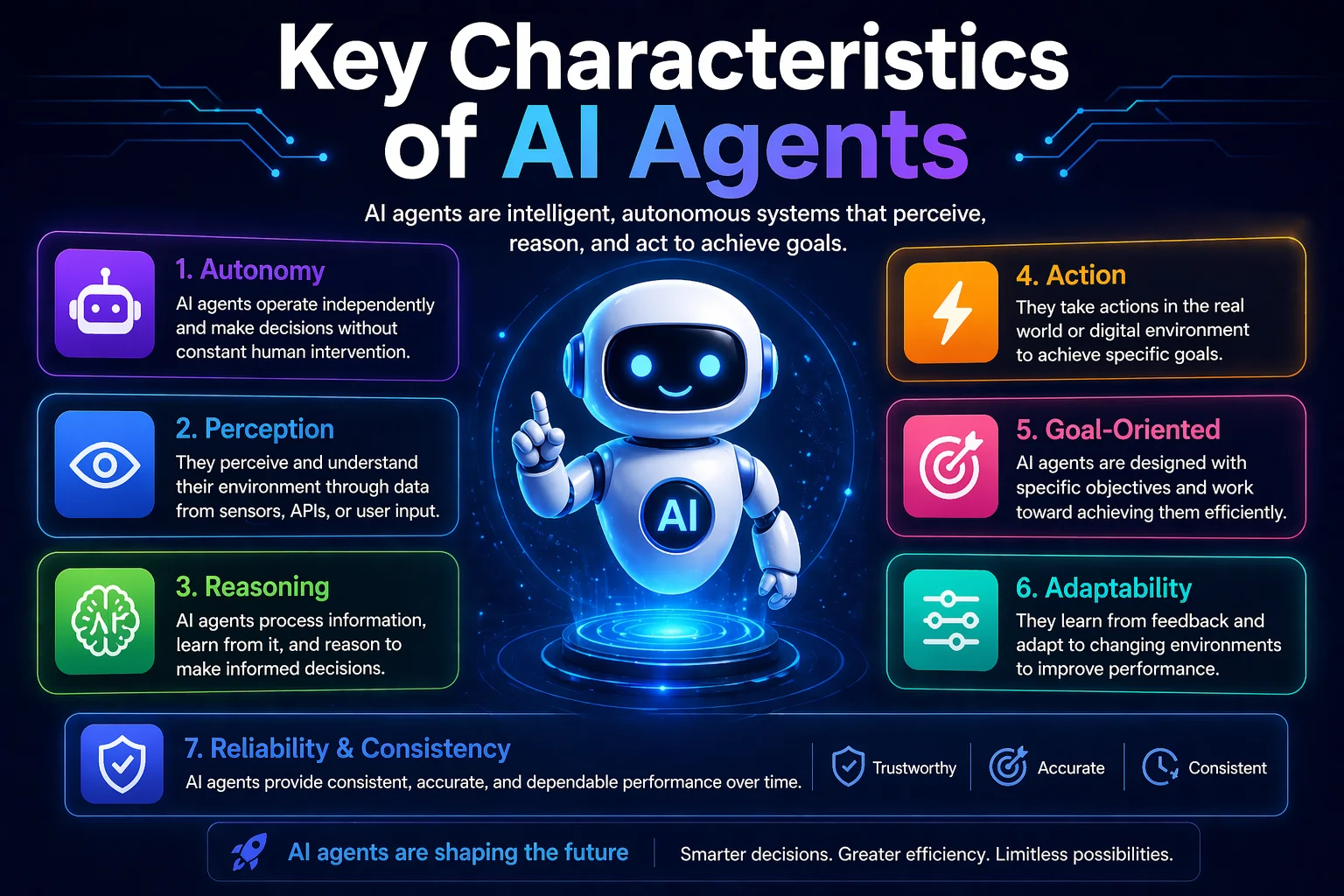
AI Agents introduce automation and task execution. They can work through a series of steps to achieve a specific outcome.
Key characteristics include:
- Executes tasks based on goals
- Uses tools and integrations
- Handles multi-step workflows
- Maintains context and memory
- Limited autonomy
- Requires defined instructions
Examples of AI Agents in Action
AI Agents are increasingly used in business operations. Some examples include:
- Automating keyword research for SEO
- Monitoring website performance
- Scheduling meetings
- Sending automated follow-up emails
- Generating reports
- Publishing blog content automatically
- Responding to customer queries
- Managing CRM updates
For example, an AI Agent can take a keyword, generate content using Generative AI, optimize the content, and publish it to a CMS. This entire workflow can be automated with minimal human intervention.
However, AI Agents still operate within defined rules. They follow instructions but do not independently create strategies or redefine goals. This is where Agentic AI comes in.
What is Agentic AI?
Agentic AI represents the next evolution of artificial intelligence. These systems are designed to operate autonomously, meaning they can plan, decide, and execute actions independently to achieve broader objectives.
Instead of simply following instructions, Agentic AI systems understand goals and determine the best way to achieve them. They can break down complex objectives into smaller tasks, coordinate multiple agents, and continuously optimize outcomes.
Agentic AI introduces a higher level of intelligence, where AI systems behave more like decision-makers rather than assistants.
Key Characteristics of Agentic AI
Agentic AI focuses on autonomy and goal-driven behavior. These systems can manage complex workflows with minimal supervision.
Key characteristics include:
- Goal-based decision making
- Autonomous planning and execution
- Multi-agent coordination
- Continuous optimization
- Minimal human intervention
- Adaptive learning capabilities
Examples of Agentic AI in Business
Agentic AI can transform how businesses operate. Some potential use cases include:
- Managing end-to-end SEO strategy
- Running full marketing campaigns automatically
- Optimizing paid ad performance in real time
- Handling customer journey automation
- Managing content strategy and publishing schedules
- Monitoring competitors and adjusting tactics
- Running business analytics and decision-making workflows
For example, an Agentic AI system could be given a goal such as “increase organic traffic by 30%.” It could then:
- Conduct keyword research
- Plan content strategy
- Generate content
- Optimize on-page SEO
- Publish articles
- Build internal links
- Monitor rankings
- Adjust strategy based on performance
This level of automation goes far beyond traditional AI tools.
Generative AI vs AI Agents vs Agentic AI: Key Differences
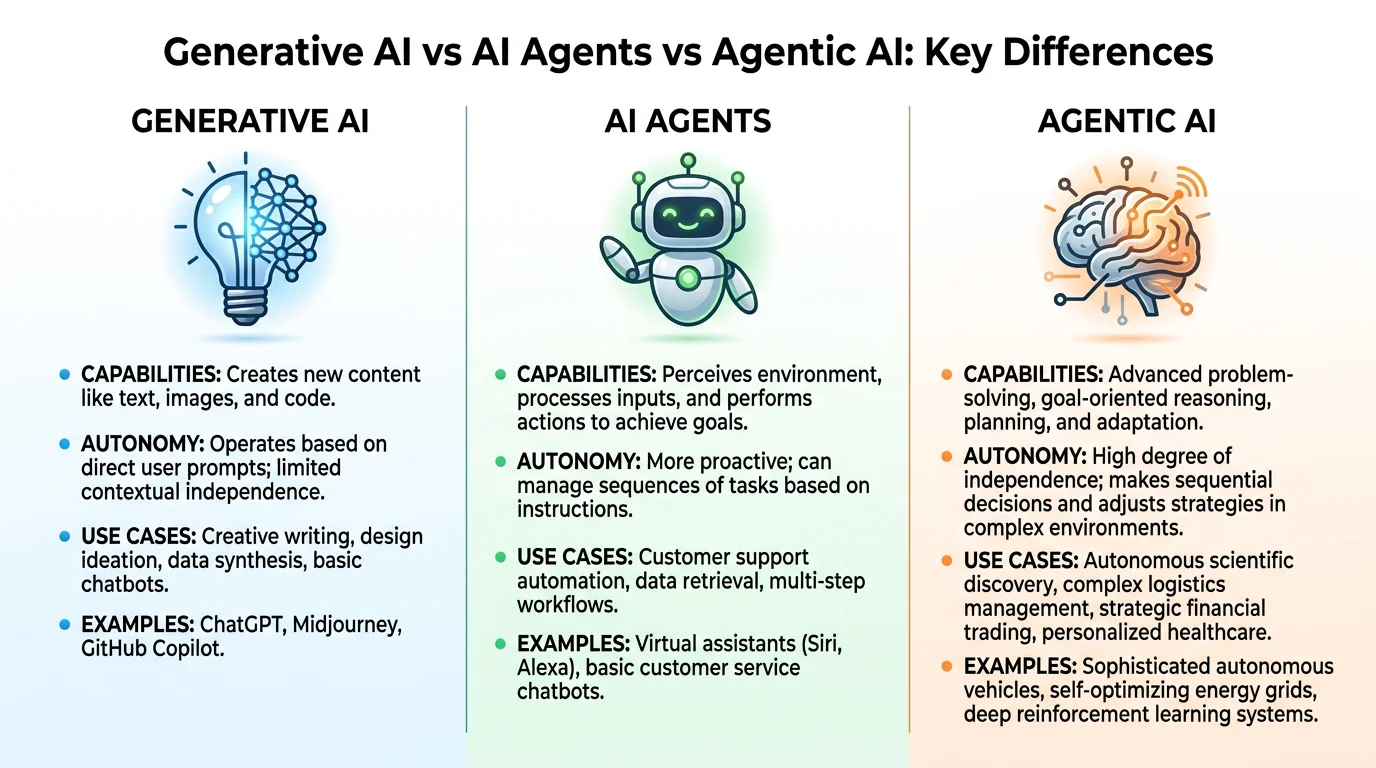
The main difference between these three lies in their level of autonomy and functionality.
Generative AI focuses on creation. AI Agents focus on execution. Agentic AI focuses on strategy and autonomous decision-making.
Here is a simplified comparison:
- Generative AI creates content but does not act
- AI Agents execute tasks but follow defined instructions
- Agentic AI plans, decides, and executes independently
Another way to understand it is:
- Generative AI = Assistant
- AI Agent = Task Executor
- Agentic AI = Autonomous Operator
Each layer adds more intelligence and independence.
How These Technologies Work Together
These technologies are not competing with each other. Instead, they work best when combined.
A typical workflow might look like this:
- Generative AI creates blog content
- AI Agent optimizes and publishes the content
- Agentic AI manages the overall SEO strategy
This layered approach allows businesses to automate processes while maintaining control over strategic goals.
In many real-world implementations, Agentic AI systems use multiple AI Agents, which in turn use Generative AI models to produce outputs. This creates a hierarchical structure of intelligence.
Why Understanding This Difference Matters
Understanding these distinctions helps businesses choose the right AI tools for their needs.
If a company only needs content creation, Generative AI may be enough. If they want to automate repetitive tasks, AI Agents are more suitable. If they aim to fully automate workflows and decision-making, Agentic AI becomes the ideal solution.
Choosing the wrong type of AI can lead to unrealistic expectations or underutilization of technology.
For example, expecting Generative AI to manage an entire marketing campaign will not work. Similarly, using Agentic AI only for content generation would be inefficient.
Impact on SEO and Digital Marketing
These AI advancements are already reshaping SEO and digital marketing.
Generative AI is speeding up content creation. AI Agents are automating technical SEO tasks. Agentic AI is beginning to manage strategy and performance optimization.
This shift means marketers will move from manual execution to strategic oversight. Instead of performing tasks, they will guide AI systems and define business goals.
Some expected impacts include:
- Faster content production
- Automated SEO audits
- Intelligent keyword targeting
- Dynamic content updates
- Autonomous campaign optimization
- Real-time performance adjustments
Businesses that adopt these technologies early will gain a competitive advantage.
The Future of AI: Moving Toward Autonomous Systems
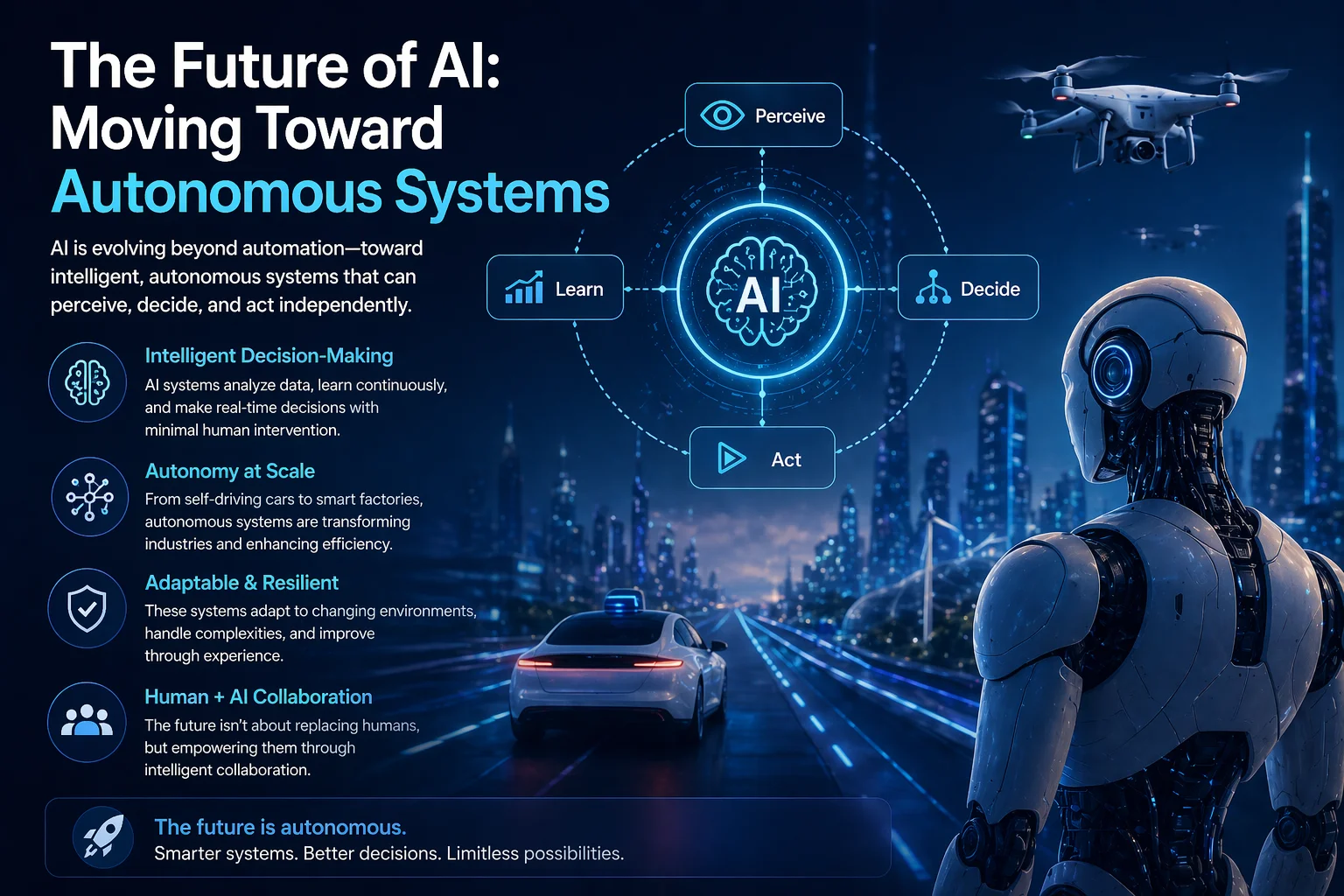
AI is clearly moving toward autonomy. The transition from Generative AI to Agentic AI represents a shift from assistance to independence.
In the near future, businesses may rely on AI systems that:
- Manage marketing campaigns
- Optimize websites automatically
- Handle customer interactions
- Monitor performance metrics
- Make data-driven decisions
Human roles will evolve to focus on strategy, creativity, and oversight rather than execution.
Conclusion
Generative AI, AI Agents, and Agentic AI represent the next phase in the evolution of artificial intelligence and automation. While Generative AI focuses on content creation, AI Agents automate specific tasks, and Agentic AI brings autonomous decision-making and strategic execution.
Together, these technologies are transforming how businesses approach SEO, digital marketing, and digital transformation. Organizations that adopt AI-driven workflows can improve efficiency, scale content production, automate optimization, and make smarter data-driven decisions.
However, implementing AI effectively requires the right strategy, tools, and expertise. This is where Matrix Bricks can help.
Matrix Bricks provides AI-powered digital marketing, SEO, and digital transformation services designed to help businesses leverage Generative AI, AI Agents, and Agentic AI in practical ways. From building AI-driven SEO strategies to automating marketing workflows and optimizing performance, the team focuses on delivering measurable growth using advanced AI technologies.
Whether you want to improve search visibility, automate repetitive marketing tasks, or implement AI-driven decision-making, Matrix Bricks helps organizations transition from traditional marketing to intelligent, AI-powered digital ecosystems.
As AI continues to evolve, businesses that embrace Generative AI, AI Agents, and Agentic AI today will be better prepared for the future of search, automation, and digital growth.
Frequently Asked Questions
What is the difference between Generative AI and Agentic AI?
Generative AI focuses on creating content such as text, images, or code based on prompts. Agentic AI goes further by planning, making decisions, and executing tasks autonomously to achieve specific goals.
How are AI Agents used in SEO?
AI agents can automate keyword research, technical SEO audits, internal linking, content optimization, and performance tracking. They help streamline repetitive SEO workflows.
Is Agentic AI the future of digital marketing?
Yes, Agentic AI is expected to play a major role in digital marketing by managing campaigns, optimizing SEO strategies, analyzing data, and improving performance with minimal human intervention.
Can Generative AI replace SEO professionals?
Generative AI assists SEO professionals by speeding up content creation, but it cannot replace strategic thinking, decision-making, and business understanding required for effective SEO.
How do Generative AI, AI Agents, and Agentic AI work together?
Generative AI creates content, AI Agents execute tasks such as publishing and optimization, and Agentic AI manages the overall strategy and workflow automation.
Why is Agentic AI important for AI SEO?
Agentic AI enables automated SEO strategy planning, real-time optimization, and data-driven decisions, making AI SEO more scalable and efficient.