

 India
India  UK
UK  UAE-English
Have you ever tried to cancel an online subscription and found yourself clicking through page after page before you could finally exit?
Or rushed to complete a purchase because a website warned you that the deal would disappear in two minutes, only to realise the same timer appears every time you visit?
These experiences are not accidental. They are often the result of dark patterns in website design. These design tactics subtly influence users to make decisions that benefit the business rather than the user.
Many companies use these techniques without realising the ethical and legal risks they create. What may seem like clever marketing can quickly turn into a manipulative UX design that damages customer trust and attracts regulatory scrutiny.
Today, discussions around dark patterns in UX, dark UX design, and dark patterns in websites are becoming increasingly important for businesses that operate online.
If you manage a digital platform, these questions are becoming harder to ignore.
- Are your design choices encouraging users or quietly pushing them toward decisions?
- Could some conversion tactics fall under unethical UX patterns?
- Are regulators beginning to view certain interfaces as user experience manipulation?
In this blog, we will explore how dark pattern UX works, examine real dark patterns examples, understand the growing focus on dark pattern regulation, and, most importantly, learn how businesses can design ethical digital experiences that still perform well.
What are dark patterns in website design?
Dark patterns in website design refer to user interface techniques that guide users toward actions they may not have chosen if the options were presented clearly.
The term was introduced by a UX researcher to describe deceptive digital design practices that prioritise business goals over user interests.
In simple terms, dark UX occurs when design choices are intentionally structured to make certain actions easier and others harder.
Instead of helping users make informed decisions, these designs rely on psychological triggers that push users toward purchases, subscriptions, or data sharing.
How dark patterns influence behaviour
Digital design has a powerful behavioural influence. Even small layout changes can affect how users think and act.
Common tactics used in dark UX pattern strategies include:
- Artificial urgency that pressures users to act quickly
- Hidden information that appears only at the final stage
- Default selections that enrol users automatically
- Complicated exit processes that discourage cancellations
These tactics create user experience manipulation because users are guided subtly rather than informed clearly.
Why these patterns are hard to detect
One reason dark patterns in UX are difficult to identify is that they often look like ordinary design choices.
Many users only realise something is wrong after they have already taken an action they did not intend to.
For example:
- A subscription renewal that appeared automatically
- Additional products added to a shopping cart
- A cancellation process that seems impossible to complete
These experiences may appear small individually, but when repeated across millions of users, they can create significant ethical and legal concerns.
Why are dark patterns considered unethical?
Good user experience design is built on transparency, fairness, and user control. When these principles are ignored, design can start influencing decisions in ways that primarily benefit the platform rather than the user.
Although dark UX design may improve short-term conversions, the ethical concern arises when users are not given a clear and genuine choice.
Here are some common reasons why dark patterns in website design are considered problematic:
- Users may unknowingly subscribe to services or agree to data sharing because important information is hidden or unclear.
- Many patterns UX strategies rely on psychological triggers such as urgency, fear of missing out, or guilt to push users toward decisions.
- Interfaces sometimes make it very easy to join a service but unusually difficult to cancel or leave.
- Visual design elements such as colour contrast, button placement, or wording can subtly steer users toward one option over another.
Why ethical UX matters for businesses
Companies that rely on dark UX patterns examples may see quick results, but the long-term consequences can be damaging.
Ethical UX helps businesses achieve:
- Higher customer satisfaction
- Long-term brand credibility
- Sustainable user engagement
- Stronger customer loyalty
As digital users become more aware of unethical website design, transparency is quickly becoming a competitive advantage.
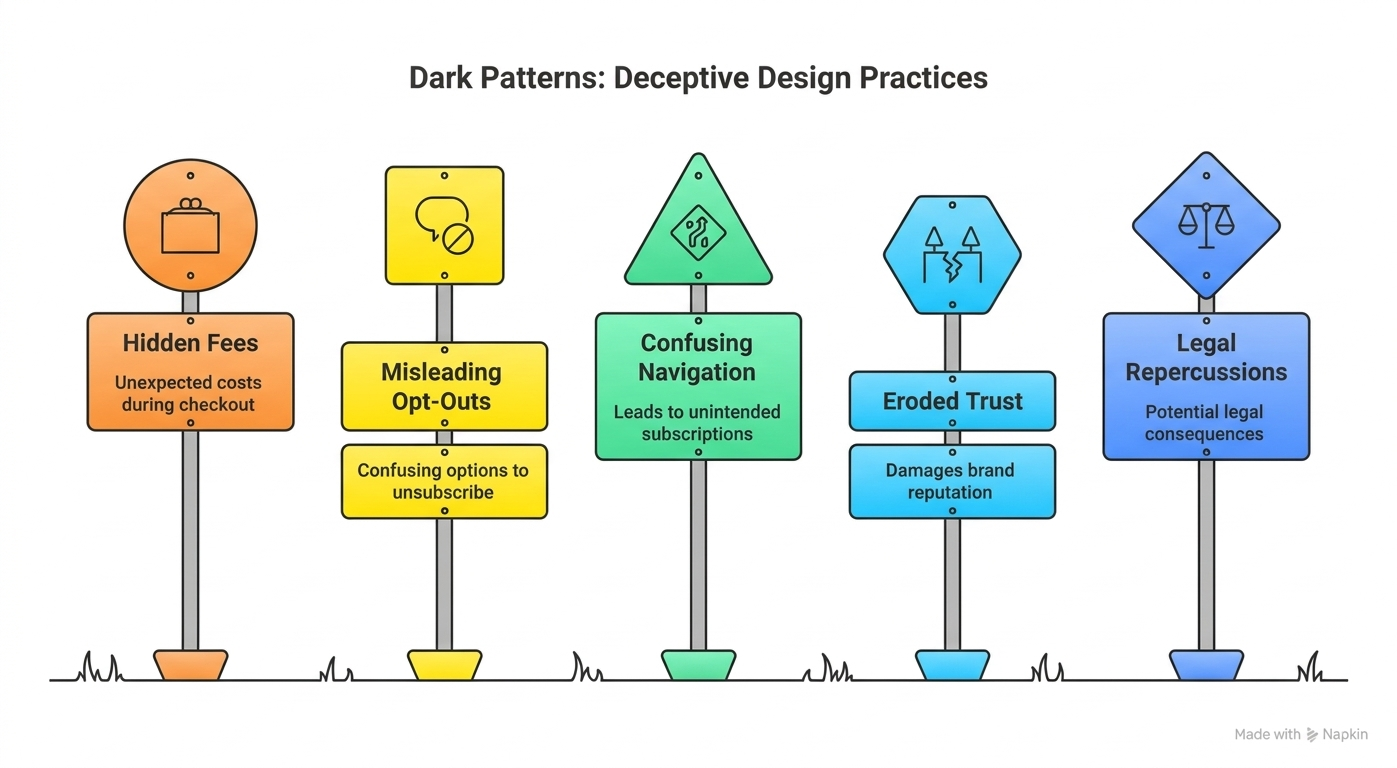
What are common examples of dark patterns?
Most internet users encounter dark patterns in websites regularly, especially on e-commerce and subscription platforms. Below are some widely recognised dark patterns examples used across digital interfaces.
Common dark UX patterns
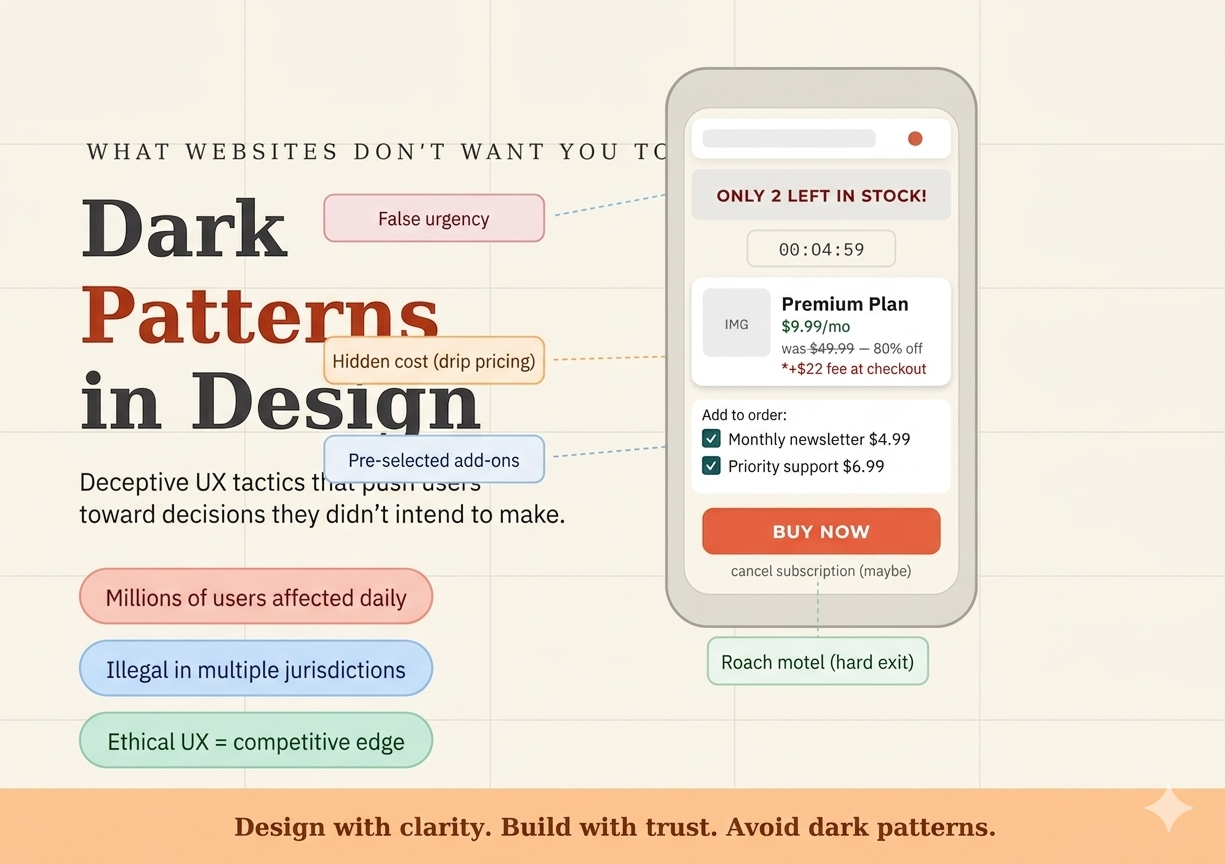
- False urgency
Platforms create artificial pressure through countdown timers or stock alerts like “Only 3 items left.” These messages push quick decisions even when the same offer appears again later. - Hidden costs
Extra charges appear only at the checkout stage after users have invested time in the purchase. This tactic, known as drip pricing, makes the product seem cheaper at first. - Roach motel design
Signing up is simple, but cancelling a service involves several confusing steps. This discourages users from leaving the platform. - Pre-selected options
Additional services or add-ons are automatically selected in the cart. Users must remove them manually before completing the purchase. - Confirm shaming
The interface uses guilt-based language like “No thanks, I prefer paying full price” to push users toward accepting offers. - Disguised advertisements
Promotional content is presented as system alerts or recommendations, making it difficult for users to recognise it as advertising.
Quick comparison of ethical and dark UX
| Design approach | User experience | Business outcome |
| Transparent UX | Clear pricing and choices | Builds trust |
| Ethical persuasion | Helps users make decisions | Long-term engagement |
| Dark patterns in website design | Confusing flows or hidden details | Short-term conversions |
| Honest consent | Users understand data usage | Stronger customer loyalty |
This comparison shows why many companies are moving away from unethical website design.
Are dark patterns illegal?
The legal status of dark patterns in website design is evolving rapidly. While not every manipulative interface is illegal, regulators worldwide are increasingly treating certain tactics as deceptive practices.
In India, guidelines introduced in 2023 address dark pattern regulation under the consumer protection framework. These rules identify several practices that may be considered unfair trade practices, including:
- False urgency messages
- Subscription traps
- Basket sneaking
- Confirm shaming
- Hidden pricing structures
- Disguised advertisements
Businesses using manipulative UX design may therefore face regulatory scrutiny. These practices can also raise concerns under consumer protection, data protection, advertising standards, and competition law. As enforcement strengthens, dark patterns in UX are increasingly seen as a significant compliance risk for digital platforms.
How do dark patterns affect customer trust?
Trust is one of the most valuable assets for any online business. However, user experience manipulation can erode that trust quickly. While customers may initially comply with manipulative interfaces, repeated negative experiences often lead to frustration and disengagement.
Businesses often underestimate the long-term impact of dark UX design. Over time, these tactics can lead to:
- Loss of credibility when users discover hidden charges or misleading messages
- Higher churn rates as customers abandon platforms that feel manipulative
- Negative brand perception through reviews and social media feedback
- Reduced engagement once users become cautious about interacting with the platform
By contrast, companies that avoid dark patterns in websites and prioritise transparency often see stronger long-term outcomes. Trust becomes a key differentiator that drives retention, loyalty, and positive word of mouth.
How can businesses avoid using dark patterns?
Many organisations do not intentionally introduce dark patterns in website design. These issues often arise during aggressive conversion optimisation. The key is to adopt responsible UX practices that prioritise clarity and user choice.
Practical steps businesses can take
- Conduct regular UX audits
Review interfaces for potential dark UX patterns examples, especially in checkout journeys, subscription flows, consent prompts, and pricing displays. - Prioritise transparency
Show key information clearly and early instead of hiding details behind multiple clicks. - Simplify cancellations
Make it easy for users to leave services. Simple exit flows build trust. - Avoid artificial urgency
Use genuine promotions rather than pressure tactics like misleading timers. - Train teams on ethical design
Help designers and marketers understand how patterns UX influence behaviour to prevent unethical UX patterns.
Case Study: Simplifying a subscription platform
A global media platform noticed rising complaints about its subscription cancellation process.
Users had to navigate multiple pages before completing the process.
After analysing feedback, the company redesigned its interface.
Key changes included
- One-step cancellation
- Clear billing reminders
- Transparent subscription details
Within months, the company saw measurable improvements.
- Customer complaints dropped significantly
- User satisfaction scores improved
- Subscription renewals increased organically
This example shows how removing dark UX tactics can actually strengthen long-term growth.
Why are regulators focusing on dark patterns in digital platforms?
Digital platforms influence billions of decisions every day. From online shopping to app subscriptions, design choices shape how people interact with digital services. Because of this scale, dark patterns in websites can affect millions of users at once.
Governments are increasingly introducing dark pattern regulation for several reasons:
- Users may unknowingly make purchases or share personal data.
- Manipulative interfaces can give certain businesses an unfair competitive advantage.
- Confusing consent mechanisms can undermine data protection principles.
- Regulators want to maintain trust and transparency in digital environments.
Studies analysing thousands of platforms have also identified widespread dark UX patterns examples, highlighting the growing need for oversight.
What is the difference between persuasive design and dark patterns?
Not all behavioural design techniques are unethical. Persuasive design can help users make decisions more easily when applied responsibly. The key difference lies in transparency and intent.
Ethical persuasive design
- Product recommendations help users discover relevant options without pressure.
- Simple onboarding guidance helps users understand features and navigate the platform.
- Pricing and conditions are presented clearly so users can make informed decisions.
- Reminder notifications gently prompt users about unfinished actions without creating urgency.
These approaches support users rather than manipulating them.
Dark patterns
By contrast, dark patterns in UX push users toward specific outcomes through confusion or pressure.
- Costs appear only at the final checkout stage.
- Users are automatically enrolled into subscriptions or find it difficult to cancel.
- Leaving a service requires several confusing steps.
- Timers or alerts create artificial urgency to push quick decisions.
The distinction is simple. Ethical design helps users make informed choices, while dark UX design focuses on influencing decisions in favour of the platform. Businesses that understand this difference can create digital experiences that are both effective and trustworthy.
If your website focuses heavily on conversions, it is worth reviewing how design choices influence user behaviour. Small interface decisions can unintentionally introduce dark patterns in UX, affecting trust and compliance.
For guidance on building transparent, high-performing experiences that avoid dark patterns in website design, connect with Matrix Bricks today.
Frequently Asked Questions
1. What are dark patterns in UX?
Dark patterns in UX refer to interface strategies that guide users toward decisions through subtle pressure or confusion.
These techniques often involve user experience manipulation.
Common indicators include:
- Hidden pricing during checkout
- Pre-selected subscription options
- Difficult cancellation processes
- Artificial urgency messages
Recognising these patterns helps businesses design fairer digital experiences.
2. Why do companies use dark UX patterns?
Some organisations adopt dark UX patterns examples in an attempt to increase conversions or engagement.
However, these tactics can create long-term risks.
Businesses often use them to:
- Increase product purchases quickly
- Boost subscription sign-ups
- Reduce cancellation rates
- Collect more user data
Ethical design strategies generally lead to stronger customer loyalty.
3. How can users identify manipulative website design?
Spotting manipulative UX design becomes easier when users recognise certain warning signs.
Look for situations where:
- Prices increase suddenly at checkout
- Countdown timers create pressure
- Subscription cancellation is difficult
- Add-ons appear automatically in the cart
These signals often indicate dark patterns in websites.
4. Are dark patterns regulated by law?
Many governments are beginning to introduce dark pattern regulation to address deceptive digital design.
Regulators are focusing on practices such as:
- Hidden charges
- Forced subscriptions
- Misleading urgency messages
- Confusing consent mechanisms
As rules evolve, businesses may face penalties for unethical website design.
5. How can businesses create ethical UX design?
Avoiding dark UX design requires a focus on transparency and user respect.
Companies can improve their patterns UX strategies by:
- Displaying pricing and policies clearly
- Making subscription cancellations simple
- Providing honest promotional messaging
- Conducting regular UX reviews
These steps help replace unethical UX patterns with trustworthy digital experiences.