





 India
India  UK
UK  UAE
UAE 

Is Your Store Built to Scale or Just Survive?
You are driving traffic. You are investing in ads. You are improving product listings. Yet your revenue feels inconsistent.
Before blaming marketing, ask yourself something deeper. Is your platform limiting you?
Choosing the best CMS for e-commerce is one of the most critical decisions in your ecommerce website development journey. With global online buyers increasing every year, competition is tighter than ever. Your CMS directly affects:
- How fast does your website load during high traffic periods
- How effectively does your store support ecommerce SEO optimization
- How smoothly customers move from product pages to checkout
- How well your store integrates with tools during digital transformation ecommerce initiatives
If you have ever wondered what is CMS and why it matters so much in 2026, this blog will give you clarity. We will walk through what to look for, compare leading ecommerce CMS platforms 2026, and help you confidently choose the right CMS for online store growth.
Let us begin with the basics.
What Is CMS and Why It Has Become the Engine of Online Commerce
Many business owners still think a CMS is just a content editing tool. That definition is outdated. When asking what is CMS, think of it as the operational backbone of your online business. It manages how your website functions, not just how it looks.
A strong CMS for online store operations controls:
- How quickly pages load across devices and regions, which directly influences conversions and search rankings
- How easily customers search, filter, and discover products without friction
- How secure and stable the checkout process feels during transactions
- How efficiently your store connects with CRMs, marketing tools, payment gateways, and inventory systems
This is why discussions around ecommerce CMS platforms 2026 focus heavily on scalability, automation, and integrations. Businesses undergoing digital transformation ecommerce are no longer treating CMS selection as a minor technical step. It is a long-term infrastructure decision.
If the foundation is weak, growth becomes expensive and inefficient.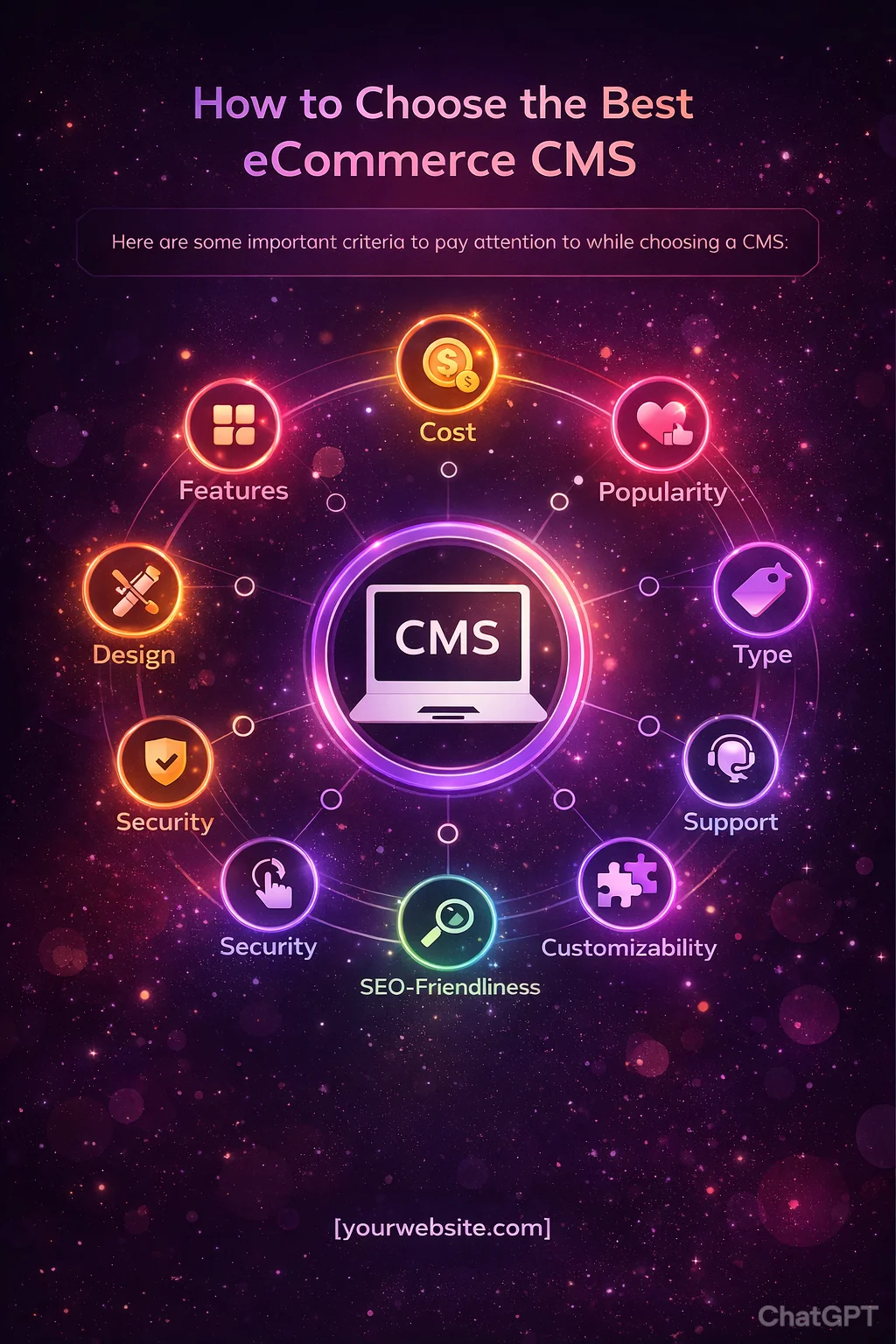
What to Look for When Choosing the Best CMS
When evaluating the best CMS for e-commerce, focus on core capabilities rather than surface features. These five pillars directly influence revenue, efficiency, search visibility, and customer trust.
Speed and Scalability
Speed shapes first impressions, while scalability protects growth. If your store slows down during peak campaigns, conversions drop quickly. A dependable CMS must balance performance and expansion readiness, including:
- Cloud infrastructure with auto scaling, keeping your store stable during sales spikes and high traffic campaigns.
- Optimized caching systems, ensuring large catalogs and filtered searches load smoothly across devices.
- Strong uptime backed by monitoring tools, reducing unexpected downtime and technical disruptions.
- Global delivery networks maintaining fast loading speeds for customers in different regions.
Scalability ensures your technology grows alongside your business.
Ease of Use and Operational Efficiency
A CMS should empower your team instead of increasing technical dependency. Faster execution improves agility and competitiveness. Platforms supported by professional web development services for ecommerce enhance workflow through:
- Visual editing tools for quick content updates, reducing reliance on developers for routine changes.
- Centralized dashboards for orders, inventory, and content, improving operational clarity.
- Built-in automation for emails and promotions, lowering manual workload and errors.
- Role-based permissions for secure collaboration, maintaining structure across teams.
Efficient systems translate into faster decision-making and execution.
SEO Capabilities
Search success depends on technical foundations. Without proper structure, visibility becomes expensive. A CMS built for ecommerce SEO optimization should offer:
- Control over URLs and metadata, enabling precise optimization for products and categories.
- Structured data supports improving eligibility for rich search results.
- Mobile first architecture, aligning with modern indexing standards.
- Logical internal linking frameworks, strengthening crawl efficiency and authority.
Strong SEO capabilities reduce dependence on paid traffic.
Security and Compliance
Customer trust depends on secure transactions and compliant data practices. A reliable CMS must include:
- PCI DSS compliance for payment security, protecting financial information.
- GDPR support for international customers, ensuring lawful data handling.
- DPDP compliance for Indian businesses, aligning with local regulations.
- Regular updates and automated backups minimizing cyber risks.
Security protects both revenue and brand credibility.
AI and Integration Capabilities
Modern ecommerce CMS platforms 2026 support intelligent automation and seamless connectivity. Businesses driving digital transformation ecommerce initiatives benefit from platforms that provide:
- AI-powered product recommendations, increasing average order value.
- CRM and marketing automation integrations, improving targeting and retention.
- Real-time inventory synchronization reduces overselling errors.
- Analytics dashboards with actionable insights, supporting strategic decisions.
Integrated intelligence turns your CMS into a true growth engine.
Platform Comparison for 2026
When conducting an ecommerce platform comparison 2026, these platforms are frequently evaluated for scalability, flexibility, and overall business fit.
- Shopify
Recognized for ease of use and fast deployment, Shopify suits businesses that want a quick launch with minimal technical complexity. Its hosted setup, built-in security, and strong app ecosystem make it ideal for growing brands. - WooCommerce
WooCommerce offers greater customization and control. Built on WordPress, it works well for businesses that are comfortable managing technical configurations or working with developers. - Magento
Magento is tailored for enterprise businesses with complex requirements. It supports large catalogs, advanced integrations, and custom workflows suited for high-volume operations. - BigCommerce
BigCommerce provides a balance between built-in features and scalability. It supports multi-channel selling and offers reliable performance for mid-sized to large brands. - Headless CMS Setups
Headless solutions enable high customization and omnichannel flexibility. They separate frontend and backend systems, allowing advanced digital experiences across platforms.
Quick Comparison Table
| Platform | Best For | Strengths | Investment Level |
| Shopify | Growing SMBs | Managed hosting, ease of use | Moderate |
| WooCommerce | Custom flexibility | WordPress integration, deep control | Low to Moderate |
| Magento | Enterprise brands | Advanced scalability, global support | High |
| BigCommerce | Scaling businesses | Built-in tools, multi-channel readiness | Moderate |
| Headless CMS | Custom ecosystems | Performance flexibility, omnichannel | High |
Case Study: How Gymshark Scaled Successfully
Gymshark’s rapid global expansion created performance challenges during high-traffic product launches. Website slowdowns began affecting conversions.
By investing in scalable infrastructure aligned with modern ecommerce website development practices, the brand achieved:
- Stable performance during major product drops
- Faster global page loading times
- Reduced checkout friction and lower cart abandonment
- Easier expansion into new international markets
The key lesson is simple. Choosing the best CMS for e-commerce allows growth to continue without technical limitations holding it back.
Final Thoughts Before You Decide
Choosing the best CMS for e-commerce is not about trends. It is about clarity and direction. Ask yourself one honest question: Will this platform still support my growth three years from now? And just as importantly, can it scale without forcing a costly rebuild later? If your CMS cannot support your digital transformation of ecommerce ambitions, it will eventually slow you down. Make a decision that protects your future, not just your present.
Conclusion
Your CMS influences speed, security, automation, and visibility. It shapes every customer interaction.
If you are planning new ecommerce website development or reconsidering your current setup, now is the time to make a strategic choice.
Need expert guidance to choose the right platform? Contact Matrix Bricks today and build a scalable online store designed for long-term growth.
Frequently Asked Questions
1. What is the best CMS for a small e-commerce business?
The answer depends on budget, technical comfort, and growth goals. When selecting a CMS for online store, consider:
- The total cost, including subscriptions, hosting, and extensions
- The level of customization your brand requires
- How easily your team can manage updates without external support
- Whether the platform can scale as traffic increases
Shopify is often preferred for simplicity, while WooCommerce suits brands wanting flexibility.
2. Is Shopify better than WooCommerce in 2026?
The comparison depends on business needs and technical resources. During any ecommerce platform comparison 2026, evaluate:
- Who manages hosting and security
- The flexibility required for customization
- Ongoing maintenance responsibilities
- Long-term scalability expectations
There is no universal winner. The better option is the one aligned with your operational capacity.
3. What is a headless CMS, and do I need one?
A headless CMS separates the front-end experience from backend systems. It is often used in advanced digital transformation ecommerce projects.
It may be suitable if you require:
- Omnichannel selling across web, mobile, and apps
- High-performance front-end customization
- Complex integrations with multiple systems
- Greater control over user experience design
However, it requires stronger technical expertise.
4. Which CMS is best for SEO?
The best platforms support strong ecommerce SEO optimization through:
- Customizable metadata and URL structures
- Structured data implementation
- Fast mobile performance
- Clean internal linking architecture
SEO performance depends on both the platform and execution strategy.
5. How much does ecommerce website development cost?
Costs vary significantly depending on scope and platform choice within your ecommerce website development plan.
Typical investment areas include:
- Platform subscriptions or licensing
- Design and customization
- Security and compliance setup
- Ongoing maintenance and upgrades
Small stores require modest budgets, while enterprise solutions demand larger investments.