





 India
 UK
 UAE
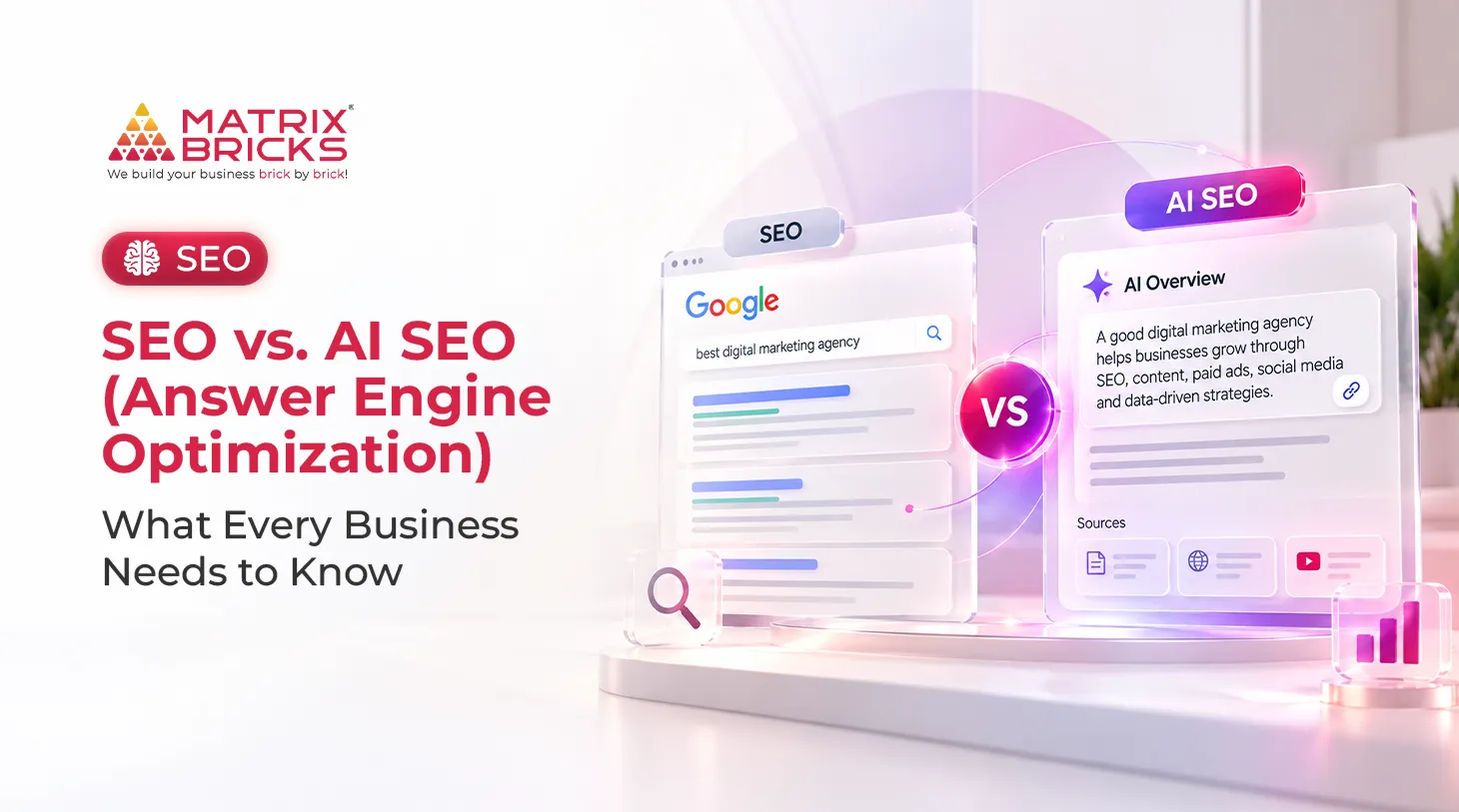
A website can rank on Google, attract qualified traffic, and still miss opportunities when potential customers turn to AI tools for recommendations, comparisons, and answers. Customers are increasingly exploring AI-powered tools alongside search engines to research products, compare services and identify businesses that meet their needs. They are also using platforms such as ChatGPT, Gemini, and Google’s AI search experiences to research solutions and evaluate businesses.
Does this mean traditional SEO is becoming obsolete? AI SEO and traditional SEO are complementary strategies that work together to strengthen a business’s visibility across search engines and AI-powered platforms. Traditional SEO establishes the foundation for online discovery, while answer engine optimization (AEO) expands the focus to how a brand’s information may be surfaced in AI-generated responses.
For businesses evaluating their next investment in search, three questions matter most:
- Visibility: Are potential customers finding your website through conventional search and AI-generated answers?
- Trustworthiness: Does your content demonstrate genuine expertise and provide clear evidence that users and search platforms can rely on?
- Performance: Are your search efforts contributing to qualified traffic, inquiries, and conversions?
How Does Traditional SEO Differ from AI SEO?
Traditional SEO improves a website’s visibility in organic search results through technical optimization, relevant content, internal linking, and authority building. AI SEO applies these foundations while also considering how search and answer platforms retrieve, interpret, and reference information in generated responses.
The distinction becomes clearer when you consider how people search. Someone looking for enterprise CRM software might first search Google for available platforms. They may then ask ChatGPT to compare solutions based on integrations, pricing considerations, and business requirements.
The first interaction may lead to a list of websites. The second may produce a synthesized answer with references to selected sources. Both create opportunities for businesses to be discovered, but the visibility mechanisms differ.
| Comparison point | Traditional SEO | AI SEO and AEO |
|---|---|---|
| Primary focus | Organic rankings and website discovery | Visibility across search results and AI-generated answers |
| Content approach | Relevant, useful pages targeting search intent | Clear explanations, contextual depth and answer-ready information |
| Keywords | Search terms and related topics | Search terms, conversational questions and underlying intent |
| Visibility signals | Rankings, impressions and clicks | Rankings, AI citations, brand mentions and referrals where measurable |
| Technical priorities | Crawlability, indexing, site structure and performance | The same foundations, with attention to how content is retrieved and represented |
| Success measures | Organic traffic, leads and conversions | Organic performance plus measurable AI visibility and business outcomes |
The two approaches overlap considerably. Google’s guidance states that core SEO principles still support visibility in AI Overviews and AI Mode. There is no separate set of special technical requirements that guarantees inclusion in these experiences.
Get Your Free Consultation!
Connect with our team to improve visibility, unlock growth opportunities, and build strategies tailored to your business goals.
Why Search Intent Matters More Than Keyword Placement Alone
Keywords remain useful, but understanding what a searcher wants to accomplish is essential to creating content that earns attention. A page that repeats a phrase without addressing the user’s actual concern is unlikely to provide a satisfying answer.
Consider someone searching for enterprise cybersecurity services. Their next question might be which security controls their business needs, how providers compare, or what influences implementation costs. A useful website anticipates these connected questions instead of treating every keyword as an isolated content opportunity.
Businesses can improve their content strategy by focusing on three key areas:
- Address the decision behind the search: Explain options, trade-offs, suitability, and limitations rather than offering generic descriptions.
- Lead with a clear answer: State the main point early, then support it with practical details, examples, or evidence.
- Build topic depth: Connect related service pages, technical explanations, case studies and FAQs through logical internal links.
This is where AI SEO vs. traditional SEO becomes a useful strategic discussion. The fundamentals of keyword research and search intent remain important, but content must also help readers understand a subject well enough to make an informed decision.
Rankings vs. AI Citations: What Should Businesses Measure?
Rankings show where a page appears in conventional search results. AI citations indicate when a platform references or links to a source in a generated response. Neither metric alone establishes whether a marketing strategy is generating business value.
For example, a B2B software company may rank well for a broad industry keyword but remain absent from AI-generated comparisons of software providers. That observation can help identify a visibility gap, although it does not automatically mean the website needs more content or a complete SEO overhaul.
A practical measurement framework includes:
Organic search performance: Use Google Search Console to monitor impressions, clicks, queries, and landing pages. These metrics help identify where existing SEO is working and where relevant opportunities remain.
AI search visibility: Test a consistent set of relevant questions across platforms such as ChatGPT, Gemini, and Google AI Mode. Record brand mentions, cited pages, competitor appearances, and factual accuracy. Treat these observations as directional because responses can vary between queries and over time.
Business impact: Use Google Analytics 4 and CRM reporting to assess referral traffic, qualified leads, inquiries, and conversions. Where attribution is incomplete, avoid assuming that every increase in branded search or direct traffic came from AI exposure.
The objective is to connect visibility with meaningful customer actions rather than chase citations as a standalone vanity metric.
Does Answer Engine Optimization Need a Different Content Strategy and Structured Data?
Answer engine optimization focuses on making useful information easier to identify, interpret, and reference in answer-driven search experiences. Businesses do not need to overhaul all their web pages for AI search or implement additional markup solely to appear in AI-generated results. Instead, improve the quality and clarity of information already central to your customers’ decisions.
Content that answers questions directly
Use descriptive headings, concise definitions, relevant comparisons, and evidence-backed explanations. A service page should clarify what the service does, who it helps, how the process works, and what affects the outcome.
Original insights, detailed case studies and accurate product or service information can distinguish a business from websites that repeat the same general advice.
Structured data that reflects real content
Schema markup helps search engines interpret certain information about a page and can support eligibility for specific search features. Use relevant types, such as Organization, Product, or LocalBusiness, when appropriate.
However, structured data does not guarantee AI citations, higher rankings, or rich results. It should complement clear content and sound technical SEO, not substitute for them.
Credible information across the web
Maintain consistent company details and build genuine authority through relevant publications, professional profiles, industry contributions, and customer evidence. Prioritize accuracy and relevance over manufactured brand mentions or low-quality links.
Businesses considering AEO services should look for a strategy that improves content quality, technical accessibility, and measurable search visibility, rather than one built around unsupported promises of AI rankings.
Should Businesses Invest in SEO, AEO or Both?
For most businesses, an integrated approach makes more sense than choosing one discipline exclusively. The right balance depends on current organic performance, audience behavior, competition, and the commercial importance of AI-driven discovery.
- Prioritize traditional SEO first if your website has indexing issues, weak service pages, poor internal linking, or limited organic visibility.
- Expand into AEO when customers increasingly research complex questions, compare providers conversationally, or seek direct answers before visiting a website.
- Combine both approaches when organic search already contributes to growth and the business wants to extend its visibility across emerging AI search experiences.
A credible provider offering AEO services should explain the work involved, establish a baseline, define realistic measurement methods, and distinguish verified results from estimates. No agency can guarantee that a third-party AI platform will cite a particular website.
Final Thoughts
Search visibility is expanding beyond the traditional results page, but the fundamentals of earning attention have not disappeared. Businesses still need technically sound websites, relevant content, and credible information. Answer engine optimization adds another consideration: whether that information can contribute meaningfully when customers seek answers through AI.
Matrix Bricks combines SEO, AI SEO, answer engine optimization, and LLM SEO to help businesses strengthen their presence across conventional search and AI-driven discovery. The goal is to create a long-term search strategy that improves online visibility, builds trust, and contributes to measurable business growth.
Frequently Asked Questions
Is AI SEO replacing traditional SEO?
No. AI SEO builds on traditional SEO rather than replacing it. Search engines and AI-powered search experiences still rely on discoverable, relevant information, although their methods of presenting answers can differ.
- Keep SEO fundamentals: Maintain technical health, useful content, and internal links.
- Expand content coverage: Answer relevant customer questions and explain complex topics clearly.
- Measure both channels: Track organic performance alongside observable AI visibility.
Can a website rank on Google but not appear in ChatGPT answers?
Yes. Google rankings do not guarantee that ChatGPT will cite the same website. Different platforms use their own retrieval and ranking processes, and inclusion depends on the query and available sources.
- Check accessibility: Ensure relevant pages can be crawled by the appropriate search systems.
- Review answer coverage: Test realistic customer questions across relevant platforms.
- Strengthen useful pages: Improve factual clarity, relevance, and supporting evidence.
Does answer engine optimization require FAQ pages or schema markup?
No. Neither FAQ pages nor schema markup is universally required for AI visibility. Both can be useful when they serve a genuine purpose, but content quality and technical accessibility remain essential.
- Add relevant FAQs: Address genuine customer concerns.
- Use appropriate schema: Ensure markup matches the visible page content.
- Avoid unnecessary additions: Do not create repetitive pages or markup solely to target AI systems.
How Soon Can Businesses Expect Results from AEO Services?
There is no universal timeline for AI visibility improvements. Results depend on the website's starting point, the work performed, content relevance, and how different platforms retrieve information.
- Establish a baseline: Record existing organic performance and AI mentions.
- Implement improvements: Address content gaps and technical barriers.
- Review progress regularly: Evaluate trends, citations, referral traffic, and qualified leads.