





 India
India  UK
UK  UAE
UAE 
You invest time and money to drive traffic to your website, yet most visitors still leave without taking action. Sounds familiar? You are not alone. More than 35 percent of online visitors bounce without filling out a form, booking a demo, or making a purchase. For many businesses, the real struggle is not getting traffic. It is converting that traffic into real leads and sales.
Now imagine a solution that works around the clock, responds instantly to every visitor, and nudges them toward action without adding extra staff or overhead costs.
An AI chatbot for website visitors does exactly that. It keeps conversations flowing, answers questions in seconds, and guides users to the right next step. Businesses using AI chatbot services are seeing stronger engagement, better lead quality, and measurable lifts in conversions. In simple terms, conversational AI for business is turning passive websites into active sales engines.
Before we dive deeper, here is where most websites lose conversions today:
- Visitors cannot find quick answers and leave.
- Support teams respond too slowly.
- Contact forms feel impersonal and outdated.
- High-intent users drop off at pricing or checkout pages.
Let’s explore how AI chatbots solve these challenges and transform the way your website performs.
What Is an AI Chatbot for a Website?
At its core, an AI chatbot for website is a smart piece of software that engages visitors through automated text or voice responses. Unlike traditional rule-based chat systems, modern chatbots learn from interactions and tailor responses to individual users in real time.
In essence:
- A website visitor types or clicks a prompt.
- The AI chatbot interprets intent using natural language.
- It responds with personalized guidance, offers, or next steps.
This form of AI chatbot integration helps convert visitors who might otherwise leave without engaging. Its ability to respond instantly and adapt based on user behavior makes it far more effective than static FAQs or contact forms.
Most importantly, conversational AI can deliver a personalized experience for every visitor, which plays a major role in website conversion optimization.
How AI Chatbots Directly Boost Website Conversions
AI chatbots impact conversion rates in multiple measurable ways. Below are the biggest conversion drivers you need to understand.
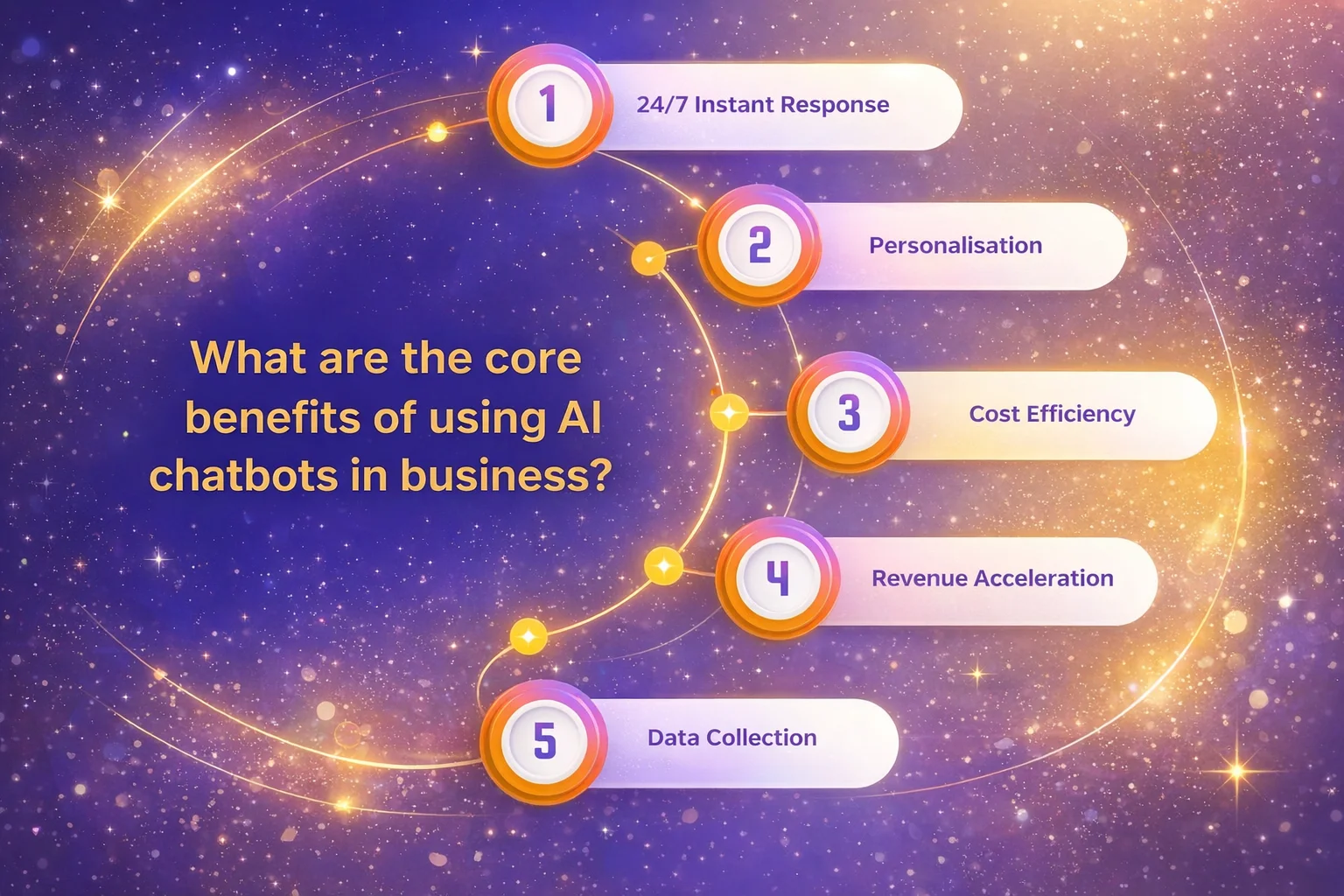
1. 24/7 Lead Capture: Never Miss a Prospect Again
People browse and shop at all hours. Your potential customers do not care about business hours. An AI chatbot to boost website conversions provides constant support and engagement.
With 24/7 availability, chatbots can:
- Respond to visitor queries instantly at any time.
- Capture lead details during nights, weekends, and holidays.
- Prevent visitors from bouncing due to unanswered questions.
Studies show that businesses using chatbots can see significant improvements in conversion rates because leads are never left unattended.
2. Personalized User Journeys That Reduce Bounce Rate
Every visitor behaves differently. A generic message misses opportunities. A well-trained AI chatbot recognizes patterns in browsing behavior and adapts conversations accordingly.
For example:
- New visitors receive product information.
- Returning visitors get targeted offers.
- Confused visitors are guided step-by-step to the next action.
This level of personalization increases trust and encourages users to stay longer, explore more, and complete conversion actions.
3. Automated Lead Qualification and CRM Integration
Not all leads are equal. An intelligent chatbot can qualify prospects automatically by asking key questions.
A smart AI chatbot:
- Collects visitor details like contact information and intent.
- Rates the quality of leads based on responses.
- Sends qualified leads instantly to CRM or sales teams.
This automation means your sales team engages only with hot leads, saving time and increasing revenue opportunities.
4. Instant FAQ Resolution
Many conversions are lost because visitors cannot find quick answers. Even small delays create doubt and cause users to leave. An AI chatbot removes that gap by delivering instant, accurate responses right when questions arise.
An AI chatbot typically handles:
- Pricing clarifications and plan comparisons
- Feature explanations in simple language
- Shipping details, delivery timelines, or service availability
- Return policies, guarantees, and support-related questions
By answering in seconds instead of minutes or hours, the chatbot reduces uncertainty and keeps high-intent visitors moving toward conversion.
5. Proactive Engagement on High-Intent Pages
Some chatbots wait for users to interact. Better ones start conversations automatically based on visitor behavior.
For instance:
- A chatbot can pop up when a visitor lingers on a pricing page.
- It can offer help when a visitor tries to exit the checkout page.
- It can share personalized discounts at the right moment.
This proactive engagement significantly increases the chance of converting hesitant visitors into customers.
Real-World Results: What the Data Says
AI chatbots are not theoretical tools. Many brands see real increases in lead quality, sales conversions, and customer satisfaction.
Here is a concise comparison showing benefits:
| Benefit | Without an AI Chatbot | With an AI Chatbot |
| Lead capture after hours | Low | High |
| Response time | Minutes to days | Seconds |
| Personalized engagement | Limited | Dynamic and adaptive |
| Qualified leads | Manual | Automated |
| Bounce rate | High | Reduced |
| Sales conversions | Lower | Higher (up to 35%) |
According to industry reports, websites with chatbots often see double-digit increases in conversion rates. These improvements are especially evident on landing pages, product pages, and support pages where visitors need immediate answers.
Case Study: How Effishent Technology Boosted Conversions
To make this tangible, let’s look at a real example.
Effishent Technology, a B2B software provider, struggled with visitor engagement. Most visitors left without contacting sales or booking demos.
After implementing a tailored AI chatbot:
- Response time improved from hours to seconds.
- Visitors asked key questions directly to the bot.
- Lead quality increased by 42 percent.
- Demo bookings increased by 30 percent within three months.
The chatbot was configured to engage users on high-intent pages such as pricing and feature comparison pages, which dramatically increased conversions with minimal upkeep.
This example shows how AI chatbot integration can act as a revenue driver rather than just a support feature.
AI Chatbot Services vs DIY Chatbot Tools: Which Is Right for You?
Not all chatbots are built the same. Businesses typically choose between DIY chatbot platforms and professional AI chatbot services, depending on their goals, budget, and long-term growth plans.
1. DIY Chatbot Platforms
DIY platforms are ready-made tools that let you add a chatbot to your website quickly. They are built for simplicity and are usually suitable for basic automation and FAQ handling.
- Pros:
The biggest advantage of DIY tools is speed and affordability. You can set them up quickly without technical expertise, and the initial investment is relatively low. For small businesses or startups testing chatbot functionality, this can be a practical and low-risk option. - Cons:
However, DIY chatbots often rely on rule-based systems with limited intelligence. Customization options are restricted, and they may struggle with complex conversations or advanced lead qualification. As your business scales, these limitations can impact performance and conversion potential.
2. Professional AI Chatbot Services
Professional AI chatbot services are designed and implemented by specialists who tailor the solution to your specific business goals. These chatbots are aligned with your sales funnel and broader digital strategy.
- Pros:
A professionally built chatbot offers intelligent, learning-based responses that adapt over time. It integrates seamlessly with CRM systems and analytics tools, enabling automated lead qualification and deeper personalization. This level of sophistication often leads to stronger website conversion optimization. - Cons:
The primary drawbacks are higher upfront costs and a longer setup period. Since the chatbot is customized, it requires planning, strategy, and proper implementation. However, for businesses focused on sustainable growth, the long-term benefits typically outweigh the initial investment.
How to Implement an AI Chatbot on Your Website (Step-by-Step)
Here is a simple roadmap you can follow:
Step 1 — Define Your Conversion Goal
Start by identifying what you want the chatbot to achieve, whether that is lead capture, demo bookings, e-commerce sales, or customer support. A clear goal ensures the chatbot is built to drive specific results rather than just answering questions.
Step 2 — Choose the Right AI Chatbot Platform
Select a platform with strong natural language capabilities, CRM integration, and customizable flows. The right platform determines how intelligent and scalable your chatbot will be.
Step 3 — Train the Chatbot on FAQs and Data
Provide accurate answers to common questions, product details, and key user intent phrases. Proper training improves relevance and keeps conversations meaningful.
Step 4 — Place It on High-Intent Pages
Deploy the chatbot on pages where decisions happen, such as pricing, product, checkout, and homepage sections. Strategic placement increases the chances of conversion.
Step 5 — Monitor, Analyze, and Improve
Track conversation patterns, drop-off points, and missed opportunities. Ongoing optimization ensures your chatbot continues to improve performance and conversions over time.
Industries Benefiting Most from AI Chatbot Integration
AI chatbots are versatile and effective across sectors. Some industries see especially strong results:
- E-commerce: Higher sales, reduced cart abandonment
- SaaS Startups: More demo bookings, faster lead qualification
- Healthcare Providers: Immediate patient support, appointment booking
- Real Estate: Automated property suggestions
- Professional Services: Faster client onboarding
No matter your industry, if your website needs conversions, AI chatbots can play a strategic role.
Conclusion
AI chatbots are no longer optional. They are strategic tools that boost engagement, improve customer experience, and generate more conversions without adding staff or complexity.
If you want to harness the power of AI chatbot services and transform your website into a conversion engine, do not wait.
Book a free consultation with Matrix Bricks today to start increasing your conversions with AI.
Frequently Asked Questions
1. How does an AI chatbot increase website conversions?
An AI chatbot for website improves conversions by engaging visitors at the right moment and removing friction from the decision process. Instead of letting users leave with unanswered questions, it guides them toward clear next steps in real time.
It increases conversions by:
- Engaging visitors instantly on high-intent pages
- Reducing bounce rates with personalized responses
- Capturing and qualifying leads automatically
- Providing real-time support that drives action
When users feel supported and understood, they are far more likely to convert.
2. What is the best AI chatbot for a small business website?
The right AI chatbot service depends on your goals and growth plans. Small businesses benefit most from solutions that balance affordability with intelligent automation.
Look for:
- Strong natural language capabilities
- CRM integration to manage lead flow
- Customizable conversation paths
- Clear analytics to measure performance
The best chatbot is one that aligns with your sales funnel, not just your budget.
3. How much does AI chatbot integration cost?
The cost of AI chatbot integration varies depending on complexity and customization. Basic tools are affordable, while advanced solutions require more investment.
Costs typically depend on:
- Level of customization and automation
- CRM and analytics integrations
- Ongoing optimization and support
Instead of focusing only on price, evaluate the return based on improved conversions and lead quality.
4. Can an AI chatbot replace my sales team?
Conversational AI for business is designed to support sales teams, not replace them. It handles repetitive tasks so human teams can focus on closing deals.
It helps by:
- Managing initial inquiries automatically
- Qualifying and routing high-intent leads
- Scheduling meetings without manual effort
Bots streamline the process, but human relationships still close sales.
5. How long does it take to set up an AI chatbot?
Implementation timelines depend on the level of customization. Simple chatbots can be deployed quickly, while advanced solutions take longer to build and refine.
Typical timelines include:
- Template-based setups completed in days
- Custom-built solutions take several weeks
- Additional time for testing and optimization
Proper setup and training ensure better long-term performance and stronger results.