






 India
India  UK
UK  UAE
UAE 
Search engine optimization is evolving rapidly as artificial intelligence becomes a core part of how search engines understand and deliver information. Traditional SEO focused heavily on keywords, backlinks, and rankings. However, AI-driven search experiences are shifting the focus toward context, intent, and structured knowledge. One emerging concept shaping this change is WebMCP.
WebMCP is gaining attention because AI search engines now analyze content differently. Instead of simply matching keywords, they aim to understand relationships between topics, entities, and user intent. This means websites must be optimized not only for search engines but also for AI models that generate answers.
In this beginner-friendly guide, we will explain what WebMCP is, how it works in SEO, and why it matters in 2026. You will also learn how to optimize your website using WebMCP principles to improve visibility in AI-powered search results.
What is WebMCP in SEO?
WebMCP, or Web Model Context Protocol, is an emerging concept in AI-driven search optimization that helps AI systems better interpret, contextualize, and extract information from websites. As search engines evolve beyond keyword-based indexing toward semantic and conversational understanding, WebMCP provides a structured approach to making content more accessible to AI models.
Traditional SEO focused primarily on optimizing content for search engine crawlers using:
- Keywords
- Meta tags
- Backlinks
- Technical optimization
However, AI-powered search engines now aim to understand meaning rather than just match keywords. This is where WebMCP plays a crucial role. It helps search engines and AI assistants understand:
- Topic relationships
- Content hierarchy
- Contextual meaning
- Entity associations
- User intent
For example, earlier if someone searched for “SEO tools,” search engines looked for pages with that exact phrase. Now AI search systems try to understand:
- Are they looking for free tools?
- Enterprise tools?
- AI tools?
- Technical SEO tools?
WebMCP helps structure content in a way that provides this contextual depth.
Why WebMCP Matters for SEO in 2026
Search behavior is rapidly shifting toward AI-driven experiences. Users are increasingly relying on conversational queries rather than traditional keyword searches. This change requires content that AI systems can easily interpret and summarize.
One major reason WebMCP matters is the rise of AI-generated search answers. Instead of showing multiple links, search engines now generate summaries using information from multiple sources. If your content is structured using WebMCP principles, it has a higher chance of being included in these summaries.
Here’s why WebMCP is important:
1. AI Search is Growing Fast
Users are now searching through:
- AI chat interfaces
- Voice assistants
- AI search summaries
- Conversational search
WebMCP helps your content appear in these AI-generated answers.
2. Context-Based Ranking
Search engines now evaluate:
- Topic authority
- Content relationships
- Meaning of content
- User intent
WebMCP helps provide structured context for better AI understanding.
3. Zero-Click Searches Are Increasing
Users often get answers without clicking links.
WebMCP improves your chances of being referenced inside AI responses.
4. Content Discoverability
WebMCP makes your content easier for AI crawlers to:
- Access
- Parse
- Interpret
- Summarize
Search is no longer just about “10 blue links.” AI search results, summaries, and answer engines are dominating user behavior.
How WebMCP Works in SEO
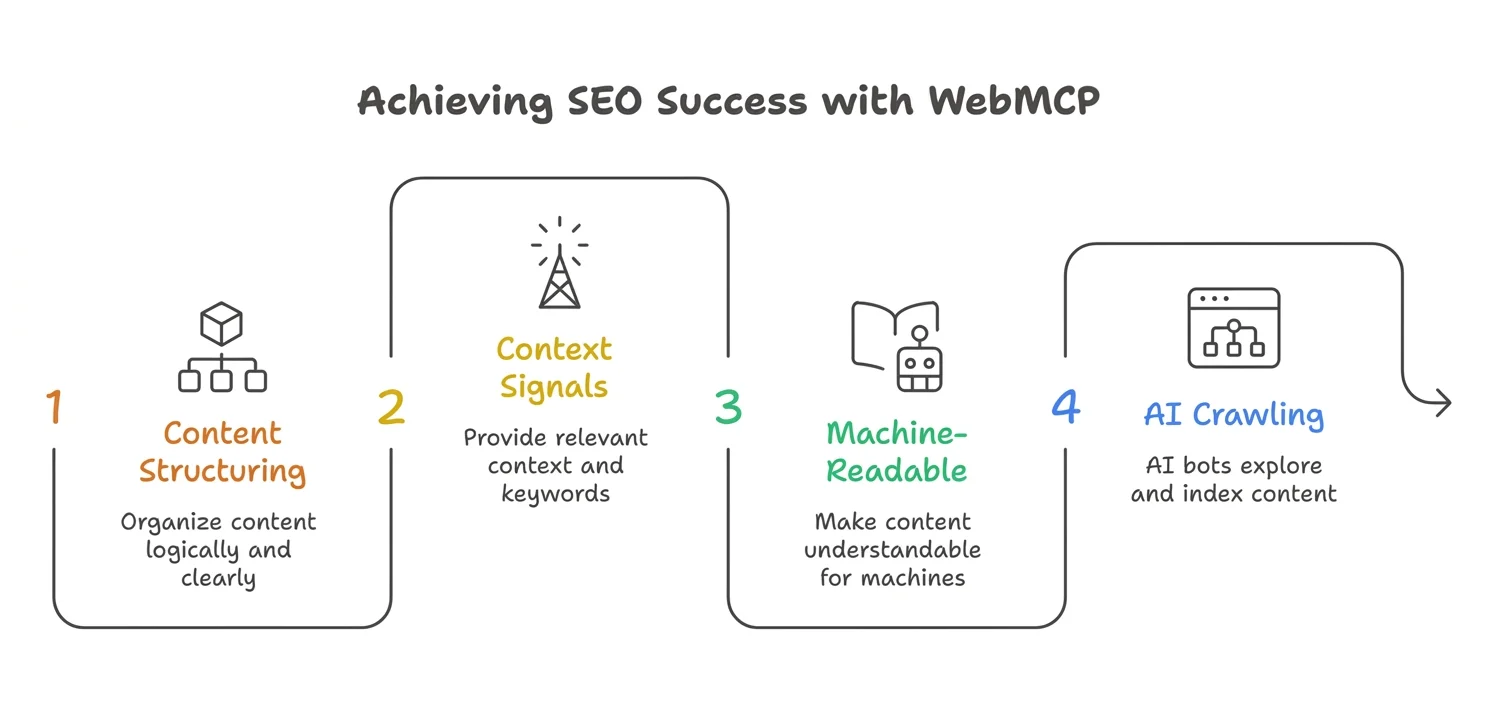
WebMCP works by creating a structured ecosystem of content that AI systems can easily interpret.
Here’s a simplified process:
Step 1: Content Structuring
Your website content is organized into:
- Clear headings
- Sections
- Semantic meaning
- Topic clusters
Step 2: Context Signals
WebMCP emphasizes:
- Internal linking
- Related content
- Topic relationships
- Entity connections
Step 3: Machine-Readable Format
AI systems prefer:
- Structured data
- Clean HTML
- FAQ sections
- Tables
- Definitions
Step 4: AI Crawling
AI systems analyze:
- Meaning
- Relationships
- Intent
- Authority
Step 5: AI Answer Generation
Your content may be used in:
- AI summaries
- Conversational answers
- Voice responses
- Knowledge panels
Another critical aspect is entity recognition. Entities refer to specific concepts such as brands, tools, or technologies. When content clearly defines entities, AI models can better understand the context.
Finally, AI systems analyze this structured content and generate responses. If your content is clear and contextual, it is more likely to be selected as a source.
WebMCP vs Traditional SEO
| Traditional SEO | WebMCP SEO |
| Focus on keywords | Focus on context |
| Ranking pages | Answer visibility |
| Backlinks important | Content relationships important |
| Search engines only | AI models + search engines |
| Meta tags | Structured knowledge |
| Click-based | Answer-based |
Both strategies now need to work together for maximum visibility.
Key Components of WebMCP SEO
1. Structured Content
Structured content improves readability for both users and AI systems.
Use:
- H1, H2, H3 properly
- Bullet points
- Short paragraphs
- Definitions
For example, a section titled “Benefits of WebMCP” helps AI systems identify relevant information quickly. This improves the chances of appearing in featured snippets and AI summaries.
2. Topic Clusters
Topic clustering involves creating multiple pieces of content around a central theme. This helps search engines understand your website’s authority in a specific niche.
For instance:
Main Topic: AI SEO
Supporting Topics:
- WebMCP
- AI content optimization
- Semantic search
- Entity-based SEO
This structure strengthens contextual signals.
3. Internal Linking
Internal links connect related pages and provide additional context. When a blog links to other relevant articles, AI systems understand relationships between topics.
Example:
- Blog linking to guide
- Guide linking to services
- Services linking to FAQs
This creates contextual depth.
For example, linking “WebMCP” to “AI SEO strategy” signals that both topics are related.
4. Entity Optimization
Clearly defining entities helps AI models understand meaning.
Entities include:
- Brands
- Concepts
- Tools
- Industries
For example, when mentioning WebMCP, define what it is, why it matters, and how it works. This improves contextual clarity.
Benefits of WebMCP for Website
One of the biggest advantages of WebMCP is improved AI visibility. As AI-powered search grows, websites optimized for context have a better chance of appearing in AI-generated responses.
Another benefit is enhanced topical authority. By structuring content around related topics, your website demonstrates expertise, which improves rankings.
WebMCP also improves user experience. Structured content is easier to read, which increases engagement and reduces bounce rates.
Additionally, WebMCP helps future-proof SEO strategies. As AI search continues to evolve, context-based optimization will become more important than traditional keyword-based approaches.
How to Optimize Your Website for WebMCP
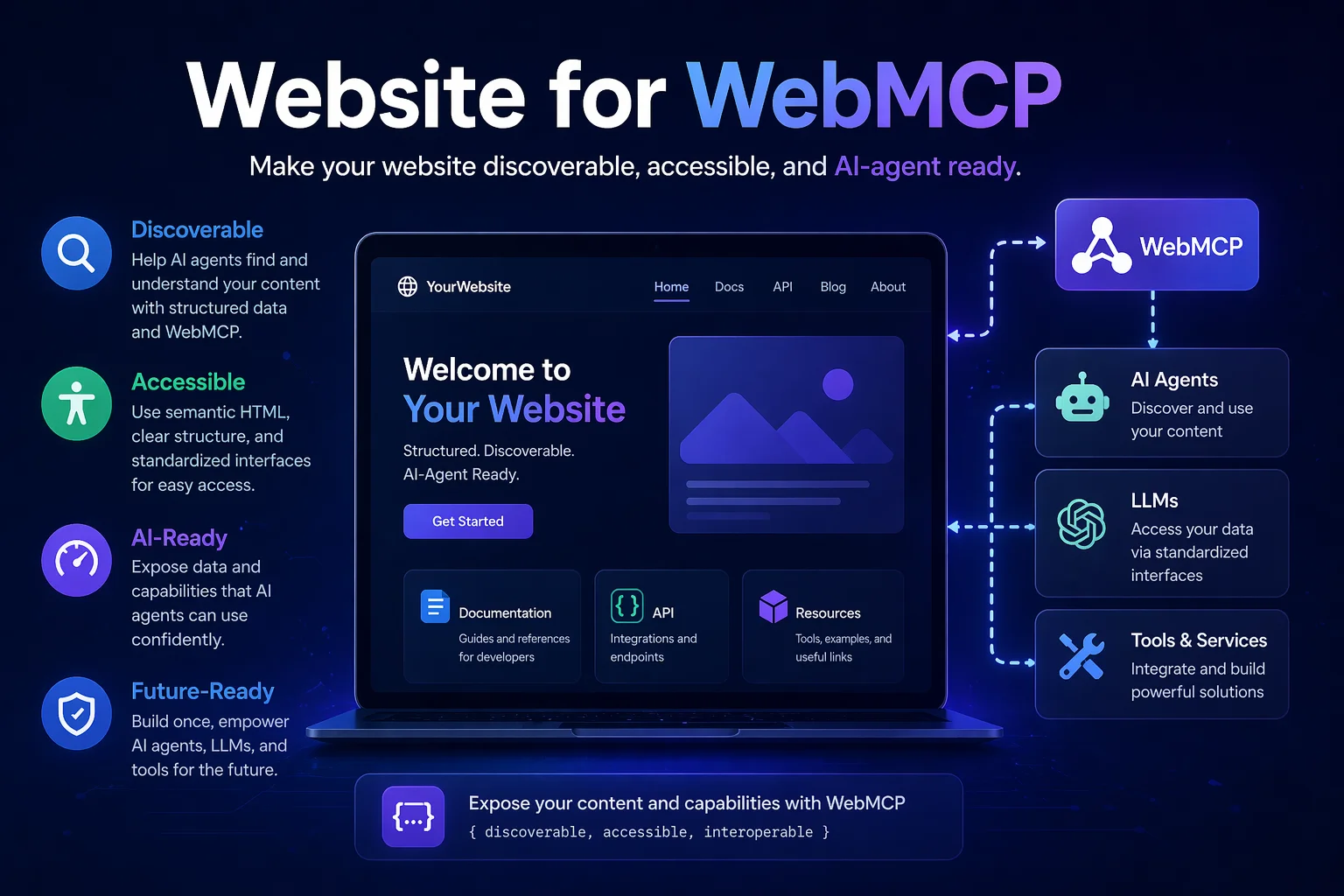
Follow these practical steps:
1. Create Contextual Content
Instead of random blogs, build topic clusters.
2. Use Clear Headings
Example:
- What is WebMCP
- Benefits of WebMCP
- How WebMCP Works
3. Add Definitions
AI models prefer:
“WebMCP is…”
“SEO is…”
“AI search means…”
4. Improve Internal Linking
Link:
- Related blogs
- Pillar pages
- Service pages
5. Add Structured Data
Use:
- FAQ schema
- Article schema
- Organization schema
6. Answer User Questions
Think conversationally:
- What is WebMCP?
- Why is WebMCP important?
- How to use WebMCP?
7. Write in Simple Language
AI models prefer clear, human-friendly content.
WebMCP and AI Search Optimization
WebMCP plays a major role in AI search optimization.
AI search engines analyze:
- Meaning of content
- Intent of user
- Topic coverage
- Authority signals
WebMCP helps you provide:
- Structured answers
- Clear explanations
- Contextual relationships
This improves chances of appearing in:
- AI Overview
- Chat search results
- Voice search
WebMCP SEO Strategy for 2026
Here’s a practical strategy:
Step 1: Build Pillar Content
Create long-form guides like:
- SEO Guide
- AI SEO Guide
- WebMCP Guide
Step 2: Create Supporting Blogs
Example:
- What is WebMCP?
- WebMCP vs SEO
- WebMCP benefits
Step 3: Interlink Everything
Link pillar → supporting → service pages.
Step 4: Add FAQs
Include 3–5 FAQs in each article.
Step 5: Update Old Content
Add:
- Context
- Internal links
- Structured headings
Common Mistakes to Avoid
Keyword stuffing
Thin content
No internal linking
No structure
Overly technical writing
Ignoring user intent
WebMCP requires clarity and context, not just keywords.
Real Examples of WebMCP in SEO
Understanding WebMCP becomes easier with practical examples. These examples show how structured context helps AI systems interpret content more effectively.
Example 1: Traditional SEO vs WebMCP Approach
Traditional SEO Article
- Title: Best SEO Tools
- Content: List of tools with minimal explanation
- No internal linking
- No contextual relationships
AI systems may struggle to understand:
- Which tools are for beginners
- Which tools are for technical SEO
- Which tools are AI-based
WebMCP Optimized Article
- Title: Best SEO Tools for Beginners, Experts & AI Optimization
- Sections:
- SEO tools for beginners
- Technical SEO tools
- AI SEO tools
- Internal links to:
- Beginner SEO guide
- Technical SEO checklist
- AI SEO strategy
This structured context helps AI models understand relationships and extract answers.
Is WebMCP Replacing SEO?
No. WebMCP is not replacing SEO, but enhancing it.
You still need:
- Keywords
- Technical SEO
- Backlinks
- Optimization
But now you must also optimize for:
- AI understanding
- Context
- Content relationships
Think of WebMCP as AI-ready SEO.
Future of WebMCP in SEO
WebMCP will become more important as:
- AI search grows
- Conversational search increases
- Voice search expands
- Zero-click searches rise
Websites that adapt early will gain:
- More visibility
- Better authority
- AI citations
- Competitive advantage
Final Thoughts
WebMCP represents the next stage of SEO evolution. As search engines become more intelligent, optimizing for context and meaning will become essential. Businesses that adapt early will gain a competitive advantage in AI-driven search results.
By combining traditional SEO techniques with WebMCP strategies, Matrix Bricks can help you improve both rankings and AI visibility. The key is to focus on structured, contextual, and user-friendly content.
FAQs
1. What is WebMCP in SEO?
WebMCP (Web Model Context Protocol) is an approach that helps AI search systems better understand website content through structured context, topic relationships, and semantic clarity, improving visibility in AI-generated search results.
2. How does WebMCP work in SEO?
WebMCP works by organizing content using clear headings, internal linking, structured data, and entity-based optimization so AI models can easily interpret and extract relevant information.
3. Is WebMCP replacing traditional SEO?
No, WebMCP is not replacing traditional SEO. Instead, it complements it by adding context-based optimization alongside keywords, backlinks, and technical SEO.
4. Why is WebMCP important for AI search optimization?
WebMCP helps AI-powered search engines understand content meaning, which increases the chances of being included in AI-generated summaries, conversational search results, and voice search answers.
5. What is the difference between WebMCP and semantic SEO?
Semantic SEO focuses on meaning and intent, while WebMCP goes further by structuring content for AI models using contextual relationships, entities, and machine-readable formats.
6. Who should use WebMCP in SEO?
WebMCP is useful for:
- SEO professionals
- Content marketers
- Businesses
- Website owners
- Digital marketing agencies
Anyone wanting visibility in AI search results should implement WebMCP.
7. How do I optimize my website for WebMCP?
You can optimize for WebMCP by:
- Creating structured content
- Building topic clusters
- Improving internal linking
- Adding FAQs
- Using schema markup
- Writing clear definitions
8. Does WebMCP help in Google AI Overview?
Yes, WebMCP improves content structure and context, which increases the likelihood of your website being referenced in AI Overview and AI-generated search answers.
9. Is WebMCP important for SEO in 2026?
Yes, as AI search continues to grow, WebMCP will become more important for improving visibility in conversational search and AI-driven results.
10. What are the benefits of WebMCP for websites?
Key benefits include:
- Better AI visibility
- Improved topical authority
- Higher content discoverability
- Future-proof SEO strategy
- Increased brand mentions