





 India
India  UK
UK  UAE
UAE 
Your website may have excellent content, a strong design, and a solid marketing strategy. But if it loads slowly, none of that may matter for long.
Today’s online users expect instant experiences. Whether someone is shopping for products, comparing service providers, reading reviews, or researching solutions, patience is incredibly limited. In fact, Google reports that 53% of mobile users abandon a website if it takes longer than three seconds to load. For businesses competing online in the United States, that is not just a technical issue. It is a revenue issue.
At the same time, search engines are advancing faster than ever. AI-powered search experiences are changing how websites are ranked, crawled, and surfaced to users. Search platforms are now prioritizing websites that are not only informative, but also fast, user-friendly, mobile-optimized, and technically reliable.
This is exactly why website speed and SEO have become deeply connected.
Businesses with poor website performance are already facing challenges such as:
- Lower rankings because users leave pages before engaging with content
- Reduced visibility in AI-generated search experiences and zero-click searches
- Poor mobile engagement despite strong products or services
- Higher bounce rates and lower conversion rates
- Reduced crawl efficiency for Google and AI search systems
The good news is that website performance can be improved strategically, often with changes that create measurable SEO and business impact relatively quickly.
In this guide, we will explore how speed affects rankings in the AI era, what modern search engines actually prioritize, and how businesses can optimize performance for stronger visibility, better engagement, and long-term growth.
Why Website Speed Has Always Mattered for SEO
Website speed has remained an important Google ranking factor because user experience has always played a key role in search quality.
Think about user behavior for a moment.
If someone clicks on a website and the page loads instantly, the experience feels smooth and trustworthy. But when a webpage loads slowly, freezes, or shifts unexpectedly, users quickly lose patience and leave.
Search engines track this behavior carefully.
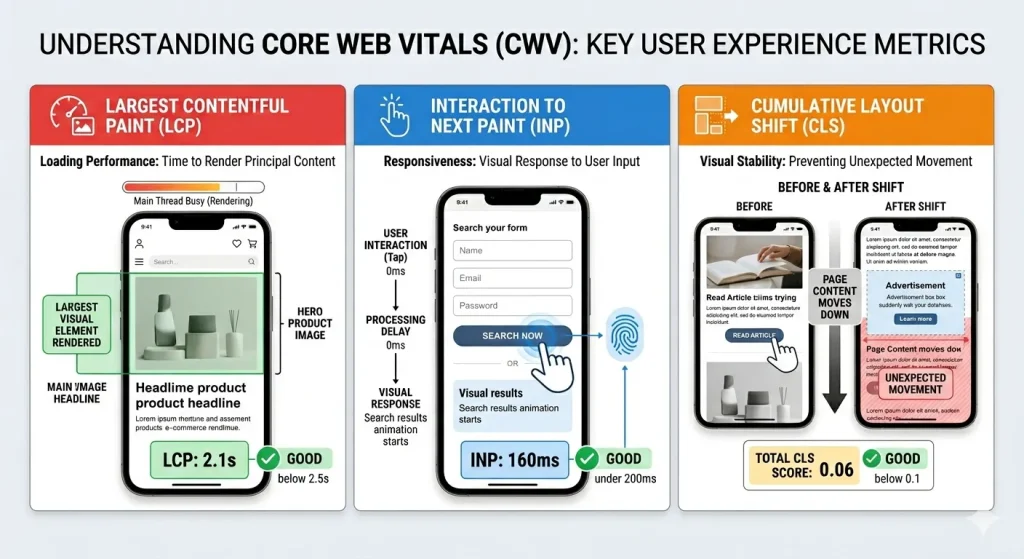
That is why Google introduced Core Web Vitals ranking factors, which measure how users actually experience a webpage instead of only analyzing technical code.
| Core Web Vital | What It Measures | Recommended Benchmark |
|---|---|---|
| Largest Contentful Paint (LCP) | Loading performance | Under 2.5 seconds |
| Interaction to Next Paint (INP) | Responsiveness | Under 200 milliseconds |
| Cumulative Layout Shift (CLS) | Visual stability | Under 0.1 |
These metrics directly influence how websites perform in search rankings because they reflect real-world usability.
For example, users often leave websites when:
- Product images load slowly on mobile devices.
- Pop-ups interrupt the page immediately after opening
- Buttons move while users try to click them
- Checkout pages lag during purchases
- Menus freeze or become unresponsive
These experiences damage engagement and create poor user satisfaction signals.
This is why discussions around page speed impact on rankings continue becoming more important every year.
Get Your Free Consultation!
Connect with our team to improve visibility, unlock growth opportunities, and build strategies tailored to your business goals.
How AI Is Reshaping Search and SEO
SEO today looks very different compared to just a few years ago.
Traditional SEO focused heavily on keywords, backlinks, and metadata optimization. While those elements still matter, AI-powered search systems now evaluate websites much more holistically.
Modern search engines analyze:
- User experience
- Mobile usability
- Semantic clarity
- Content relevance
- Technical structure
- Crawl efficiency
- Website trust signals
This shift is especially visible through AI-generated search experiences like Google AI Overviews.
Instead of simply displaying a list of links, AI systems now summarize information directly within search results. That means websites need to do more than just rank. They need to become trustworthy sources that AI systems can easily understand and prioritize.
This is exactly why businesses are investing more heavily in AI search SEO strategy planning.
Fast websites help AI systems:
- Crawl pages more efficiently
- Understand structure faster
- Access content without delays
- Deliver accurate answers to users quickly
In many ways, website performance is becoming a trust signal for AI-driven search systems.
Traditional SEO vs AI-Era SEO
The SEO landscape is evolving quickly, and optimization priorities are shifting with it.
| Traditional SEO Focus | AI-Era SEO Focus |
|---|---|
| Keyword targeting | User intent & semantic relevance |
| Backlink quantity | Trust & authority |
| Desktop optimization | Mobile-first performance |
| Metadata optimization | Structured data clarity |
| Basic crawlability | Crawl efficiency |
| Static rankings | AI visibility & discoverability |
This transition explains why technical SEO for AI search is becoming one of the most important focus areas for modern brands.
What Real Data Says About Website Speed
Website speed directly impacts business performance, not just rankings.
According to Deloitte research, improving mobile speed by just 0.1 seconds increased conversion rates across industries including retail, travel, and luxury commerce.
Google research also shows:
- Bounce probability increases by 32% when load times rise from one second to three seconds
- Faster websites generally achieve better engagement rates
- Slow websites experience shorter session durations
- Mobile users are far less patient with delays compared to desktop users
This is exactly why businesses focusing on reduce bounce rate with fast website strategies often experience stronger engagement and improved revenue performance.
How Speed Affects Different Industries
| Industry | Common Impact of Slow Websites |
|---|---|
| E-commerce | Cart abandonment and lower sales |
| SaaS | Reduced lead generation |
| Media & publishing | Lower engagement and ad revenue |
| Local businesses | Poor mobile visibility |
| Healthcare | Reduced trust and appointment drop-offs |
For e-commerce businesses especially, even a one-second delay during checkout can significantly impact revenue.
How to Diagnose Website Performance Issues
Many businesses know their website feels slow but struggle to identify the root cause.
This is where performance testing tools become essential.
Recommended Website Speed Tools
| Tool | Main Purpose |
|---|---|
| Google PageSpeed Insights | Core Web Vitals analysis |
| Lighthouse | Technical SEO and speed audits |
| GTmetrix | Detailed loading diagnostics |
| Google Search Console | Real-world performance monitoring |
These tools help identify issues such as:
- Oversized images
- Heavy JavaScript files
- Render-blocking resources
- Weak caching systems
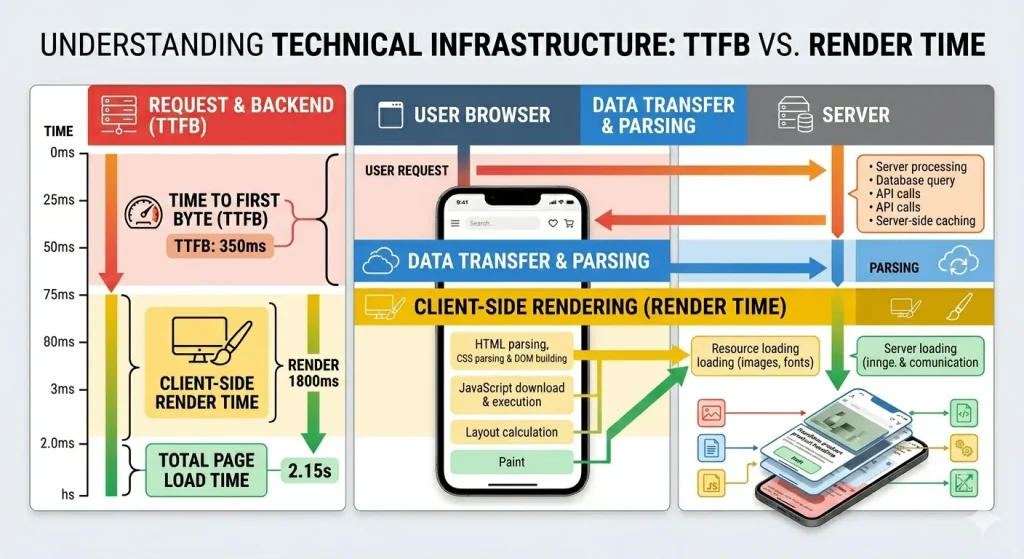
- Slow server response times
- Layout instability
However, businesses should avoid focusing only on vanity performance scores.
A perfect score means very little if the actual browsing experience still feels slow to users.
Get Your Free Consultation!
Connect with our team to improve visibility, unlock growth opportunities, and build strategies tailored to your business goals.
Practical Ways to Improve Website Performance
Businesses focusing on how to improve website loading speed should prioritize optimizations that strengthen both SEO performance and user experience. Even small speed improvements can positively impact rankings, engagement, and conversions.
- Optimize Images Properly : Large image files slow websites significantly, especially on mobile devices. Using compressed formats like WebP and AVIF helps improve loading speed without reducing visual quality.
- Reduce Unnecessary Scripts: Excessive plugins, trackers, and third-party scripts often create major performance issues. Removing unnecessary elements helps websites load faster and run more efficiently.
- Upgrade Hosting Infrastructure: Poor hosting can lead to slow server response times and unstable performance. Reliable hosting improves speed, uptime, and scalability during high traffic periods.
- Use Lazy Loading: Lazy loading improves initial page speed by delaying non-essential content until users scroll further down the page. This creates a smoother and faster browsing experience.
- Implement a CDN: A Content Delivery Network helps reduce loading times by delivering website content closer to users across different locations in the USA, improving overall performance.
- Prioritize Mobile Optimization: Strong mobile page speed SEO is essential because most users now browse on smartphones. Faster mobile experiences improve engagement, usability, and conversions.
- Focus on LCP INP CLS optimization: Strong LCP INP CLS optimization improves loading performance, responsiveness, and visual stability, helping websites deliver smoother user experiences while supporting better rankings.
The Future of Website Speed in AI Search
AI-powered search will continue evolving rapidly over the next few years.
Future ranking systems will likely place even greater emphasis on:
- Instant page rendering
- Mobile responsiveness
- User interaction quality
- Crawl accessibility
- Real-time performance signals
Voice search and conversational AI systems will also increase the importance of fast-loading experiences because users expect immediate answers.
In many ways, website speed is becoming a digital trust signal.
Fast websites feel:
- More professional
- More reliable
- More secure
- More user-friendly
And in AI-driven search ecosystems, trust matters enormously.
Conclusion
In the AI era, website speed and SEO go hand in hand. Faster websites improve rankings, user experience, AI visibility, mobile engagement, and conversions.
Businesses investing in Core Web Vitals ranking factors, mobile page speed SEO, and technical SEO for AI search will be better positioned to stay competitive as search continues to evolve.
At Matrix Bricks, we believe high-performing websites will define the future of SEO and digital growth.
Frequently Asked Questions
Website speed affects rankings, engagement, and conversions. Slow websites often increase bounce rates and reduce user trust.
Businesses focusing on page speed impact on rankings usually see:
- Better search visibility
- Higher user engagement
- Improved conversion rates
Fast websites also improve crawl efficiency for search engines and AI systems.
Core Web Vitals are Google’s user experience metrics that measure website performance.
The main Core Web Vitals ranking factors focus on:
- Loading speed
- Responsiveness
- Visual stability
Improving these metrics helps create a smoother and faster browsing experience.
Businesses searching for how to improve website loading speed should focus on:
- Compressing images and reducing heavy files
- Removing unnecessary plugins and scripts
- Using faster hosting and caching systems
Small speed improvements can significantly improve SEO and user experience.
Yes, mobile page speed SEO is important because Google uses mobile-first indexing.
A strong mobile experience helps:
- Reduce bounce rates
- Improve engagement
- Increase conversions
Slow mobile websites can negatively impact both rankings and trust.
An AI search SEO strategy 2026 focuses on optimizing websites for AI-powered search experiences.
This usually includes:
- Faster website performance
- Structured and crawlable content
- Strong technical SEO foundations
Businesses adapting early to AI search trends will gain stronger long-term visibility.

Mehul G Brahmbhatt
Founder & CEO, Matrix BricksMehul G Brahmbhatt brings over 25 years of experience in digital strategy, marketing, and business transformation. He built Matrix Bricks to help growing businesses build scalable, performance-driven digital systems. As an author, he shares clear, actionable insights drawn directly from hands-on experience, covering digital growth, technology adoption, and modern marketing.