





 India
 UK
 UAE
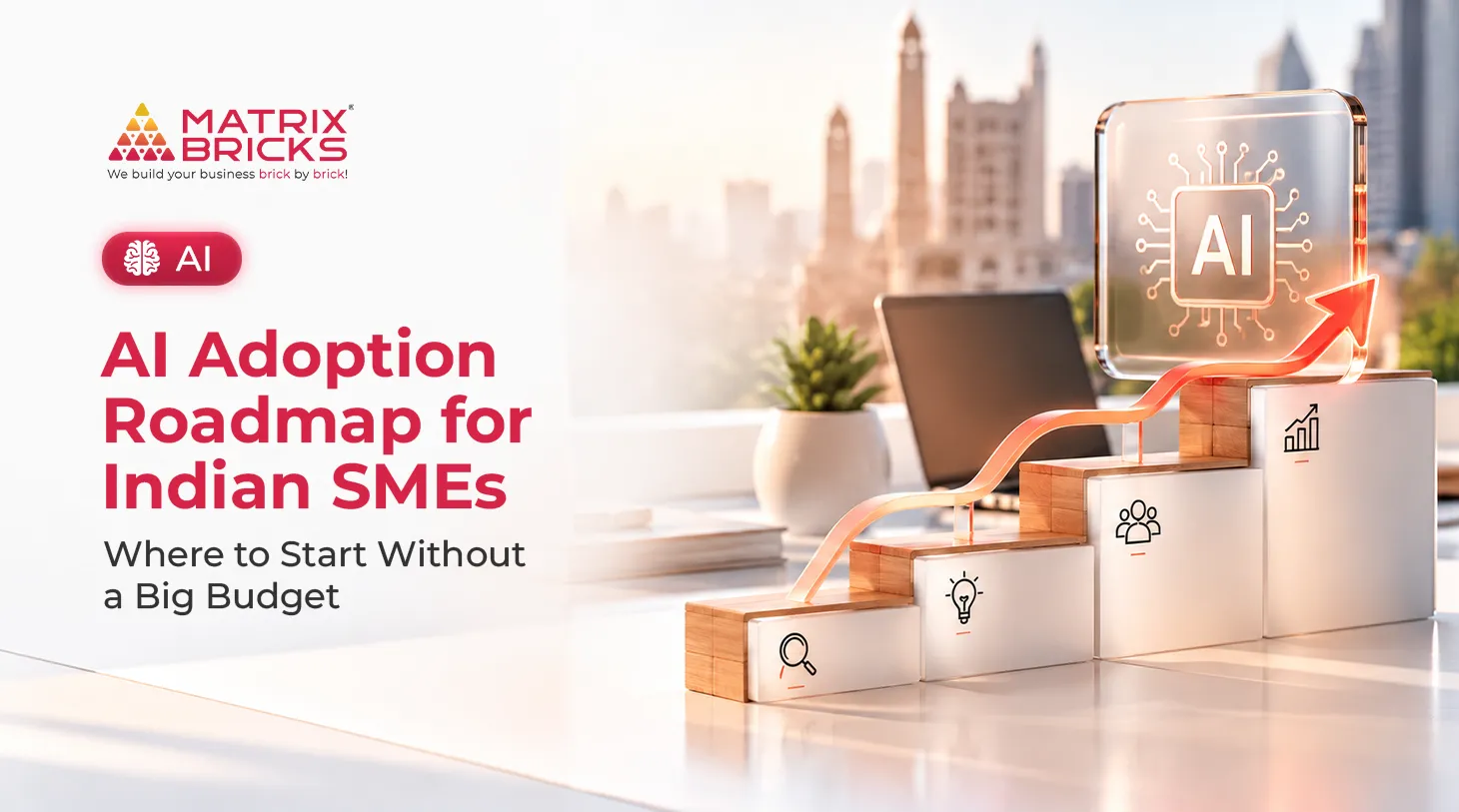
Artificial intelligence can help Indian small and medium-sized enterprises save time, improve customer service and make better business decisions without investing in expensive technology upfront. The challenge is knowing where to begin, which tools are worth paying for, and whether existing business data is ready to support AI.
A practical AI adoption roadmap starts with a business problem, not a technology purchase. SMEs can begin with simple automation, improve their data practices and introduce more advanced solutions only when there is a clear business case.
The most practical starting points include:
- Marketing: Lead management, content research and campaign analysis.
- Operations: Document processing, order updates and repetitive administrative tasks.
- Analytics: Sales reporting, inventory analysis and customer insights.
The objective is to make AI useful, affordable and relevant to everyday business operations.
1. How Should Indian SMEs Start Adopting AI?
Indian SMEs should start by identifying one repetitive, time-consuming or error-prone task, then test whether AI can improve it at a reasonable cost. A focused pilot is easier to evaluate and less disruptive than introducing AI across multiple departments.
Follow these steps:
Identify a business problem. A manufacturer might spend hours preparing sales reports, while a service company may struggle to respond promptly to incoming enquiries. Define the problem and establish how success will be measured.
Check data readiness. Review whether customer records, spreadsheets, inventory information and business documents are accurate and accessible. Poor-quality data can undermine even a well-designed AI solution.
Choose an appropriate tool. Start with existing software or automation features wherever possible. Custom development is not always necessary.
Measure the results. Track time saved, error rates, employee adoption and operating costs before expanding the project.
For businesses exploring AI for small business India, the guiding principle is straightforward: solve one problem well before investing in a more ambitious system.
2. Which AI Solutions Offer Quick Wins on a Small Budget?
The best early AI projects usually improve an existing workflow rather than require a completely new system. Many SMEs can experiment with established AI tools before investing in specialised development.
- Marketing and sales: AI can help research customer questions, organise leads, draft content outlines and summarise campaign results. Manual checks are still necessary to verify accuracy and ensure the content aligns with your brand’s voice and standards.
- Customer support: A searchable knowledge base can help employees find answers to common product, delivery and service questions. Begin with staff-assisted responses before introducing customer-facing automation.
- Finance and administration: Document extraction and invoice categorisation can reduce manual effort, provided outputs are checked before financial records are updated.
- Inventory management: Sales and stock reports can reveal recurring demand patterns, helping businesses make better replenishment decisions.
A useful test is to ask whether the task happens frequently, follows a reasonably consistent process and has an outcome that can be measured. If all three apply, it may be a suitable pilot.
3. Should SMEs Choose Automation, Analytics or Machine Learning?
The right technology depends on the business objective, available data and complexity of the task. SMEs should select the simplest solution that meets their requirements.
| Technology | Best use | Example |
|---|---|---|
| Automation | Repetitive processes | Routing customer enquiries |
| AI assistants | Text and document tasks | Summarising reports |
| Data analytics | Understanding performance | Comparing regional sales |
| Machine learning | Predicting outcomes | Forecasting product demand |
Automation is often the easiest starting point because many workflows follow established rules. Data analytics becomes useful when owners need clearer evidence to make decisions. Machine learning is appropriate when historical data can support meaningful predictions.
For example, a retailer may begin by automating stock reports, then analyse seasonal sales patterns and eventually explore demand forecasting. Each stage builds on the previous one without requiring a large initial investment.
Get Your Free Consultation!
Connect with our team to improve visibility, unlock growth opportunities, and build strategies tailored to your business goals.
4. How Much Does AI Adoption Cost for an Indian SME?
AI adoption costs vary according to the number of users, tool subscriptions, data preparation, integrations, security requirements and ongoing maintenance. There is no universal price, but a phased approach helps businesses control expenditure.
A practical budget plan includes:
- Explore: Test existing tools using non-sensitive information.
- Pilot: Apply one solution to a limited workflow and measure its performance.
- Integrate: Connect successful tools to existing business systems.
- Scale: Expand only when results justify the additional investment.
Remember to account for staff training, usage fees, cloud hosting, human verification and maintenance. A low-cost tool may become expensive if employees spend considerable time correcting its outputs.
Indian SMEs can also investigate relevant government initiatives. The India AI Mission supports several areas of India’s AI ecosystem, including computing infrastructure, datasets, skills and application development. Specific benefits depend on the programme and eligibility criteria.
5. What Data Security Measures Should SMEs Consider?
AI tools should be introduced with clear rules governing access, confidentiality and human oversight. Businesses should assess how a provider handles submitted information before using AI with sensitive records.
- Protect confidential data: Use approved tools and avoid sharing customer, employee or financial information without appropriate safeguards.
- Verify important outputs: Review financial calculations, contractual information and customer commitments before acting on them.
- Train employees: Establish practical guidelines covering approved tools, access permissions and responsible usage.
These measures help SMEs manage risk without turning an initial AI project into an unnecessarily complicated technology programme.
6. How Are Google AI Mode and AI Overviews Changing SEO?
AI-powered search is changing how customers discover businesses and evaluate their options. Google AI Mode and AI Overviews can provide answers directly in search experiences, sometimes reducing the need to visit individual websites. This makes the AI Overviews impact on SEO an important consideration for SMEs investing in digital marketing.
The associated behaviour, known as zero-click search, occurs when users find the information they need without clicking through to a website.
SMEs can respond by:
- Publishing useful, accurate content that answers specific customer questions.
- Strengthening technical SEO, internal links and clear business information.
- Measuring qualified traffic, enquiries and conversions alongside search visibility.
Google’s guidance confirms that established SEO practices remain relevant to AI search experiences. There is no guarantee of inclusion in AI-generated answers, so businesses should focus on useful content and a technically accessible website.
AI can also support keyword research, content analysis and reporting. However, human expertise is still necessary to verify facts and produce genuinely valuable content.
7. When Should an SME Hire an AI Implementation Partner?
An SME should consider AI consulting India when a project requires custom development, complex integrations, predictive analytics or stronger controls for sensitive business information.
A suitable partner should assess the business problem, data readiness, existing systems and expected return before recommending a solution.
Matrix Bricks supports businesses through AI/ML development, data analytics, cloud solutions, strategy and consulting. The objective is to identify practical opportunities, choose appropriate technologies and develop a roadmap aligned with business priorities.
Build an AI Strategy That Grows With Your Business
Successful AI adoption does not depend on having the biggest budget. It depends on choosing the right problem, preparing reliable data and expanding only when results demonstrate value. A focused AI adoption roadmap helps Indian SMEs move from experimentation to practical improvements without unnecessary spending.
With the right approach to AI for small business India, organisations can improve efficiency today while creating a stronger foundation for future automation, analytics and machine learning.
Frequently Asked Questions
Small businesses can begin with free-tier AI assistants and features already available in their existing software. Free access may have usage limits or restrictions.
- Start with: Document summaries, content drafts or routine reports.
- Measure: Time saved and output quality.
- Check: Data privacy, usage limits and paid features.
The best option depends on the task. Automation handles repetitive workflows, analytics explains business performance, and machine learning supports predictions based on historical data.
- Automation: Use for routine processes.
- Analytics: Use to understand sales and operations.
- Machine learning: Use when reliable data supports useful predictions.
It may change click-through behaviour for some searches, although the effect varies by query and industry. Businesses should evaluate the AI Overviews impact on SEO using their own performance data.
- Track: Search visibility and qualified traffic.
- Measure: Enquiries and conversions.
- Improve: Content usefulness, credibility and technical SEO.
Bespoke development may be the right choice when off-the-shelf solutions fall short of confirmed business needs or fail to connect with critical systems.
- Assess: Data quality and technical readiness.
- Compare: Custom development with existing tools.
- Consult: An experienced partner when complexity justifies the investment.
Look for AI consulting India providers that begin with business objectives, explain costs clearly and recommend a phased implementation rather than unnecessary technology.
- Request: A defined scope and measurable outcomes.
- Review: Data security, integration and maintenance costs.
- Start: With a small pilot before committing to wider implementation.