





 India
India  UK
UK  UAE
UAE 
Most Businesses Are Still Optimizing for Rankings While AI Is Choosing Who to Trust
A few years ago, showing up on Google’s first page was enough to drive visibility, traffic, and leads. Today, that strategy alone is no longer enough. Search behavior across the USA is changing because users are no longer just searching for links. They are asking AI platforms for direct answers.
A business owner comparing payroll software may ask ChatGPT for recommendations. A marketing manager researching CRM platforms may use Perplexity instead of opening ten browser tabs. A consumer evaluating cybersecurity providers may rely on Gemini summaries before visiting a single website.
That changes the rules of digital visibility completely.
Your brand is no longer competing only for rankings. It is competing to become the source AI systems trust enough to reference.
This is where generative engine optimization (GEO) services focuses on improving AI visibility, strengthening authority signals, and helping businesses appear inside AI-generated responses.
Right now, most businesses are struggling with the same problems:
- Their website ranks on Google but rarely appears in AI-generated answers
- Their content is optimized for keywords instead of real conversations
- Their brand lacks strong AI citation signals across the web
- Their blogs are too generic to build authority with AI systems
- Their competitors are quietly becoming more visible in AI search optimization
The good news is that most brands still have not adapted properly. That creates a major opportunity for businesses willing to build authority before AI-driven discovery becomes even more competitive.
Traditional SEO Still Matters. But Discovery Is Changing Fast
There is a lot of noise online claiming SEO is dead. That is not true. Google still drives massive traffic, and traditional optimization still matters. What is changing is how people discover information before making decisions.
Users are increasingly relying on AI tools during the research phase because AI platforms reduce effort. Instead of manually comparing articles, users ask direct questions and receive summarized responses instantly.
Think about how search behavior looked five years ago versus today:
| Traditional Search Journey | AI-Driven Search Journey |
|---|---|
| Search keyword on Google | Ask a conversational question |
| Open multiple websites | Receive summarized answers instantly |
| Compare information manually | AI filters information automatically |
| Spend time researching | Faster decision-making process |
This shift is important because AI systems behave differently than traditional search engines. Search engines rank webpages. AI platforms evaluate, summarize, and prioritize information based on trust, clarity, and contextual authority.
That means businesses trying to improve how to rank in AI search must focus less on rankings alone and more on becoming reliable information sources.
The real question is no longer:
“How do we rank higher?”
The better question is:
“Why would an AI system trust our content enough to reference it?”
That mindset shift changes how businesses should approach content strategy, technical SEO strategy, and brand authority moving forward.
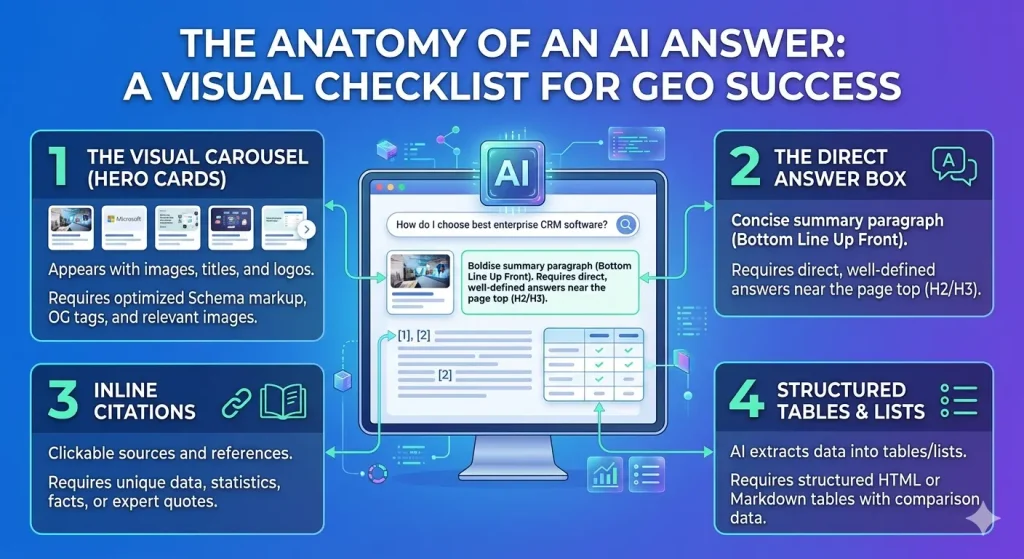
How AI Platforms Actually Decide What Content to Trust
One of the biggest misconceptions around AI answer engine optimization is the assumption that AI systems randomly pull information from the internet. In reality, AI platforms are designed to identify patterns that signal credibility and expertise.
AI systems typically prioritize content that is:
- Well-structured and easy to interpret
- Supported by authority and consistency
- Aligned with conversational user intent
- Associated with trustworthy entities
- Clear, updated, and contextually relevant
This is why shallow content struggles to perform in modern generative search environments.
For example, imagine two cybersecurity companies publishing content online.
The first company creates generic blogs like:
- “Cybersecurity Tips for Businesses”
- “How to Stay Safe Online”
- “Benefits of Data Security”
The second company publishes:
- Ransomware response strategies for healthcare organizations
- Compliance breakdowns for enterprise security teams
- Threat analysis reports for remote work environments
- Real-world case studies on breach prevention
The second company builds much stronger topical authority because its content demonstrates depth, expertise, and industry understanding.
This is one of the biggest shifts happening in the modern LLM SEO strategy. AI systems increasingly reward expertise density instead of content volume.
Get Your Free Consultation!
Connect with our team to improve visibility, unlock growth opportunities, and build strategies tailored to your business goals.
Most Brand Content Is Too Generic to Earn AI Citations
Here is the uncomfortable truth many businesses need to hear.
Most content today is created to fill publishing calendars, not to build authority.
That is why so many blogs sound identical. They repeat the same surface-level advice, recycle the same introductions, and add very little original value. AI systems are becoming much better at recognizing that type of content.
Weak content often includes:
- Keyword stuffing
- Generic explanations
- Repetitive talking points
- No expert perspective
- Minimal educational depth
Strong GEO content looks completely different.
| Weak Content Approach | Strong GEO Content Strategy |
|---|---|
| Broad general topics | Niche-specific expertise |
| SEO-first writing | Human-first educational writing |
| Recycled information | Original insights and examples |
| High publishing frequency | High authority and relevance |
| Surface-level content | Deep topical coverage |
This is also why the writing style matters more than ever. AI systems tend to prefer content that sounds natural, helpful, and genuinely informative instead of robotic or overly optimized.
Businesses trying to improve AI visibility should stop asking:
“How many blogs should we publish?”
…and start asking:
“Would an expert actually find this content valuable enough to reference?”
That single shift improves content quality dramatically.
Why Structure and Readability Matter More Than Ever
Even strong information can underperform if the structure is difficult to scan.
Modern AI systems prioritize clarity because they need to interpret and summarize information efficiently. Readers behave the same way. Large blocks of text without hierarchy often reduce engagement, especially for busy professionals researching solutions quickly.
The best-performing GEO content balances depth with readability.
That usually includes:
- Clear section headings
- Logical content flow
- Shorter readable paragraphs
- Strategic tables and summaries
- Direct explanations instead of filler language
Certain content formats naturally align better with conversational AI behavior.
| High-Performing GEO Formats | Why They Perform Well |
|---|---|
| FAQ-driven content | Matches conversational prompts |
| Comparison articles | Supports decision-making queries |
| Step-by-step guides | Easy for AI systems to summarize |
| Checklists | Improves readability and extraction |
| Industry explainers | Builds topical authority |
Businesses focused on how to appear in AI search results should think about readability as both a user experience strategy and an AI optimization strategy.
The easier content is to understand, the easier it becomes for AI systems to quote and reference.
GEO Is Becoming a Brand Authority Strategy
One of the most important changes happening right now is that AI visibility is becoming deeply connected to digital reputation.
AI systems evaluate more than webpages. They evaluate brands.
This is where entity optimization becomes critical.
An entity is essentially how AI systems recognize and understand your business across the internet. Strong entity signals help AI platforms connect your expertise, industry relevance, and credibility together.
Businesses with strong entity authority usually have:
- Consistent branding across platforms
- Active LinkedIn and industry presence
- Media mentions and PR visibility
- Guest articles and podcast appearances
- Structured business information and schema markup
This is also why many smaller niche companies are outperforming larger competitors in specialized industries. Their expertise positioning is often clearer and more focused.
For businesses investing in AI search optimization, authority is no longer built only through backlinks. It is built through recognition, consistency, expertise, and trust across the wider digital ecosystem.
The GEO Checklist Businesses Should Prioritize Right Now
The future of AI search SEO optimization depends on authority, structure, and trust. Businesses investing in Generative Engine Optimization are focusing on the signals AI systems already prioritize when selecting sources and references.
Build a Strong Content Strategy
Create niche-focused educational content that demonstrates expertise instead of publishing generic blogs. Strong GEO SEO is built on depth, relevance, and real industry value.
Create Prompt-Aligned Content
Modern users ask conversational questions, not just keywords. Businesses improving how to appear in AI search results should create FAQ-driven, comparison-based, and question-focused content.
Strengthen Off-Site Authority
Strong AI citation signals come from more than your website. PR mentions, guest articles, podcasts, and industry visibility all strengthen digital credibility.
Improve Technical SEO
Fast-loading, mobile-friendly, and well-structured websites perform better in AI answer engine optimization because they are easier for AI systems to crawl and interpret.
Focus on Entity Optimization
Strong entity optimization helps AI systems clearly understand your brand, expertise, and industry relevance through consistent digital signals across platforms.
Keep Content Updated
Refreshing outdated statistics, examples, and insights improves long-term AI visibility and strengthens trust signals over time.
Get Your Free Consultation!
Connect with our team to improve visibility, unlock growth opportunities, and build strategies tailored to your business goals.
Conclusion
Search visibility is no longer only about rankings. It is increasingly about recognition, authority, and trust within AI-generated experiences.
Businesses that continue relying entirely on traditional SEO may still attract traffic, but that alone will not guarantee visibility inside conversational AI platforms. As AI becomes more integrated into research and buying decisions across the USA, businesses need to rethink how they build authority online.
That is why Generative Engine Optimization, GEO SEO, and AI visibility are quickly becoming essential for long-term strategies instead of temporary industry trends.
The companies investing early will not just improve discoverability. They will shape how AI systems understand and recommend expertise within their industries moving forward.
If your business wants to stay competitive as AI-driven discovery evolves, now is the time to build a stronger GEO strategy. Connect with Matrix Bricks to improve your AI visibility, strengthen digital authority, and position your brand for the future of search.
Frequently Asked Questions
AI search engines rank websites based on trust, relevance, authority, and content structure rather than keyword density alone. Platforms like ChatGPT Search and Perplexity analyse how useful and reliable your information is before deciding whether to reference it in generated answers. Businesses investing in AI search engine optimisation in India strategies often focus on topical authority and conversational content.
- AI systems prefer clear formatting, FAQs, and schema markup.
- Expert-led content and strong brand mentions improve citation opportunities.
The best approach is creating structured content that directly answers user intent while remaining easy for AI systems to summarise. Businesses focusing on Google AI Overviews optimisation usually prioritise concise explanations, FAQs, and trustworthy insights.
- Use tables, bullet points, and FAQ schema for better extraction.
- Keep content updated regularly to maintain credibility signals.
Indian businesses can improve visibility by publishing conversational, locally relevant, and experience-driven content. A strong AI SEO guide for small business India strategy includes topic authority, structured data, and detailed educational resources.
- Include local references naturally where relevant.
- Build trust using reviews, author expertise, and consistent branding.
Semantic SEO helps AI systems understand context and relationships between topics instead of relying only on exact keywords. Modern AI platforms use LLM SEO best practices to identify websites that provide comprehensive and useful answers.
- Topic clusters improve contextual understanding.
- Natural language writing performs better than keyword-heavy content.
Businesses now use advanced tools to monitor AI-generated visibility, citations, and mentions across conversational search platforms. Companies adopting digital marketing AI tools India 2026 strategies often combine traditional SEO tracking with AI-focused analytics.
- Google Search Console helps track AI Overview visibility.
- Platforms like Semrush and Ahrefs help monitor authority and brand mentions.

Mehul G Brahmbhatt
Founder & CEO, Matrix BricksMehul G Brahmbhatt brings over 25 years of experience in digital strategy, marketing, and business transformation. He built Matrix Bricks to help growing businesses build scalable, performance-driven digital systems. As an author, he shares clear, actionable insights drawn directly from hands-on experience, covering digital growth, technology adoption, and modern marketing.