





 India
India  UK
UK  UAE
UAE 
Technical SEO is often the silent reason why websites fail to grow. You may have strong content, good design, and even decent backlinks, yet your rankings stay stuck. The issue usually lies deeper, in how search engines crawl, interpret, and index your website.
Slow pages, duplicate URLs, messy site structures, or broken internal links can quietly hold everything back. The frustrating part is that most of these issues are not visible on the surface.
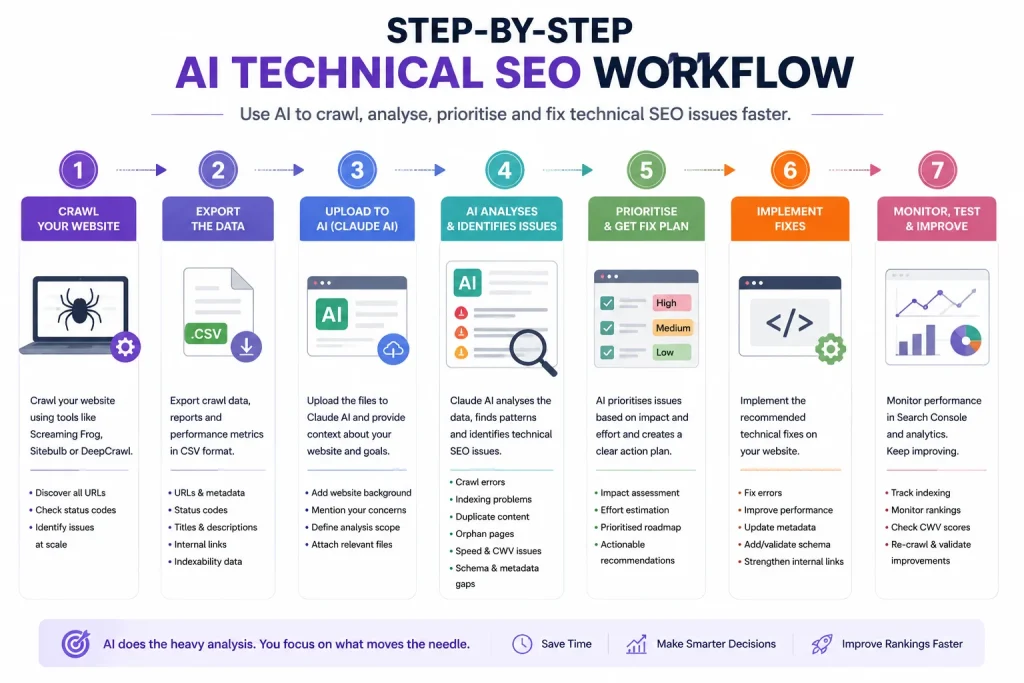
This is where a Technical SEO audit with AI is changing how SEO is done. Instead of manually digging through thousands of URLs and reports, marketers now use Claude AI for SEO to understand problems faster and make smarter decisions.
For Indian businesses competing in crowded markets like ecommerce, SaaS, travel, and local services, this shift is becoming essential. Search visibility is no longer just about content. It is about technical clarity.
In this blog, you will understand how AI is transforming SEO audits and how you can practically use it to improve your website performance.
You will learn:
- How AI-powered SEO audit workflows simplify complex technical analysis
- How Claude AI helps interpret crawl data, Core Web Vitals, and indexing issues in plain English
- Practical ways to identify and solve technical SEO problems faster
- How Indian brands are improving performance using smarter SEO systems
Why Technical SEO Audits Still Decide Your Rankings
A technical SEO audit forms the backbone of how visible a website is in search results. It checks whether search engines can properly access, understand, and rank your pages.
Even today, many websites fail not because of content, but because of technical barriers.
Modern websites are extremely complex. Ecommerce websites usually have large-scale catalogues made up of thousands of product pages, combined with filter options, product variations, and URLs that are generated dynamically based on user selections. Publishers constantly update content. Service websites target multiple cities.
This creates a massive challenge.
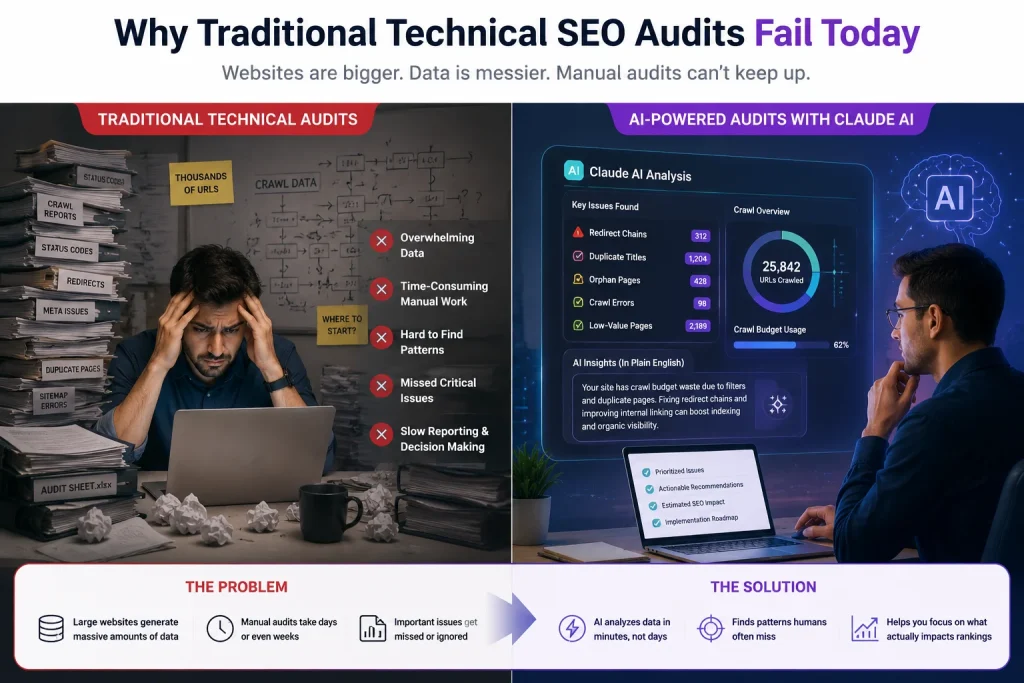
A traditional audit usually involves:
- Reviewing crawl reports manually
- Checking status codes and redirects one by one
- Identifying duplicate pages
- Analysing metadata issues across hundreds of URLs
- Studying sitemap and robots file behaviour
It works, but it is slow and overwhelming.
This is why businesses are now exploring how to do technical SEO audit processes using AI support. Instead of replacing SEO expertise, AI simplifies interpretation.
Where Claude AI Fits in Modern SEO Workflows
It is important to understand one thing clearly. Claude AI does not replace SEO tools like Screaming Frog or Google Search Console. It makes them easier to use.
Think of it as an analysis layer that translates complex SEO data into meaningful insights.
Here is how it fits into real workflows:
| SEO Task | Traditional Approach | With Claude AI |
|---|---|---|
| Crawl analysis | Manual filtering in spreadsheets | Instant pattern identification |
| Technical errors | Line-by-line review | Plain English explanation |
| Reporting | Time-consuming documentation | Automated summaries |
| Prioritisation | Experience-based guessing | Data-backed ranking of issues |
This is why SEO site audit automation is becoming a major trend among agencies and startups.
Instead of spending hours trying to understand raw data, teams can focus on fixing issues.
For example, a Mumbai-based ecommerce brand might upload a Screaming Frog export into Claude and ask:
“Point out the key technical issues that could be limiting how well the site is indexed and how much organic traffic it receives.”
Within minutes, Claude can surface patterns like:
- Redirect chains slowing down crawling
- Duplicate title tags across product categories
- Orphan pages not linked internally
- Thin pages created by filters or tags
This instantly reduces analysis time and improves decision-making.
Smarter Crawling and Crawl Error Analysis with AI
One of the biggest advantages of crawl error analysis with AI is pattern recognition.
Most SEO issues do not exist alone. They are connected.
For example:
- Broken internal links often lead to orphan pages
- Redirect chains waste crawl budget and slow indexing
- Duplicate pages confuse canonical signals
- Filter-generated URLs create crawl traps
Manually identifying these patterns takes time. AI makes it faster.
In large Indian ecommerce platforms, this becomes even more important. Websites like fashion and retail stores often generate thousands of unnecessary URLs due to filters like size, colour, and brand variations.
Without proper control, search engines waste time crawling low-value pages instead of important ones.
AI helps highlight these inefficiencies quickly.
It can also identify robots.txt and sitemap conflicts where:
- Important pages are accidentally blocked
- Low-value pages are being indexed
- Sitemap files contain outdated URLs
These are common issues that silently affect rankings.
Core Web Vitals and Page Speed in Simple Terms
Speed is not just a technical metric. It directly affects user experience and conversions.
Google uses Core Web Vitals to measure how users experience your website.
The three main signals are:
- Loading performance
- Visual stability
- Interaction speed
Most businesses struggle to interpret these reports. This is where AI helps simplify things.
With Core Web Vitals optimisation, Claude can explain:
- Why images are slowing down your homepage
- Why layout shifts are affecting user experience
- Why JavaScript is delaying interaction
- Which fixes will give the biggest SEO improvement
| Metric | Meaning | Impact |
|---|---|---|
| LCP | Load speed of main content | Affects first impression |
| CLS | Visual stability | Impacts readability |
| INP | Interaction speed | Affects usability |
For example, Indian platforms like Zomato often deal with heavy mobile traffic. Even small delays in loading restaurant pages can affect user engagement.
Similarly, ecommerce brands like Nykaa rely heavily on fast mobile experiences because most purchases happen on smartphones.
AI helps SEO teams prioritise fixes based on real impact instead of guessing.
Structured Data and On-Site SEO Fixes
Structured data is often ignored, but it plays a huge role in search visibility.
It helps search engines understand your content better and display rich results like FAQs, ratings, and product snippets.
However, many websites either:
- Implement incorrect schema
- Miss opportunities for enhancement
- Or use outdated formats
With AI support, structured data becomes easier to manage.
Claude can help:
- Review JSON-LD for errors
- Suggest missing schema types
- Generate improved structured data
- Identify duplicate content issues
This is especially useful for businesses with large catalogues or multiple service pages.
For example, many Indian service companies create similar landing pages for cities like Delhi, Pune, Bengaluru, and Hyderabad. Without proper differentiation, these pages may look repetitive to search engines.
AI helps identify these content patterns and suggests improvements.
This is one of the reasons fix technical SEO issues becomes much faster with AI-assisted workflows.
Log Files and Building a Clear SEO Roadmap
Log files show how search engines actually behave on your website. This is different from crawlers, which only simulate behaviour.
With log analysis, you can see:
- Which pages Google crawls most often
- Which pages are ignored
- Where crawl budget is wasted
- How bots react to site changes
For large websites, this data is extremely valuable.
AI makes log analysis easier by identifying patterns that are difficult to spot manually.
For example, an Indian travel website may discover that:
- Googlebot is spending too much time on outdated destination filters
- Important booking pages are rarely crawled
- Server errors are affecting indexing of key pages
Claude can turn this data into actionable insights and structured SEO roadmaps.
| Priority | Issue | Impact |
|---|---|---|
| High | Indexing problems | Major ranking impact |
| High | Speed issues | UX and SEO loss |
| Medium | Redirect chains | Crawl inefficiency |
| Medium | Duplicate content | Ranking dilution |
| Low | Schema gaps | Minor improvements |
This helps teams focus on what actually matters instead of getting lost in data.
Get Your Free Consultation!
Connect with our team to improve visibility, unlock growth opportunities, and build strategies tailored to your business goals.
Real Example: AI-Assisted Technical SEO Audit
Let’s take a real-world scenario.
A travel booking website in India notices a drop in organic traffic even though new content is being published regularly.
After running an audit, the issues include:
- Slow mobile pages
- Duplicate city landing pages
- Poor internal linking
- Crawl traps from filters
- Missing structured data
Using a combination of Screaming Frog, Search Console, and Claude AI, the team builds a faster workflow.
First, crawl data is analysed using AI.
Then performance reports are simplified into actionable fixes.
Finally, indexing and sitemap issues are prioritised.
Within a few weeks, improvements include:
- Better crawl efficiency
- Faster mobile performance
- Cleaner indexing structure
- Improved search visibility
This is the real strength of AI tools for SEO site crawl and fix workflows. They reduce confusion and improve execution speed.
Conclusion
Technical SEO today is not limited to just finding and fixing issues anymore. It has evolved into a process of interpreting complex datasets and making quicker, more informed decisions.
An AI-driven technical SEO audit enables businesses to break down this complexity and streamline the entire optimisation process. Claude AI does not replace SEO expertise, but it enhances it by making data easier to understand and act on.
For Indian businesses competing in fast-moving digital markets, this approach can significantly improve crawl efficiency, site speed, and overall search visibility.
If your website is struggling with technical SEO challenges or slow growth, it is time to upgrade your approach. Partner with Matrix Bricks and build a smarter, faster, and more search-ready website that performs better in modern search ecosystems.
Frequently Asked Questions
AI improves AI-powered SEO audit audit workflows by simplifying large datasets and highlighting key issues faster than manual analysis.
- It helps identify patterns across crawl reports that are difficult to detect manually
- It simplifies technical SEO findings into clear, actionable insights
The most effective approach for how to use Claude AI for technical SEO audit is combining traditional tools with AI analysis.
- Use tools like Screaming Frog for crawling
- Use AI to interpret and prioritise findings
Many websites struggle when they try to fix technical SEO issues without structured workflows.
- Duplicate pages and canonical confusion are very common
- Poor mobile performance and slow loading pages affect rankings
Modern SEO teams rely on crawl error analysis with AI to understand website behaviour better.
- It identifies redirect chains and broken links quickly
- It highlights crawl inefficiencies that waste search engine resources
Strong Core Web Vitals optimisation improves both rankings and user experience.
- Faster pages reduce bounce rates and improve engagement
- Stable layouts and fast interactions increase conversions